
Same-Day Service Available
00
Hrs
00
Mins
00
Secs
Need a Plumber in Knoxville? We’re Ready to Help!
Same-Day Service Available
Need a Plumber in Knoxville? We’re Ready to Help!
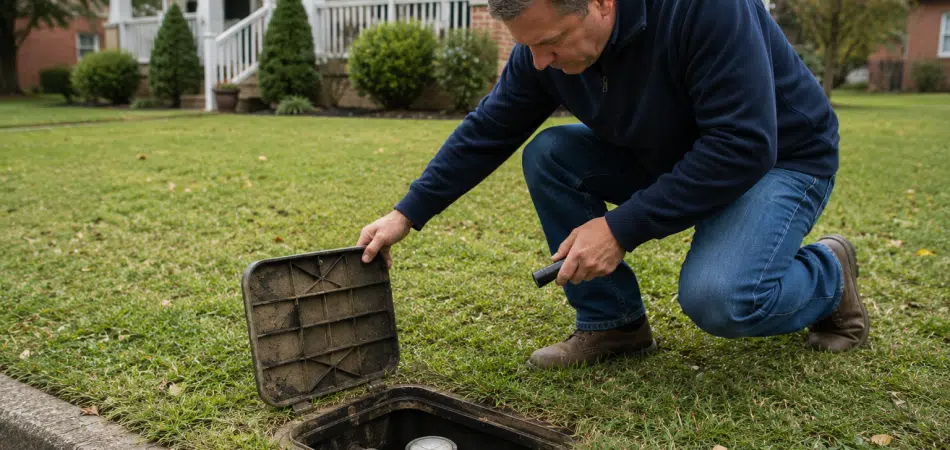
Ask around, and almost everybody says the same thing: yes, they should probably know where that is. Then nobody goes and looks.
It stays a five-minute job right up until the night it becomes a forty-minute one, in the dark, with a flashlight, while a supply line under a bathroom sink empties into the floor. And in Alcoa there is a wrinkle that catches people out even when they do go looking. The obvious-looking valve, the one in the box by the road, belongs to the city, and city ordinance is restrictive about what anyone else may do to it.
The valve that matters is somewhere else, and where it sits depends on whether the house is on a slab or over a crawl space. This page covers where Alcoa requires meters to go, what the ordinance restricts, and how to find and test the one valve a household actually controls. Ordinance language was read from the published Alcoa Municipal Code on September 1, 2026.
Alcoa’s ordinance tells households roughly where to look outdoors. Section 18-513 requires that all new meters be installed adjacent to the edge of a street right-of-way or utility easement at locations approved by the city, and, unless a special exception applies, outside of driveways, streets, parking lots, and sidewalks.
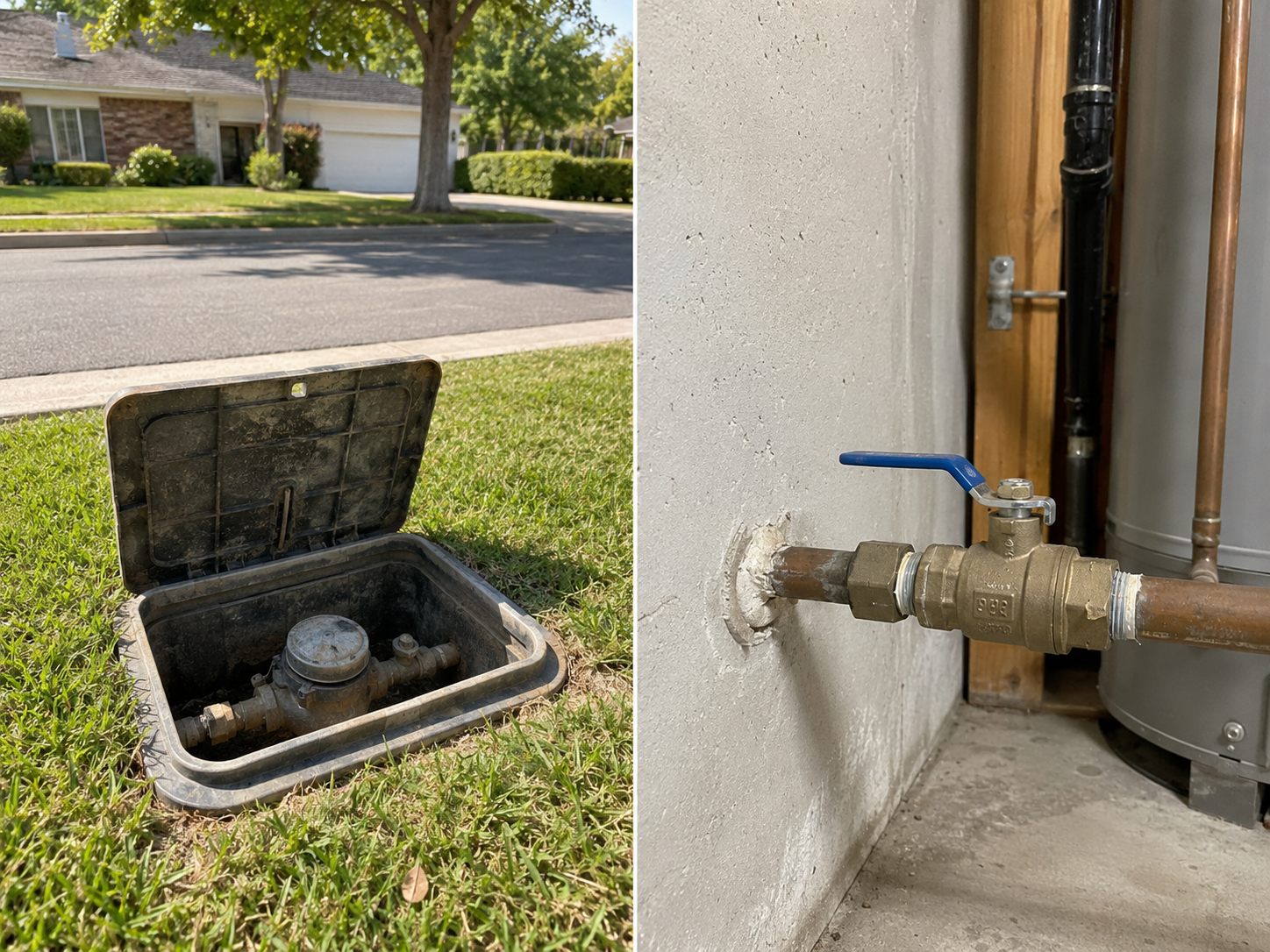 Section 18-513 of Title 18 of the Alcoa Municipal Code states that “all new meters shall be installed adjacent to the edge of a street right-of-way or utility easement and at locations approved by the city,” and that “unless by special exception, all new meters will be installed outside of all driveways, streets, parking lots, and sidewalks.”
In practice, that means a rectangular lid, usually cast iron or plastic, set flush in grass near the front property boundary, roughly in line with the front door or the point where the service enters the yard.
The same section addresses legacy placements, providing that meters located inside buildings or in settings the city deems unsatisfactory “may be moved to more suitable locations at the discretion of, and at the expense of, the city.”
It also states that where a meter is relocated on application by the consumer or because of a change in the grade of a lot, the relocation is made by the city at the expense of the consumer. In an older Alcoa home, the meter may still be somewhere the current rule would not put it.
Section 18-510 provides that “meters and meter settings must be accessible at all times and not covered with rubbish or material of any kind.” Mulch piled over a lid, a shrub grown across it, or a parked trailer all create a problem before an emergency rather than during one.
The same section makes the consumer responsible for damage to meters and meter settings caused by a change in the grade of the lot, or by carelessness or negligence. Properties across the city are covered by the Alcoa plumbing page.
The valve inside the meter box belongs to the city. Section 18-510 of the Alcoa Municipal Code states that all meters and meter settings are furnished, owned, and maintained by the city, and that no one other than an authorized agent of the city may repair, adjust, remove, or replace any meter or any part of one.
The language in section 18-510 is unambiguous: “All meters and meter settings shall be furnished, owned and maintained by the city … No one other than an authorized agent of the city shall be permitted to repair, adjust, remove or replace any meter or any part thereof.”
Read closely, that language is about working on the meter rather than about operating a curb stop, and the ordinance does not spell out whether the curb stop counts as part of the meter setting. The safe course is not to touch it without the utility saying so, because section 18-510 also places the cost of damage caused by carelessness on the consumer.
Water shutoff points on a typical Alcoa property
Ordinance references are to Title 18 of the Alcoa Municipal Code as published by the City of Alcoa and read on September 1, 2026.
When the house-side valve will not hold, the city is the party that can stop water at the meter. Alcoa publishes Public Works and Engineering at 865-380-4800 for business hours and an after-hours emergency number, 865-380-4921, for nights, weekends, and holidays.
Those numbers appear in the City of Alcoa utilities FAQ, and they are the same ones the city gives for reporting a leak.
A property that depends on the city’s curb stop for every shutoff has a gap, not a plan. The house-side main valve is the one a household controls and the one that should be in working order.
Older gate valves that have not been turned in years commonly seize or fail to seat once moved. That is a known and fixable condition, and it is worth finding out about on a quiet Tuesday rather than during a burst. The case for replacing a poor one is set out in the whole-home shutoff valve upgrade guide.
The house valve sits where the water service enters the building, so the search starts with geometry. Draw a straight line from the meter box to the house and look where that line meets the structure. Crawl space homes and slab homes then diverge predictably.
In crawl space construction, the service typically comes up through the floor near the front wall, and the main valve is usually within a few feet of that entry point, sometimes right at the rim joist.
Section 18-505 of the city code requires that customer lines “be installed at least two (2) feet deep,” so the run outside is buried well below the surface and gives no visible clue about where it comes up. The wall it faces is the better guide.
Slab construction usually brings the service up through the slab inside the building, and the main valve tends to appear in a utility room, a garage wall, a laundry area, or near the water heater.
Some slab homes have no accessible interior main valve at all, which is one of the situations that makes an upgrade worth discussing. Piping questions of this kind sit with water piping services.
Closing the valve, checking that a cold tap runs dry, then reopening it slowly is a five-minute test that answers the only question that matters: does it work? Reopening slowly reduces the pressure surge through the system.
Two failure modes are common on valves that have sat untouched for years. The handle turns, but water keeps flowing, meaning the valve no longer seats. Or the handle will not move at all. Both are worth finding before a pipe fails.
Households that share the property, including tenants and anyone staying while owners travel, should know where the valve is and what turns it.
Order matters. Safety hazards come first, then the water, then the property. Water near an electrical panel, near outlets, or near a gas appliance changes the sequence entirely and makes leaving the building and calling for help the correct first move.
Water reaching an electrical panel, outlets, or the base of a gas appliance is a safety situation before it is a plumbing one. In that case the right action is to leave the area and call for help rather than to wade in and hunt for a valve.
No plumbing outcome justifies standing in water near live electrical equipment. That judgement belongs to the household on the scene, and the safe default is to withdraw.
A leak under one sink is stopped at that fixture’s stop valve. A leak in a wall or a supply run needs the main house valve. Shutting down only what is necessary keeps the rest of the building usable.
After the main valve is closed, opening the lowest fixture in the building drains the standing pressure and reduces what continues to escape from a break upstairs.
Moving contents away, lifting fabrics off wet floors, and getting air moving limits secondary damage. Photographs taken before cleanup starts carry more weight than a description written later.
Whether any part of the loss is covered depends on the policy, its exclusions, and its limits, and coverage is subject to policy terms. That question belongs to the insurer.
The Alcoa answer has two halves. Outside, the meter box sits near the edge of the street right-of-way, and the valve in it belongs to the city, which under section 18-510 permits only its own agents to work on it. Inside, the house-side main valve is the one a household owns and the one to find, test, and keep accessible.
This week, then: find the house valve and actually close it once to confirm it works. Clear whatever is sitting on the meter lid, since the ordinance requires it to stay accessible. And make sure more than one person in the household knows where both of them are.
Tennessee Standard Plumbing locates, tests, and replaces main shutoff valves across Alcoa and Blount County, and our team would far rather walk a household through it during a routine visit than during a flood. It is part of what Knoxville’s local plumbing team does on ordinary service calls.
Call (865) 352-9003 or schedule your service to get it sorted before it matters.
We serve Alcoa, Maryville, Rockford, and communities across Blount County, Knox County, and East Tennessee.
Section 18-513 of the Alcoa Municipal Code requires new meters to be installed adjacent to the edge of a street right-of-way or utility easement at locations approved by the city, and, unless a special exception applies, outside of driveways, streets, parking lots, and sidewalks. In practice that usually means a flush lid in grass near the front boundary.
Section 18-510 of the Alcoa Municipal Code states that all meters and meter settings are furnished, owned, and maintained by the city, and that no one other than an authorized agent of the city may repair, adjust, remove, or replace any meter or any part of one. Whether a customer may operate the curb stop itself is a question for Alcoa Utilities. The valve intended for household use is the house-side main valve.
It sits where the water service enters the building. In crawl space homes that is usually near the front wall, often within a few feet of where the line comes through the floor. In slab homes it more often appears in a utility room, garage wall, laundry area, or near the water heater.
Some homes, particularly slab-built ones, have no accessible interior main valve. That is a gap worth closing, because it leaves a household dependent on the city’s curb stop for every shutoff. Adding a serviceable house-side valve is normal plumbing work.
The City of Alcoa can stop water at the meter. Its published contacts are Public Works and Engineering at 865-380-4800 during business hours and an after-hours emergency number, 865-380-4921, for nights, weekends, and holidays. A failed house valve should then be repaired or replaced.
Section 18-505 of the Alcoa Municipal Code requires that all customer lines be installed at least two feet deep. That is a minimum set by ordinance rather than a measurement of any particular installation, and actual depth varies with grade and with when the line was put in.
Testing it is sensible. Closing the valve, confirming a cold tap runs dry, then reopening it slowly takes a few minutes and reveals the two common failures: a valve that no longer seats, and a handle that will not move. Both are much better discovered in advance.
Opening a main valve quickly sends a pressure surge through the system that can stress joints and fixtures. Turning it back on gradually lets the system refill without that shock, and it gives a chance to listen for anything running that should not be.
No. Section 18-510 of the Alcoa Municipal Code requires that meters and meter settings be accessible at all times and not covered with rubbish or material of any kind. The same section makes the consumer responsible for damage caused by a change in the grade of the lot or by carelessness.
Check for hazards before anything else. Water reaching an electrical panel, outlets, or a gas appliance makes leaving the area and calling for help the correct first move. Where there is no such hazard, shut the water at the lowest level that works, then open the lowest fixture to drain standing pressure, then protect the building.
Same-day Service Available
Mon – Fri: 7:30 am – 5:00 pm