Same-Day Service Available
00
Hrs
00
Mins
00
Secs
Need a Plumber in Knoxville? We’re Ready to Help!
Same-Day Service Available
Need a Plumber in Knoxville? We’re Ready to Help!
Two very different people ask this question. One closed on a place off Sam Houston School Road three weeks ago and cannot work out why no water bill has turned up. The other has lived on the same road for twenty-two years and has genuinely never had a reason to think about it until a home inspector wrote something odd on a report.
Both are asking because rural Blount County is a patchwork. Utility district boundaries out here were drawn around infrastructure rather than around city limits, so two houses facing each other across a road can be on different systems. Some properties have a meter, some have a well, and a few have both because the well came first and the line arrived later and nobody ever disconnected anything.
The distinction is not academic either. It changes who tests the water, who fixes the pipe, what happens in a power cut, and whose problem it is when the pressure drops. Sources below were checked on September 1, 2026, and none of it should be read as a statement about a particular address.
Three checks settle it in about ten minutes. Look for a monthly water bill from a utility. Look outside for a meter box near the road. Look for well equipment: a wellhead casing above ground, or a pressure tank and control switch inside the building, usually near where the supply enters.
A property on a public system receives a water bill from whichever utility serves it. A property on a private well pays for electricity to run a pump and receives no water bill at all.
A bill that shows a sewer charge but no water charge, or the reverse, is worth a call to the utility, because it usually means the property is connected to one service and not the other.
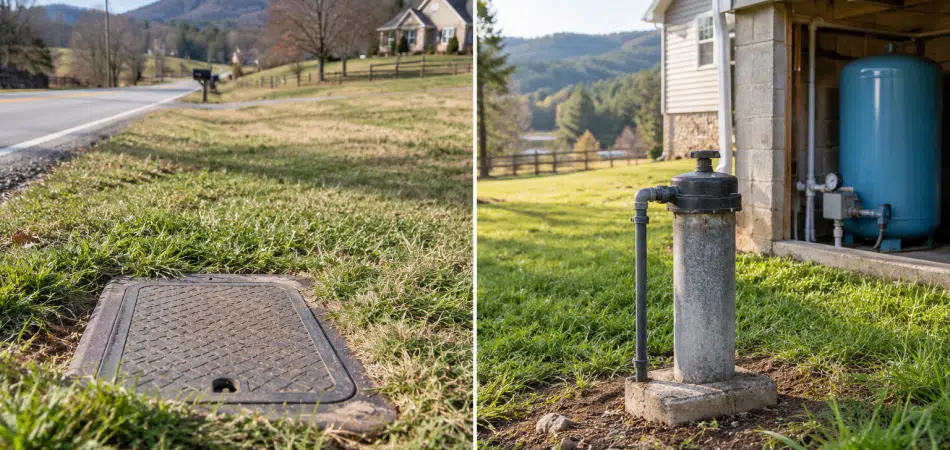
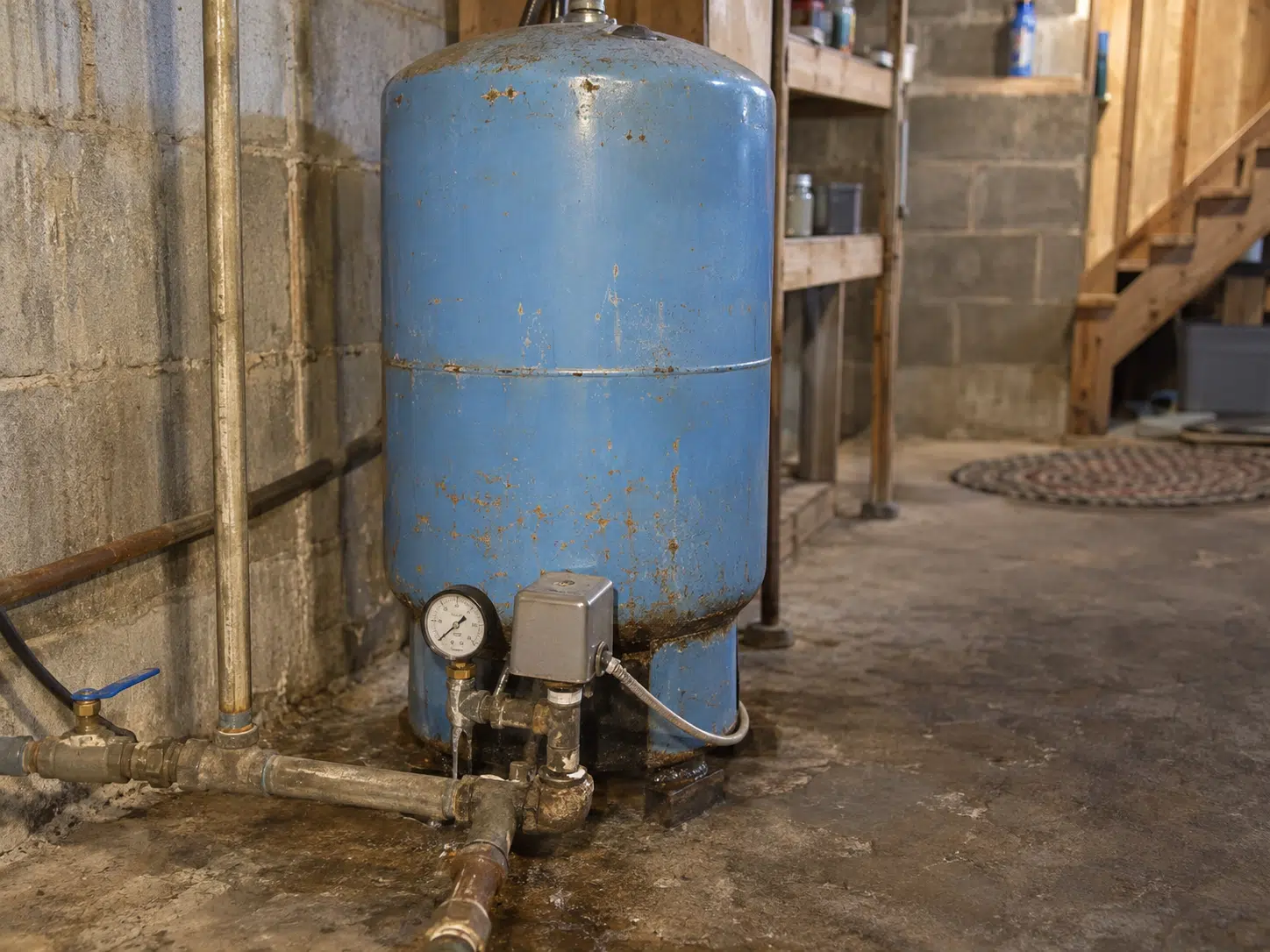 A public connection leaves a visible meter box near the road. A private well leaves different evidence: a capped casing standing above grade somewhere in the yard, and inside, a pressure tank, usually a steel cylinder, alongside a pressure switch and a gauge.
The pressure tank is the giveaway that general home-buying checklists most often miss, because a public connection does not need one. It is a strong indication rather than proof, since booster and storage arrangements do turn up on public supplies, so it is worth confirming against the bill, the meter, and the serving utility. Related equipment sits under well plumbing services.
A property not on public water is frequently not on public sewer either, and the two questions are worth answering together. Blount County holds septic records, and its published services include an inspection letter, described as “a letter which is usually requested by realtors, mortgage lenders, home buyers, etc.” that “provides information as to the current operation of the septic system at a particular address.”
That letter is requested from Blount County Department of Environmental Health, at 1221 McArthur Road, Maryville, TN 37804, published phone 865-681-9301.
Friendsville has a city utility department, and the wider rural area is served by South Blount County Utility District. The district states that it has operated since 1958 and now serves over 18,000 homes, businesses, and schools in Blount County, Friendsville, and Louisville, about 30 percent of the county’s population.
The city runs its own utility department. Its published utility contact is (865) 995-0243, with office hours listed as Monday to Friday, 8 AM to 4:30 PM, closed daily from 12 PM to 1 PM.
On the ownership question, the City of Friendsville utility department is direct: “anything past the meter is the customer’s responsibility. The customer has to fix it or can call a plumber.” The city also describes its offering as “water and sewer (if available in your area) service,” which is a useful reminder that sewer is not universal here.
Compiled from City of Friendsville, South Blount County Utility District, and EPA private well guidance, checked September 1, 2026. Service boundaries vary by address.
South Blount County Utility District states that it has provided water service since 1958 and now reaches “over 18,000 homes, businesses, and schools in Blount County, Friendsville, and Louisville, which is approximately 30% of the county’s population.” The district also describes operating decentralized wastewater systems.
Its published office is at 320 Partnership Parkway, Maryville, TN 37801, with a published phone number of 865-982-3560.
Utility district boundaries in Blount County were drawn around infrastructure, not around municipal lines, and neighboring properties on the same road are sometimes on different systems.
That is why the bill, not the mailing address, is the answer. A household that cannot find a bill can call either utility with the address and ask. Either way, the property sits inside the area covered by the Friendsville plumbing page.
A private well makes the owner the water system. EPA recommends testing a private well annually for total coliform bacteria, nitrates, total dissolved solids, and pH levels, and recommends periodic inspection of the exposed parts of the well for cracked or damaged casing, a broken or missing cap, and cracking surface seals.
EPA private well guidance states the baseline plainly: “Test your private well annually for total coliform bacteria, nitrates, total dissolved solids, and pH levels.”
EPA also lists circumstances that call for testing sooner, including where “there are known problems with ground water or drinking water in your area,” where “conditions near your well have changed significantly (i.e. flooding, land disturbances, and new construction or industrial activity),” where any part of the well system is replaced or repaired, and where there is “a change in your water quality (i.e. odor, color, taste).”
Blount County publishes that its environmental health department, “upon request, performs bacteriological water analysis on private water supplies to determine total coliform and fecal coliform bacteria present.”
That covers the bacteriological part. The broader panel EPA describes, covering nitrates, total dissolved solids, and pH, generally needs a laboratory that offers those analyses. The county office is the right starting point for a household that has never tested.
EPA advises periodically inspecting exposed parts of the well for problems including a “cracked, corroded or damaged well casing,” a “broken or missing well cap,” and “settling and cracking of surface seals.”
The same guidance recommends hiring “a certified well driller for any new well construction, modification, or abandonment and closure,” and keeping “accurate records of well maintenance, such as disinfection or sediment removal.”
A missing or damaged cap is the failure that most directly exposes a well to surface contamination, and it is visible from ground level without any equipment at all.
Water source affects pressure behavior, treatment needs, and what happens during a power cut. A public system delivers pressure from the distribution network. A well delivers pressure from a pump and a pressure tank, which cycle between a cut-in and a cut-out point.
Well systems run between two pressure points set at a switch, so pressure at the tap rises and falls slightly through a long shower as the pump cycles. That variation is normal for the design.
On a public system, pressure comes from the network and stays comparatively flat. A household that moves from one to the other sometimes reads normal behavior as a fault, and occasionally the reverse: a genuine problem gets shrugged off as just how wells are.
Hardness, iron, sulphur odor, and sediment turn up in both public and private supplies in East Tennessee, and the right treatment depends on what a test actually finds rather than on whether the water came from a well.
What differs is who is watching. A public system is monitored under drinking water rules. A private well is monitored by whoever owns it, or not at all. Regional background sits in well water treatment for East Tennessee homes.
A well pump runs on electricity. When power goes out, a well-supplied home has whatever pressure remains in the tank and then nothing.
Public systems usually keep delivering through a short outage because pressure is held in storage and distribution. Households on a well in rural Blount County are the ones for whom storing drinking water ahead of a storm is a practical habit rather than an abstract one.
Three checks answer the question for almost every property: is there a water bill, is there a meter box near the road, and is there a pressure tank inside. Where the answer comes out mixed, the City of Friendsville utility department at (865) 995-0243 and South Blount County Utility District at 865-982-3560 can both confirm service for a specific address.
Whatever the answer turns out to be, it carries consequences. On a public system, Friendsville states that anything past the meter belongs to the customer. On a well, nobody tests the water unless the owner arranges it, and EPA recommends doing it annually. And because sewer service is not universal around here, the septic question deserves an answer of its own.
Tennessee Standard Plumbing works on both kinds of system across Friendsville and Blount County, and our team can usually identify what a property runs on within a few minutes of a routine visit. It is part of the plumbing help across East Tennessee we provide.
Call (865) 352-9003 or contact our team if the answer is still unclear.
We serve Friendsville, Maryville, Louisville, and communities across Blount County, Knox County, and East Tennessee.
Check three things. Whether a water bill arrives from a utility, whether there is a meter box near the road, and whether there is a pressure tank inside the building. A pressure tank is the strongest single indicator of a private well, because a public connection does not need one, though booster and storage arrangements mean it is not conclusive by itself.
The City of Friendsville operates its own utility department, with a published contact of (865) 995-0243. South Blount County Utility District serves a wide area and states it reaches over 18,000 homes, businesses, and schools across Blount County, Friendsville, and Louisville. Boundaries do not follow city limits, so confirm by address.
The City of Friendsville states that anything past the meter is the customer’s responsibility, and that the customer has to fix it or can call a plumber. Confirm the position for a specific address with the utility department.
No. The City of Friendsville describes its offering as water and sewer service if available in your area, which indicates sewer is not universal. Properties without sewer service generally rely on a septic system, and Blount County holds those records.
EPA recommends testing a private well annually for total coliform bacteria, nitrates, total dissolved solids, and pH levels. EPA also recommends testing sooner after flooding, land disturbance or nearby construction, after any part of the well system is repaired or replaced, and whenever the odor, color, or taste of the water changes.
Blount County states that its environmental health department performs bacteriological water analysis on private water supplies upon request, to determine total coliform and fecal coliform bacteria present. The published contact is 865-681-9301. Testing for nitrates, total dissolved solids, and pH generally requires a laboratory offering those analyses.
EPA recommends periodically inspecting the exposed parts of the well for a cracked, corroded, or damaged well casing, a broken or missing well cap, and settling or cracking of the surface seals. A missing or damaged cap is the failure that most directly exposes a well to surface contamination.
Well systems cycle between a cut-in and a cut-out pressure set at a switch, so pressure rises and falls a little as the pump runs and stops. Modest variation is normal for the design. Wide swings, very rapid cycling, or air at the taps are worth investigating.
It happens, particularly where a well predated the arrival of a public line. Where both exist, cross-connection between them raises separate concerns and any such arrangement should be discussed with the serving utility, since utilities have their own rules on it.
A well pump runs on electricity, so when power goes out the household has whatever pressure remains in the pressure tank and then nothing. Public systems usually keep delivering through short outages because pressure is held in storage and distribution. That is why storing drinking water ahead of a storm matters more on a well.
Same-day Service Available
Mon – Fri: 7:30 am – 5:00 pm