
Same-Day Service Available
00
Hrs
00
Mins
00
Secs
Need a Plumber in Knoxville? We’re Ready to Help!
Same-Day Service Available
Need a Plumber in Knoxville? We’re Ready to Help!
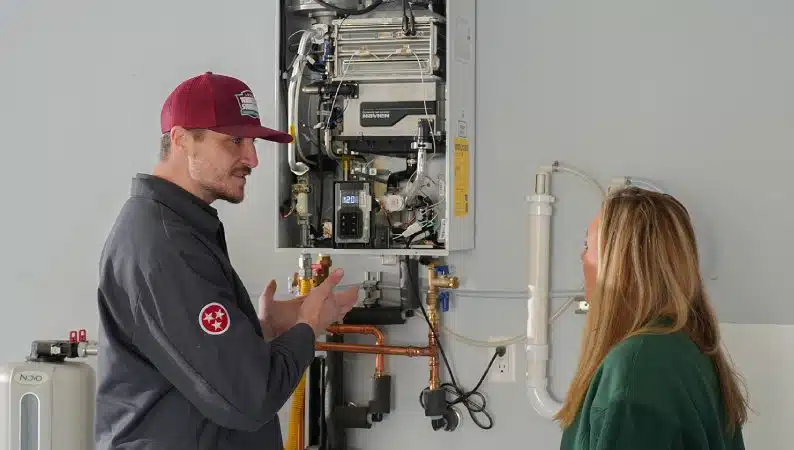
Traditional tank water heaters typically last 8-12 years, while tankless models last 15-20 years. Common warning signs include age, strange noises, rusty water, and leaks around the base for tank models, or error codes and reduced heating capacity for tankless units. Tennessee Standard Plumbing offers expert water heater replacement services in Maryville to keep your home safe and comfortable.
Nobody wants to wake up to a freezing cold shower. But that’s exactly what happens when a water heater finally gives out. Knowing when your unit is on its last legs can save you from a massive headache—and potentially thousands of dollars in water damage.
Whether you’ve got a traditional tank sitting in your garage or a modern tankless unit mounted on the wall, they all show warning signs before they fail. You just need to know what to look for.
If you’re already noticing some weird behavior from your system, Tennessee Standard Plumbing can take a look. As your trusted local experts for plumbing in Maryville, we’ll give you an honest assessment of whether you need a simple repair or a full replacement. Schedule a water heater inspection today.
Traditional Tank Water Heaters:
Let’s talk lifespan. Most standard tank water heaters last about 8 to 12 years. If your unit has celebrated its tenth birthday, you’re officially on borrowed time. Even if it seems to be running perfectly fine right now, older tanks are notorious for failing suddenly.
Tankless Water Heaters:
These units are built differently and typically last 15 to 20 years if you’ve kept up with maintenance. But once a tankless system hits that 15-year mark, you should definitely have a pro check its efficiency.
Not sure how old your unit is? Look for the manufacturer’s sticker on the side. The serial number usually contains the manufacturing date. If it looks like a confusing jumble of letters and numbers, our plumbing team can decode it for you during a routine service call.

Tank Water Heater Sign:
Turn on your hot water tap. Does the water look rusty, muddy, or slightly brown? That’s a massive red flag. It usually means the inside of your steel tank is literally rusting away. Once that corrosion starts, a leak isn’t far behind. (Quick tip: If your cold water is also rusty, the problem is likely your home’s pipes, not the heater itself.)
Tankless Water Heater Sign:
You won’t see rust as often with a tankless unit, but cloudy or discolored water can still happen. It usually points to heavy mineral buildup inside the heat exchanger. If you live in an area with hard water and haven’t been descaling the unit yearly, this is exactly what you’ll see. Our technicians offer professional descaling services to clear this out before it ruins the unit.
Tank Water Heater Sign:
Water heaters shouldn’t sound like a popcorn machine. If you hear loud popping, banging, or rumbling coming from the tank, you’ve got a sediment problem. Minerals from your water settle at the bottom of the tank and harden into a thick crust. The burner has to heat the water through that crust, which causes the water trapped underneath to boil and pop. It ruins efficiency and destroys the tank.
Tankless Water Heater Sign:
Tankless systems run pretty quietly. If yours starts making unusual humming or clicking noises, it might be struggling with a blocked exhaust vent, a failing fan, or severe mineral scaling.
Tank Water Heater Sign:
See water pooling around the bottom of your tank? Don’t ignore it. As tanks age, the metal expands and contracts thousands of times. Eventually, microscopic fractures form. A tiny drip today can turn into a catastrophic flood tomorrow. If the tank itself is leaking, it cannot be repaired—you need a replacement immediately.
Tankless Water Heater Sign:
Since they don’t store water, tankless units rarely experience major leaks. But if you spot drips around the connection pipes or valves, get it checked out. It might just be a loose fitting, or it could be a cracked heat exchanger.
Tank Water Heater Sign:
 You step into the shower, and the water goes from hot to lukewarm in three minutes. Sound familiar? Failing heating elements or a broken dip tube are usually to blame. While we can sometimes replace these parts, pouring money into a 10-year-old tank rarely makes financial sense.
Tankless Water Heater Sign:
The whole point of a tankless system is endless hot water. If yours is suddenly struggling to keep up, or the water temperature fluctuates wildly, the unit might be overloaded. Trying to run two showers and the dishwasher at the same time can overwhelm older or smaller units. If it happens during normal use, you likely have a failing sensor or severe scaling.
Tankless Water Heater Sign:
Modern tankless heaters are basically computers that heat water. When something goes wrong, they’ll flash an error code on the digital display and shut themselves down to prevent damage. Common culprits include ignition failures, gas supply drops, or blocked vents. Check your manual to see what the code means, but you’ll usually need a pro to fix it.
Tank Water Heater Sign:
Standard tanks don’t have digital displays. But if your pilot light refuses to stay lit, or the burner constantly cycles on and off without actually heating the water, the gas valve or thermocouple is likely shot.
 If you’re dealing with any of these warning signs, you don’t have to figure it out alone. We specialize in diagnosing, repairing, and replacing all types of water heaters across Maryville.
We don’t believe in pushing unnecessary replacements. When you call us, we’ll inspect your current unit, give you an honest assessment of its condition, and explain your options. If a simple repair makes sense, we’ll fix it. If it’s time for an upgrade, we’ll help you choose the perfect traditional tank or high-efficiency tankless model for your home’s needs and budget.
Don’t wait for a total breakdown or a flooded garage. Schedule your water heater services with Tennessee Standard Plumbing today, or contact us online to get a fast, honest evaluation of your system.
Prices vary based on what you’re installing. A standard tank replacement usually runs between $800 and $2,500, which covers both the unit and the labor. Upgrading to a tankless system costs more—typically $1,500 to $3,500 or higher—because the units are pricier and we often have to modify your gas lines and venting to accommodate them.
A traditional tank will give you 8 to 12 years of reliable service. Tankless models last significantly longer, usually hitting 15 to 20 years. Of course, this assumes you’re actually maintaining them. Skipping your annual flush or descale will cut those lifespans short.
Sometimes, yes. If a thermostat breaks or a pressure valve starts dripping on a newer unit, we can absolutely fix that. But if your tank is actively leaking, or if the unit is past its expected lifespan, replacement is the smarter move. A good rule of thumb: if the repair costs more than half the price of a new unit, just replace it.
The greatest benefit is that you will never run out of hot water halfway through a shower. They also free up a ton of floor space and use less energy since they aren’t keeping 50 gallons of water hot 24/7. Plus, they last 15 to 20 years compared to the 8 to 12 years you get from a tank. The trade-off is a higher installation cost.
Yes, local building codes require a permit for water heater installations. It ensures the gas lines, venting, and electrical connections are completely safe. Don’t worry about the paperwork, though; our licensed plumbers handle all of that for you.
Swapping out an old tank for a new one is pretty straightforward. It usually takes our professionals about two to three hours. Installing a tankless system takes longer, roughly four to eight hours, because we have to adjust the plumbing and venting to fit the new setup.
Same-day Service Available
Mon – Fri: 7:30 am – 5:00 pm