
Same-Day Service Available
00
Hrs
00
Mins
00
Secs
Need a Plumber in Knoxville? We’re Ready to Help!
Same-Day Service Available
Need a Plumber in Knoxville? We’re Ready to Help!
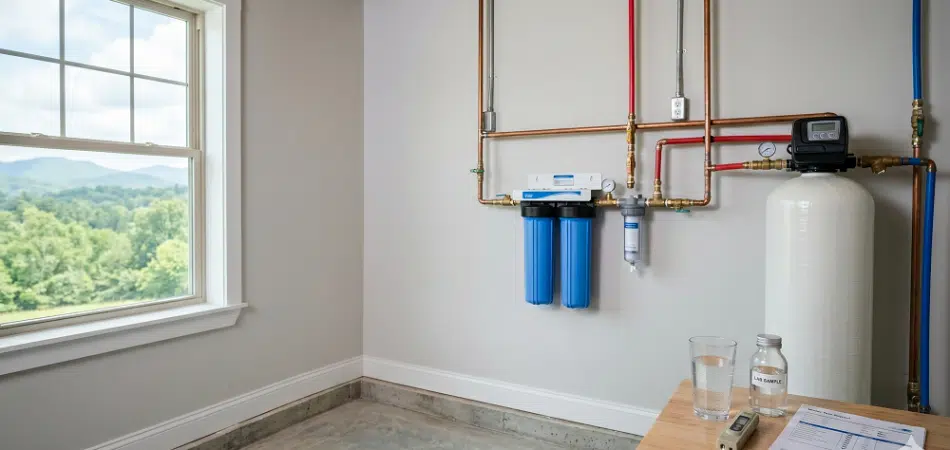
Water treatment in Maryville, TN, generally provides high-quality municipal water (rated 98/100 in 2023), but residents often use softeners or filtration for hardness and sediment, particularly on private wells. Key options include whole-house filtration (e.g., Halo 5), softeners for mineral buildup, and free testing from local specialists.
Maryville homeowners often ask the same question: is the water coming out of my tap actually safe and good for my home? The City of Maryville municipal supply meets EPA Safe Drinking Water Act standards, but federal compliance does not address everything that affects taste, odor, fixture lifespan, or how skin and laundry feel. The right water treatment services in Maryville, TN depend on the source serving your address, the age of your home’s plumbing, and what a certified lab test reveals.
At Tennessee Standard Plumbing, our team brings five generations of plumbing experience and 13+ years of daily fieldwork serving Maryville, Alcoa, Knoxville, and the wider Blount County region. We help homeowners interpret water quality reports, match equipment to verified test data, and install systems that comply with Tennessee plumbing code.
Find out exactly what’s in your water. Contact us to schedule a test today
Maryville drinking water comes from three utilities: the City of Maryville Water Department draws from the Little River, the South Blount County Utility District (SBCUD) draws from Tellico Lake and Alcoa Water serve the Alcoa area. All three meet EPA Safe Drinking Water Act standards, but each system shows measurable disinfection byproducts and varying mineral content by source and season.
Private wells in rural Blount County draw from limestone karst aquifers that produce noticeably harder water with different treatment needs.
Surface water treated with chlorine produces disinfection byproducts (DBPs), including trihalomethanes (TTHMs) such as chloroform and bromodichloromethane, plus haloacetic acids (HAA5). These form when free chlorine reacts with naturally occurring organic matter in the source water.
EPA limits TTHMs to 80 parts per billion (ppb) and HAA5 to 60 ppb, and the City of Maryville’s annual Consumer Confidence Report shows detectable but compliant levels of both. Other concerns documented by area utilities include:
 Residual chlorine and chloramines used for disinfection
Water hardness is measured in parts per million (ppm) of calcium carbonate or grains per gallon (gpg), where 1 gpg equals 17.1 ppm. The US Geological Survey classifies water under 60 ppm (3.5 gpg) as soft, 61 to 120 ppm as moderately hard, 121 to 180 ppm as hard, and over 180 ppm (10.5 gpg) as very hard.
SBCUD publishes a customer hardness reading near 38 ppm (2.2 gpg), which sits in the soft range on the USGS scale, though the utility describes it locally as “slightly hard.” City of Maryville and Alcoa Water levels can run slightly higher depending on the treatment plant and time of year.
Approximately one in ten Tennessee households relies on a private water supply, with higher concentrations in rural Blount County. Well water in this region typically draws from carbonate karst aquifers, producing measurably higher hardness plus possible iron, manganese, hydrogen sulfide (the “rotten egg” smell), and coliform bacteria depending on well depth, casing condition, and surface contamination.
The EPA does not regulate private wells, so testing is the homeowner’s responsibility and should happen at least annually for bacteria, nitrates, and pH.
Water treatment services in Maryville, TN fall into four categories: water quality testing, whole-home filtration, water softening, and point-of-use purification. Each addresses a different problem, and most homes benefit from a combination rather than a single device. The right starting point is a certified water test that measures hardness in gpg, chlorine in ppm, total dissolved solids (TDS), and any contaminants of concern before equipment is selected.
A professional water quality test measures hardness, free chlorine, pH, total dissolved solids (TDS), iron, manganese, total coliform bacteria (for wells), and disinfection byproducts. Test results determine which equipment makes sense and which would be wasted spend.
Water quality testing typically involves a technician collecting samples at multiple points in the home, sending them to an EPA-certified lab, and reviewing results with the homeowner before recommending any system.
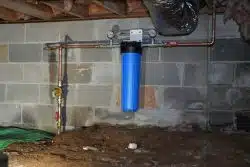 A whole-home water filtration system treats water at the point where the main supply line enters the house, so every tap, shower, and appliance receives filtered water. These systems combine a sediment pre-filter (typically 5 to 20 micron) with an activated carbon stage that removes chlorine, taste and odor compounds, and many disinfection byproducts.
NSF/ANSI Standard 42 certifies carbon filters for chlorine reduction. For Maryville homes on city water, a whole-home water filtration system is the most useful first upgrade because it improves drinking, bathing, and appliance water at once.
A water softener uses a cation exchange resin to remove calcium and magnesium ions, replacing them with sodium or potassium ions. Softeners are most useful for private well homes or city homes where hardness consistently runs above 7 gpg (120 ppm). NSF/ANSI Standard 44 certifies softeners for hardness reduction performance.
Common signs a softener is worth considering include white scale on faucets, soap that will not lather, dingy laundry, and water heaters that lose efficiency within a few years. Professional water softener installation sizes the unit to household demand, sets proper regeneration cycles, and ties the brine line into approved drainage.
A reverse osmosis (RO) system pushes water through a semipermeable membrane that blocks dissolved solids, lead, fluoride, nitrates, and most chemical contaminants. NSF/ANSI Standard 58 certifies RO systems for performance, requiring a minimum 75% TDS reduction, with most certified systems achieving 90 to 96%.
RO systems install under the kitchen sink and deliver filtered water through a dedicated faucet. A reverse osmosis drinking water system is the most thorough way to treat drinking and cooking water for homes wanting bottled-water quality at the tap, and it pairs well with a whole-home filter handling the rest of the house.
Choosing the right water treatment system in Maryville starts with three steps: identify the source water utility or well, document the symptoms you want to fix, and verify the contaminants through a certified lab test. A licensed master plumber should size, place, and connect the system to comply with the Tennessee plumbing code and local utility cross-connection rules.
Different complaints point to different systems. Use this quick map:
A 1950s home in downtown Maryville with original galvanized steel pipes has different needs than a new build in Alcoa. Older homes may show metallic taste from corroded supply lines, while newer subdivisions on city water often only need carbon filtration.
Homes with copper or PEX plumbing handle softened water without issue, but galvanized or older steel pipes can react poorly to certain treatment chemistries, which is why a licensed plumber’s assessment matters before installing any equipment.
Tennessee adopts the International Plumbing Code (IPC), which requires water treatment equipment to be installed with proper backflow protection, accessible bypass valves, and air-gapped drain connections for softener brine and RO reject water.
Sizing matters too, since an undersized softener regenerates too often and an oversized filter wastes water and money. Annual filter cartridge changes, periodic resin replenishment, and yearly inspections keep systems running at full performance for 10 to 15 years.
Maryville water is generally safe to drink, but “safe” and “the best your home can have” are not the same thing. The smartest first step is a certified water quality test that maps exactly what is in your supply, followed by equipment matched to those specific findings rather than guesses.
Tennessee Standard Plumbing serves homeowners across Maryville, Alcoa, Friendsville, Rockford, and the wider Blount County area, with water treatment services that include lab testing, system selection, code-compliant installation, and ongoing maintenance. Our licensed master plumbers explain every result in plain language and never recommend equipment the test data does not support.
To schedule a water quality test or talk through options with a licensed plumber near you, call us today!
Water treatment costs in Maryville range from $300 to $500 for a basic whole-home sediment and carbon filter, $1,500 to $3,500 for a quality water softener installed, and $400 to $1,200 for an under-sink reverse osmosis system. A combined whole-home filtration plus RO drinking system typically runs $2,500 to $5,000, depending on home size and source water complexity.
Yes, tap water in Maryville meets all EPA drinking water standards, according to the most recent annual water quality reports from the City of Maryville and South Blount County Utility District. Some homeowners still install filtration to reduce chlorine taste, disinfection byproducts, and sediment, especially in older homes with aging interior plumbing.
Most Maryville homes on city water do not need a softener since SBCUD water measures around 38 ppm (2.2 gpg), which is on the soft side of the USGS scale. Homes on private well water in rural Blount County usually benefit from a softener because well sources draw from limestone karst aquifers that produce hardness levels of 10 gpg or higher.
Private well water should be tested at least once a year for bacteria, nitrates, and hardness, plus every three years for a broader contaminant panel. Test more often if anyone in the home is pregnant, immunocompromised, or under one year old, or if you notice a sudden change in taste, color, or smell.
A water filter removes contaminants like chlorine, sediment, and chemicals, while a water softener removes hardness minerals like calcium and magnesium. The two systems solve different problems, and many Maryville homes benefit from running both because filtration improves taste and odor while softening protects appliances and pipes.
A whole-home filtration system typically lasts 10 to 15 years with proper maintenance, including annual filter cartridge changes and periodic system flushes. Reverse osmosis membranes usually need replacement every two to three years, while carbon filter media generally lasts five to seven years depending on water volume.
A properly sized water softener should not noticeably reduce water pressure, since modern units are designed to handle full household flow. Pressure drops usually point to a clogged sediment pre-filter, undersized softener, resin bed problems, or unrelated plumbing issues that a licensed plumber can diagnose during a service visit.
Tennessee plumbing code requires licensed installation for systems that connect to the main water line, include drain lines, or require backflow protection, which covers most softeners and whole-home filters. A licensed plumber also sizes equipment correctly, sets regeneration cycles, and protects warranty coverage that DIY installation often voids.
The City of Maryville’s water leaves the treatment plant lead-free, but trace lead can still appear at the tap in homes built before the 1986 federal Safe Drinking Water Act amendment due to older lead-soldered joints or brass fixtures. The most reliable way to know is to test water from your kitchen tap, and an under-sink reverse osmosis system removes lead at the point of use if any is detected.
Your monthly water bill identifies your utility, which will be either the City of Maryville Water Department, the South Blount County Utility District (SBCUD), or Alcoa Water depending on your address. Each utility publishes an annual Consumer Confidence Report (CCR) online with full water quality data for your specific service area.
Same-day Service Available
Mon – Fri: 7:30 am – 5:00 pm