
Same-Day Service Available
00
Hrs
00
Mins
00
Secs
Need a Plumber in Knoxville? We’re Ready to Help!
Same-Day Service Available
Need a Plumber in Knoxville? We’re Ready to Help!
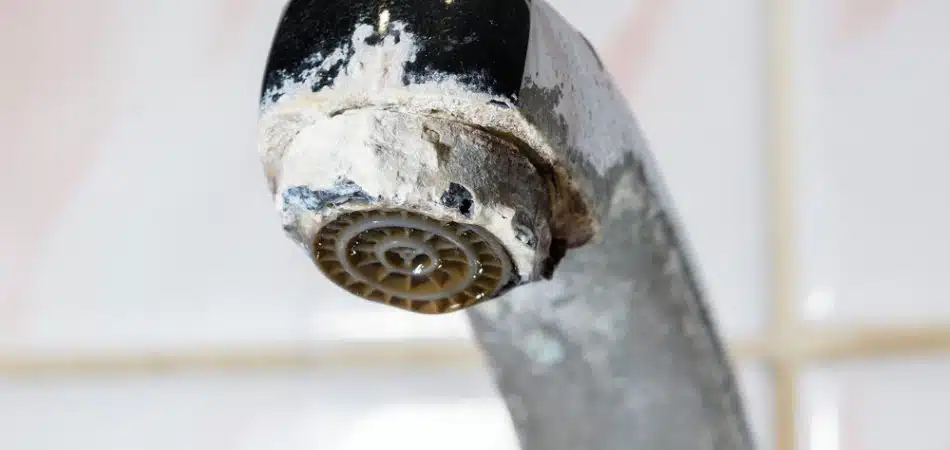
The white, crusty buildup on faucets in Maryville is limescale, caused by high levels of calcium and magnesium in local hard water. When water evaporates from faucets and showerheads, these dissolved minerals are left behind, forming a hardened, white residue. This buildup is harmless to health but can restrict water flow.
You noticed it a few weeks ago. Maybe a chalky ring around the faucet base, a crusty white film on the spout tip, or gritty buildup inside the aerator screen. You cleaned it off. It came back. Now you are wondering what it actually is, whether your water is causing it, and whether ignoring it is going to cost you later.
At Tennessee Standard Plumbing, our licensed plumbers work with Maryville and Blount County homeowners on exactly this problem every week. We test your water quality, identify the source of the buildup, and install the right treatment so it stops coming back.
Contact us today to schedule your water quality assessment.
The white buildup on faucets in Maryville is almost always limescale, a mineral deposit formed when dissolved calcium and magnesium in tap water evaporate and leave residue on fixture surfaces. Not all white deposits on plumbing fixtures come from the same source, and treating the wrong one wastes time.
 Limescale is a deposit of calcium carbonate (CaCO3) and magnesium compounds that forms when hard water evaporates from a surface and leaves its dissolved minerals behind. It looks chalky white to off-white, feels gritty or crusty to the touch, and typically concentrates around faucet bases, spout tips, aerator screens, and the underside of showerheads.
Limescale dissolves in mild acids such as white vinegar, which is the fastest way to confirm you are dealing with it. Apply a small amount, wait a few minutes, and the deposit should soften and break apart.
White buildup that appears only on cold water fixtures and feels slimy rather than gritty is more likely a biofilm or mineral-assisted bacterial growth, which requires a different response. Deposits with a blue-green tint are typically caused by copper pipe corrosion and indicate a water chemistry or pipe age problem.
If the buildup is isolated to one fixture and does not match the appearance of typical limescale, have your water tested before assuming hard water is the cause.
If the deposit is white, gritty, returns consistently after cleaning, and dissolves in vinegar, you are dealing with hard water mineral deposits. The question then becomes: where is the hardness coming from, and how much do you have?
The source of white faucet buildup in Maryville, TN depends on which water provider serves your address, and municipal hardness levels differ from well water levels across Blount County. Most homeowners do not know this detail, and it matters for choosing the right solution.
Homes served by South Blount County Utility District (SBCUD) receive municipal water with a hardness of approximately 38 ppm, which the utility describes as slightly hard. On the US Geological Survey (USGS) scale, 38 ppm sits within the soft range (0 to 60 ppm).
This is not aggressively hard water, but it contains enough dissolved calcium and magnesium to produce visible limescale deposits on fixtures over weeks and months, particularly around drains and in aerators where water sits and evaporates repeatedly.
Maryville also has customers served by the City of Maryville Water Department and Alcoa Water, each drawing from separate treatment systems with their own hardness profiles. If you are unsure which utility serves your address, a professional water test will give you an accurate reading regardless of provider.
If your home draws from a private well, your hardness level is likely higher than municipal customers. East Tennessee sits on a limestone-rich geology, and groundwater moving through that bedrock picks up substantial calcium and magnesium before reaching your well.
Well water hardness in Blount County varies by location and depth and cannot be estimated without a test. Homeowners on well water who see significant limescale buildup, poor soap lathering, or scale inside appliances are dealing with a measurable hardness problem that a softener is designed to solve.
A professional water quality test takes 15 to 20 minutes and gives you an accurate hardness reading, iron level, pH, and other factors that determine which treatment, if any, your home’s water actually needs. It is the only way to make a confident decision rather than guessing based on how the deposits look.
Hard water mineral deposits cause two distinct problems in Maryville homes: cosmetic surface buildup on faucets that is easy to see, and internal scale accumulation inside water heaters, appliances, and pipes that is harder to notice but more expensive to ignore. The two often exist at the same time.

Aerator screens sit at the tip of every faucet and mix air into the water stream. They are also the first place mineral deposits clog your fixtures. A fully blocked aerator can reduce water flow by 50 percent or more and is one of the most common reasons for low pressure at a single fixture. Showerheads develop clogged spray holes that produce an uneven spray pattern and gradually reduce pressure over time. Both are easy to clean, but they will re-clog until the water chemistry changes.
Calcium carbonate deposits settle out of hot water more readily than cold, which is why water heaters accumulate sediment on the tank floor faster than any other fixture in the home. According to the US Department of Energy (DOE), sediment buildup can reduce water heater efficiency by 10 to 15 percent, cause rumbling or popping sounds during heating cycles, and shorten the unit’s lifespan. A 40-gallon water heater carrying 10 gallons of sediment delivers only 30 gallons of usable hot water per draw. Annual flushing helps, but a softener stops the accumulation at the source.
Dishwashers, washing machines, and coffee makers accumulate scale in their heating elements and internal supply lines, reducing efficiency and leading to earlier replacement. Inside older metal pipes, mineral deposits narrow the interior diameter and increase resistance to flow over years of use. Visible limescale on your fixtures is the early signal for all of this. Ignoring it does not make the internal accumulation slower.
Removing white faucet buildup in Maryville requires two separate actions: cleaning existing calcium carbonate deposits with an acid-based solution, and treating the water supply to prevent new deposits from forming. Now that you know what you have and how serious it is, there are two responses: clean what is already there, and prevent more from forming.
White distilled vinegar is the most accessible and effective cleaning agent for calcium carbonate deposits. Wrap a vinegar-soaked cloth around the faucet base and spout for 30 to 60 minutes, then wipe clean. For aerator screens, unscrew and soak directly in undiluted vinegar for the same period.
For showerheads, fill a plastic bag with vinegar, secure it around the head so it is fully submerged, and leave it overnight. Commercial descaling products formulated with citric acid or phosphoric acid work faster on heavy buildup and are generally safe on common fixture finishes. Test on a small, inconspicuous area first on brushed nickel or oil-rubbed bronze, which can be sensitive to prolonged acid exposure.
If cleaning removes the surface deposit but the aerator flow rate does not return to normal, scale has built up inside the aerator housing or faucet body. If your faucet handles have become stiff or difficult to operate, mineral deposits may have reached the cartridge or valve seat. At that point, a plumber can disassemble the fixture, descale or replace the internal components, and assess whether long-term mineral exposure has compromised the valve seat.
 Cleaning is a short-term answer. If your water hardness level warrants it, a whole-home water softener in Maryville removes dissolved calcium and magnesium through an ion exchange process before the water reaches any fixture, appliance, or pipe in your home. The result is water that no longer deposits scale anywhere in the system.
For homeowners who want to address hardness alongside chlorine taste, sediment, or other water quality factors, a whole-home water treatment system combines softening with broader filtration in a single installation.
Maryville homeowners should call a licensed plumber when DIY cleaning does not restore normal flow, when faucet valves are stiff or leaking, or when a water heater is showing signs of sediment damage. Some limescale situations are DIY-manageable. Others need a professional, and knowing the difference saves money.
Call a plumber when aerator cleaning does not restore normal flow, when faucet handles are stiff or leaking, when your water heater is rumbling or recovering slower than it used to, or when you want an accurate water quality test and a professional recommendation on whether treatment makes sense for your home. A water treatment assessment in Maryville takes 15 to 20 minutes and costs nothing. It gives you real data rather than a guess.
At Tennessee Standard Plumbing, our Maryville plumbing team tests water quality, explains every result in plain language, and presents treatment options at multiple price points before any work begins. No pressure, no surprises, and every job is backed by our We Own It Guarantee. Call us today!
It is limescale, a deposit of calcium carbonate and magnesium compounds that forms when water containing dissolved minerals evaporates from fixture surfaces. It is not harmful to touch, but it signals that your water chemistry is working against your fixtures and appliances over time.
Calcium carbonate deposits are not toxic. The US Environmental Protection Agency (EPA) has not set a legal limit for water hardness because calcium and magnesium do not cause harmful health effects at the concentrations found in drinking water. The concern is fixture and appliance damage, not health risk.
South Blount County Utility District reports a municipal water hardness of approximately 38 ppm, which SBCUD describes as slightly hard. Homes on private well water in Blount County typically experience higher mineral levels because of East Tennessee’s limestone geology. A professional water test is the most accurate way to know your specific home’s hardness level.
Cleaning removes the deposits that have already formed but does not change the dissolved mineral content of your water. As long as your water contains calcium and magnesium and continues to evaporate from fixture surfaces, deposits will re-form. A water softener stops the cycle at the source.
Yes. White distilled vinegar dissolves calcium carbonate deposits. Wrap a vinegar-soaked cloth around the affected area for 30 to 60 minutes, then wipe clean. For aerator screens, soak them directly in vinegar. Stubborn buildup may require a commercial descaling product or professional service if the deposits have reached internal components.
Yes, over time. Scale inside aerator screens reduces water flow. Deposits inside faucet cartridges interfere with valve operation and can cause stiff handles or leaks. Inside water heaters, sediment reduces efficiency, shortens service life, and causes rumbling noises during heating cycles. The visible buildup on fixtures is an early indicator of what is happening inside your plumbing system.
Not necessarily. At 38 ppm, South Blount County municipal water is in the slightly hard range and will produce some deposits over time, but a softener is not always warranted at that level. Homeowners on private well water with higher hardness readings, or those experiencing noticeable appliance issues, stiff soap lathering, or significant scale buildup, are better candidates. A water test gives you an accurate number to base that decision on.
A water softener uses an ion exchange process where negatively charged resin beads attract and hold the positively charged calcium and magnesium ions as water passes through, releasing sodium ions in exchange. The softened water that flows into your home no longer contains the minerals that form limescale, so no new deposits accumulate on fixtures, inside water heaters, or inside appliances.
Tennessee Standard Plumbing offers professional water quality testing in Maryville and throughout Blount County. Our licensed plumbers test for hardness, iron, chlorine, pH, and other factors, explain the results in plain language, and recommend treatment based on what your water actually contains. Call (865) 352-9003 or schedule online.
A water softener specifically removes hardness minerals (calcium and magnesium) through ion exchange. A water filter removes contaminants such as chlorine, sediment, iron, sulfur, and bacteria. The two systems address different problems and are often installed together for whole-home water quality. A professional water test identifies which issues your water has so the right solution is installed rather than the wrong one.
Same-day Service Available
Mon – Fri: 7:30 am – 5:00 pm