
Same-Day Service Available
00
Hrs
00
Mins
00
Secs
Need a Plumber in Knoxville? We’re Ready to Help!
Same-Day Service Available
Need a Plumber in Knoxville? We’re Ready to Help!
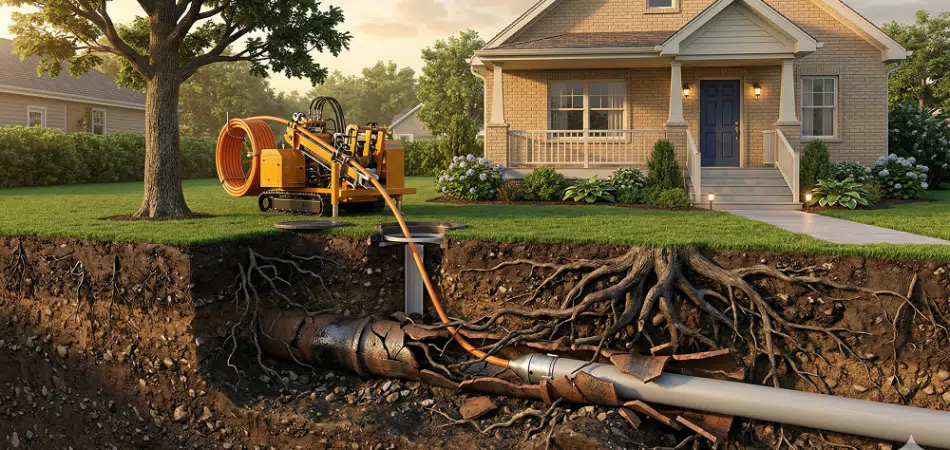
Trenchless sewer repair is a minimally invasive method to fix or replace underground pipes by digging one or two small access points, rather than a full, destructive trench. This faster, more cost-effective technique protects landscaping and is available in Maryville, TN through several local specialists.
Most Maryville homeowners do not think about their sewer line until something backs up, and by then the concern is not just the repair itself but everything it might destroy to get there. A crew digging across a yard full of mature hardwoods or through an established garden is a real cost that rarely shows up in a plumber’s estimate.
Tennessee Standard Plumbing provides trenchless sewer repair to Maryville and Blount County homeowners as a no-dig alternative that resolves the pipe problem without dismantling the property above it.
Contact us today to schedule an appointment online to find out whether your sewer line qualifies.
The short answer to the question most Maryville homeowners are asking is yes. Trenchless sewer repair is available throughout Blount County, and it applies to the most common sewer line problems found in this area, including tree root intrusion, cracked clay tile, corroded cast iron, and joint separation in aging pipe systems.
Whether a specific sewer line qualifies for trenchless repair depends on the pipe’s condition, depth, and the type of damage present. That determination requires a video camera inspection, which maps the interior of the line and identifies exactly what is going on beneath the surface before any repair method is recommended.
Trenchless sewer repair in Maryville uses two methods: cured-in-place pipe lining (CIPP) for pipes that are damaged but still structurally present, and pipe bursting for lines that are too deteriorated to rehabilitate. The appropriate method is determined by a video camera inspection before any work begins.
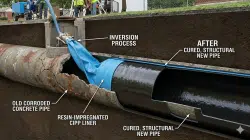 Cured-in-place pipe lining, known as CIPP, inserts a resin-coated flexible liner into the damaged pipe and inflates it against the interior wall. The resin cures and hardens into a new structural pipe within the existing one. No digging. No removal of the old pipe. Just a rehabilitated line accessed through a single entry point.
CIPP lining works well for pipes with cracks, corrosion, minor root intrusion, and joint separations that are still structurally present. The finished liner carries a service life of 50 years or more and is resistant to both root infiltration and corrosion, the two failure modes that affect most older Maryville sewer lines.
When a pipe is too deteriorated to support a liner, such as severely collapsed clay tile or Orangeburg pipe that has compressed under soil load, pipe bursting is the trenchless replacement option. A hydraulic bursting head pulls through the old pipe, fracturing it outward into the surrounding soil while simultaneously pulling a new HDPE pipe through the same underground path.
The result is a complete sewer line replacement accessed through two small pits at either end of the run. The trenchless water line replacement process follows the same general approach for water service lines. For sewer lines, the new HDPE pipe carries the same 50-plus year lifespan and eliminates the root infiltration problem permanently at the point of replacement.
Trenchless is not the right answer for every situation. Pipes with severe pipe bellying across long sections, meaning the line has sagged and collected standing water in a low point, may not drain properly after lining because the belly remains.
Pipes with major offset joints, complete collapse over extended runs, or sections running directly beneath load-bearing structures may require partial excavation to correct before or instead of trenchless work.
This is why the camera inspection matters. It identifies these conditions before any method is recommended, so the repair approach matches the actual problem rather than the preferred approach.
Maryville sewer lines fail faster than average for two measurable reasons: Blount County’s clay-heavy soils create year-round lateral pipe movement, and most residential sewer lines in established Maryville neighborhoods are made from clay tile or Orangeburg pipe that is now at or beyond its expected service life. Both factors are local, specific, and directly relevant to whether a trenchless repair addresses the root cause or only the symptom.
 The soils across much of Blount County contain heavy clay composition, consistent with the geology across the Great Smoky Mountains foothills. Clay expands when saturated and contracts when dry, which creates ongoing lateral pipe movement around buried sewer lines throughout the year.
That movement does not cause immediate failure but gradually widens joint gaps and introduces micro-fractures in clay tile and cast iron pipe walls over decades of seasonal cycling.
By the time a sewer line shows symptoms, the joint separations that started as hairline gaps have often grown wide enough for root systems to enter and for groundwater to infiltrate the line during wet periods.
Many established Maryville neighborhoods contain homes built between the 1940s and 1970s. Sewer lines installed during those decades were predominantly clay tile or Orangeburg pipe. Clay tile carries an expected service life of 50 to 100 years depending on soil and installation conditions.
Orangeburg pipe was rated for approximately 50 years at installation but commonly begins failing at 30 years — meaning any Orangeburg still in the ground today is at or past the point of expected failure.
Clay tile joints use mortar packing or rubber compression rings that lose integrity over time, allowing groundwater infiltration and root entry at connection points. Orangeburg, a bituminous fiber pipe made from layers of wood pulp and coal tar pitch, absorbs moisture and eventually deforms and collapses under soil load.
Both pipe types are strong candidates for trenchless sewer line replacement or pipe lining once they begin showing symptoms, and both can be addressed without excavating the yards and mature trees that have grown up around them over the same 50 to 70 years.
Most Maryville homeowners completing a residential trenchless sewer repair finish the project in one to three days and begin with a video camera inspection that confirms the pipe’s condition before any work is approved.
Most residential trenchless sewer repairs in Maryville are completed in one to three days from the start of work. Traditional excavation for comparable projects typically runs three to seven days or longer and requires a separate restoration phase after the plumbing work is complete.
The process starts with a video camera inspection to assess the pipe’s condition. The inspection identifies the type, location, and extent of damage and confirms whether lining, bursting, or partial excavation is the appropriate response. From there, a written estimate is provided with the recommended method and a clear total cost before any work begins. Once approved, access points are opened, the repair is completed, and the line is re-inspected by camera to confirm the result before the job is closed out.
Six warning signs indicate a sewer line problem in Maryville that warrants a video camera inspection: multiple drains backing up at once, sewage odors, gurgling sounds from fixtures, soft or green ground above the pipe path, persistent slow drains after cleaning, and a sewer line older than 40 years that has never been inspected.
 Multiple drains backing up at the same time, particularly when the toilet is flushed
Any single item on this list is sufficient reason to schedule a camera inspection through a licensed Maryville plumber before the condition worsens into a full stoppage or sewage backup.
Trenchless sewer repair is available in Maryville, it is the right approach for most of the sewer line damage found in Blount County homes, and it starts with a camera inspection that tells you exactly what you are dealing with before any money is committed to a repair.
Tennessee Standard Plumbing operates a licensed plumbing office at 392 High St. in Maryville, TN and serves Blount County homeowners with the full range of trenchless pipe installation and sewer and drain repair in Maryville services.
Every evaluation includes a written estimate with multiple options before work begins. Call us today!
Yes. Trenchless sewer repair is available throughout Maryville and Blount County for residential sewer lines. Whether a specific pipe qualifies depends on its condition, and a video camera inspection is the standard first step to confirm the appropriate repair method.
A video camera inspection is the only reliable way to determine whether a pipe can support trenchless lining or bursting. Pipes with cracks, root intrusion, corrosion, or joint separation typically qualify. Pipes with severe bellying, major offset joints, or complete collapse over extended sections may require partial excavation instead.
Pipe lining installs a resin-coated liner inside the existing pipe to rehabilitate it from the interior without removing the old pipe. Pipe bursting pulls a new pipe through the old one while fracturing it outward, fully replacing the line. Lining is used when the pipe is structurally present but damaged. Bursting is used when the pipe is too deteriorated to support a liner.
Most residential trenchless sewer repairs are completed in one to three days. Traditional excavation for comparable work typically takes three to seven days plus restoration time for landscaping and surface repairs.
Trenchless methods require only one or two small access points rather than a continuous trench, which leaves the soil, root systems, and landscaping above the pipe path undisturbed. This is a significant consideration for older Maryville properties where mature trees and established plantings are located near the sewer line.
Maryville neighborhoods built between the 1940s and 1970s used clay tile or Orangeburg pipe for sewer lines. Clay tile carries a service life of 50 to 100 years but is prone to joint failure in shifting soils. Orangeburg was rated for 50 years but commonly fails at 30, meaning all Orangeburg installed before 1972 is at or past its expected service life. Blount County’s clay-heavy soils compound the problem by expanding and contracting with moisture cycles, which accelerates joint separation and pipe wall cracking in both materials over time.
Standard homeowners insurance typically excludes sewer line damage caused by aging, root infiltration, or normal wear. Coverage may apply when damage results from a sudden, accidental event rather than gradual deterioration. A sewer line endorsement or utility protection add-on is available from some insurers for homeowners who want coverage for these repairs.
CIPP epoxy liners and HDPE pipes installed through pipe bursting are both rated to last 50 years or more under normal residential conditions. Both materials are resistant to root infiltration and corrosion, the two primary failure modes for clay tile and Orangeburg sewer lines common in Maryville’s older housing stock.
The first step is scheduling a video camera inspection of the sewer line. The inspection identifies the condition of the pipe, the type and location of damage, and which repair method is appropriate. From there, a written estimate with a clear total cost is provided before any repair work begins.
Same-day Service Available
Mon – Fri: 7:30 am – 5:00 pm