
Same-Day Service Available
00
Hrs
00
Mins
00
Secs
Need a Plumber in Knoxville? We’re Ready to Help!
Same-Day Service Available
Need a Plumber in Knoxville? We’re Ready to Help!
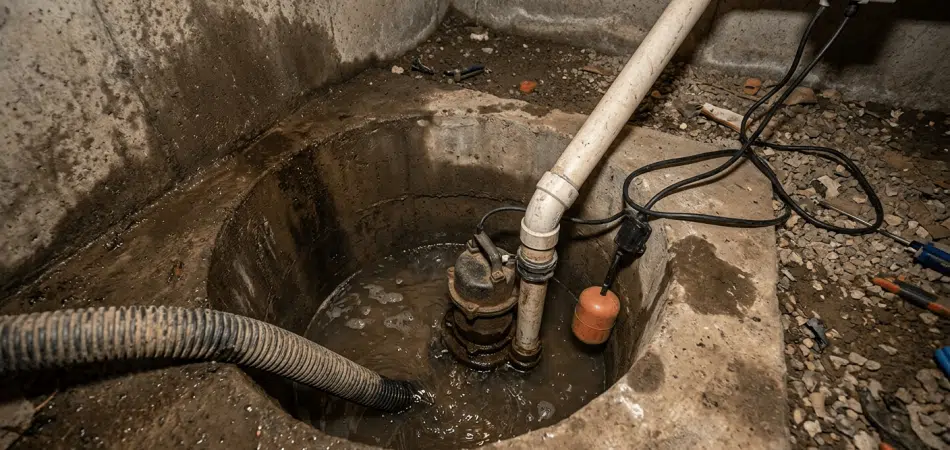
Tennessee Standard Plumbing installs and repairs sump pumps across Maryville, Alcoa, Rockford, and the surrounding Blount County communities. Our team also handles the diagnostic side, because a fair number of standing water problems turn out not to be groundwater at all. This page lays out how to tell the difference and what Maryville’s own rules say about where the water is allowed to go.
No pricing appears here, since no named, dated source for Maryville or Blount County sump pump pricing exists. What follows is the decision framework and the local rules that apply to it.
A sump pump moves water that has collected in a pit up and out of the structure. It handles groundwater and surface water that has already found its way under the house. It does not stop water from getting there; it does not fix a plumbing leak, and it does not correct a drainage problem happening outside the building envelope.
Standing water under a house has several possible sources, and they call for different fixes. Groundwater rising after rain behaves seasonally and correlates with weather. A supply line leak runs steadily regardless of weather and often shows up on the water bill. A failed drain line produces water that smells and appears when fixtures are used. Identifying which pattern is present comes before deciding on equipment.
 These two get confused constantly. A sump pump handles clean groundwater and discharges to the outside. A sewage ejector pump handles wastewater from fixtures installed below the level of the sewer line and discharges into the sanitary drainage system. They are different pumps with different pits, different discharge destinations, and different rules. Installing one where the other belongs creates a problem rather than solving one.
In a crawl space, the pit is set at the low point where water naturally collects, which is not necessarily the geometric center. Getting that location wrong leaves standing water in a corner while the pump runs dry. Homes with a partial basement or a walkout may have more than one low point, and in that case one pit may not cover the space.
A pump that runs constantly in dry weather is usually a symptom rather than a solution. So is a pit that fills within minutes of a shower or a laundry cycle. Those patterns point back to a plumbing leak or a drain failure, which is a diagnosis job for plumbers in Knoxville rather than a pump selection job. Adding pumping capacity to a leak moves the water without addressing why it is there.
Local ground conditions vary considerably across Blount County, and they drive the answer more than any general rule does. Foundation type, soil behavior, the presence of karst features, the slope of the lot, and whether the property sits in a mapped flood hazard area all matter. Two houses on the same street can reach different answers.
Crawl space construction is common across East Tennessee, and it changes the calculation. Water in a crawl space does less immediate damage than water in a finished basement, which is why some households tolerate it longer than they should. Persistent moisture under a house affects framing, insulation, ductwork, and indoor air, so the fact that nothing is visibly ruined is not evidence that nothing is happening.
Soils in Blount County differ parcel by parcel, and the USDA Natural Resources Conservation Service Web Soil Survey publishes mapped soil properties including drainage behavior for a specific address. East Tennessee also sits over soluble carbonate rock in many areas, and the USGS has published a dataset mapping depressions, sinking streams, and associated watersheds in karst areas of Tennessee. Karst affects how and where water moves underground, which is relevant to both the problem and the discharge point.
Maryville’s adopted building code names the flood hazard reference directly. The city’s amendment to Section 1612.3 inserts “Blount County, Tennessee, and Incorporated Areas, City of Maryville Community Number 475439” as the jurisdiction and September 19, 2007 as the date of issuance. A property owner can look up whether a specific parcel falls in a mapped flood hazard area through the FEMA Flood Map Service Center before assuming anything about the site.
A surprising share of crawl space water problems begin at the roof. Downspouts discharging next to the foundation, grading that slopes toward the house, and a missing or clogged perimeter drain all deliver water to the foundation on purpose. Correcting those is generally cheaper than pumping, and doing them first sometimes removes the need for a pump entirely.
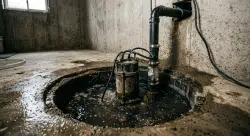 Discharge is the part most guidance skips, and it is where local rules actually apply. Maryville’s stormwater ordinance addresses crawl space pumps by name, and it separately prohibits certain connections between the sanitary and stormwater systems. Getting the discharge point right is part of the installation, not an afterthought.
Maryville’s illicit discharge chapter lists discharges that are not violations, and the list includes “discharges from potable water sources, foundation drains, uncontaminated air conditioning condensation, irrigation waters, springs, water from crawl space pumps, or footing drains.” Clean water pumped out from under a Maryville crawl space is expressly recognized in the city’s own ordinance rather than treated as a prohibited discharge.
The same chapter states that no person shall “connect, or allow to be connected, any sanitary sewer to the stormwater system.” Whether a sump may be tied into the sanitary sewer instead is a separate question governed by the plumbing code as amended by Maryville and by the Rules, Regulations, Rates and Policies of the City of Maryville Water and Sewer Department, and the city notes that where those conflict, the stricter requirement rules. That is a question for the water department rather than an assumption to make on site.
Where the line ends matters as much as whether it is allowed. A discharge that runs straight back toward the foundation recirculates the same water, and one aimed at a property line creates a dispute rather than a solution. Carrying the discharge far enough away, to a point that drains away from the structure, is the practical target.
A discharge line that freezes turns a working pump into a pump running against a closed pipe. East Tennessee cold snaps are short but sharp enough to do it. Slope, line diameter, buried depth, and the design of the outlet all affect whether a line stays clear through a freeze.
Once the decision is made, the details determine whether the system performs. Pit sizing, pump capacity, switch type, check valve placement, discharge routing, and backup power each affect reliability. A pump that is installed and then left untested tends to be discovered during the storm rather than before it.
An undersized pit makes the pump cycle rapidly, which is hard on the motor and the switch. An oversized pump in a small pit does the same thing. Switch style also matters, since tethered floats need clearance to swing and vertical floats suit narrower pits. Matching these to the actual water volume is part of the design rather than a preference.
Without a functioning check valve, water in the discharge line drains back into the pit each time the pump stops, and the pump immediately runs again to move the same water. That cycling is one of the more common reasons a pump fails early. Discharge line size, the number of fittings, and the vertical lift all affect how much water the pump actually delivers compared with its rated capacity.
Storms that produce water often produce outages, which is when the pump matters most. A battery backup system runs the pump when utility power is out, for a period that depends on the battery, the pump draw, and how often it cycles. Backup batteries are consumable and are replaced on a schedule rather than left indefinitely.
Testing is straightforward: pour water into the pit, confirm the switch activates, confirm water leaves through the discharge, and confirm the pump shuts off. Doing that before the wet season, rather than during it, is the point. Pits also collect silt and debris that shorten pump life, so periodic cleaning belongs on the same schedule.
The short version: identify the water source before buying equipment, since a pump does not fix a leak or a drainage problem. Blount County conditions vary by parcel, and soil data, karst mapping, and the FEMA flood map for Community Number 475439 are all worth checking. Maryville’s own stormwater ordinance expressly recognizes discharge from crawl space pumps. And a pump is only as good as its discharge line, its check valve, and the last time someone tested it.
Tennessee Standard Plumbing handles sump pump installation and repair, sewage pump installation and repair, drain repair, and leak detection across Maryville, Alcoa, Rockford, and Blount County. If a household is not certain whether the water under the house is groundwater or a leak, that is the question we can settle first. Local ground conditions and their effect on buried plumbing are covered further in our guide to how local soil conditions affect underground plumbing. Call (865) 352-9003 or contact our team to arrange a look.
We serve Maryville, Alcoa, Rockford, Friendsville, and communities across Blount County and East Tennessee.
No single answer covers the area. Many East Tennessee homes sit on crawl spaces rather than full basements, and conditions vary parcel by parcel with soil, slope, and drainage. A pump makes sense where groundwater or surface water actually collects under the structure, and it does not where the water is coming from a plumbing leak or a correctable drainage problem outside.
Watch the timing. Groundwater appears with or shortly after rain and recedes afterward. A supply line leak runs at a steady rate regardless of weather and usually shows up on the water bill. Water that appears when fixtures are used and carries an odor points to a drain or building sewer failure instead.
Maryville’s illicit discharge chapter lists discharges that are not violations, and that list expressly includes water from crawl space pumps, foundation drains, and footing drains. Whether a sump may instead be tied to the sanitary sewer is governed by the plumbing code as amended by the city and by the water department’s own rules, so confirm the arrangement with the City of Maryville Water and Sewer Department.
A sump pump moves clean groundwater out of a pit and discharges it outside the building. A sewage ejector pump moves wastewater from fixtures installed below the level of the sewer line into the sanitary drainage system. They use different pits, different discharge destinations, and different rules, and they are not interchangeable.
That is looked up rather than assumed. The City of Maryville’s adopted building code references the flood insurance study for Blount County, Tennessee, and Incorporated Areas, City of Maryville Community Number 475439, with a date of issuance of September 19, 2007. A property owner can check a specific parcel through the FEMA Flood Map Service Center.
Common explanations are a failed check valve letting discharge water drain back into the pit, a stuck float switch, a pit that is too small for the pump, or a plumbing leak feeding the pit continuously. Constant running in dry weather points away from groundwater and toward one of the other causes.
It is worth considering because the storms that produce the most water also tend to cause power outages, which is exactly when the pump is needed. How long a backup runs depends on the battery, the pump’s draw, and how often it cycles. Backup batteries are consumable and are replaced on a schedule.
Sometimes. Downspouts discharging next to the foundation and grading that slopes toward the house deliver water to the foundation directly, and correcting those is generally cheaper than pumping. Whether it is enough on its own depends on how much of the water is arriving from the surface rather than rising from below.
Testing before the wet season is the practical habit. Pour water into the pit, confirm the switch activates, confirm water leaves through the discharge line, and confirm the pump shuts off afterward. Pits collect silt and debris that shorten pump life, so periodic cleaning belongs on the same schedule.
It can affect how water moves underground and where a discharge should go. The USGS has published a dataset mapping depressions, sinking streams, and associated watersheds in karst areas of Tennessee, and the USDA NRCS Web Soil Survey publishes soil drainage characteristics by location. Whether a specific parcel is affected is determined by looking it up rather than by generalizing about the region.
Same-day Service Available
Mon – Fri: 7:30 am – 5:00 pm