
Same-Day Service Available
00
Hrs
00
Mins
00
Secs
Need a Plumber in Knoxville? We’re Ready to Help!
Same-Day Service Available
Need a Plumber in Knoxville? We’re Ready to Help!
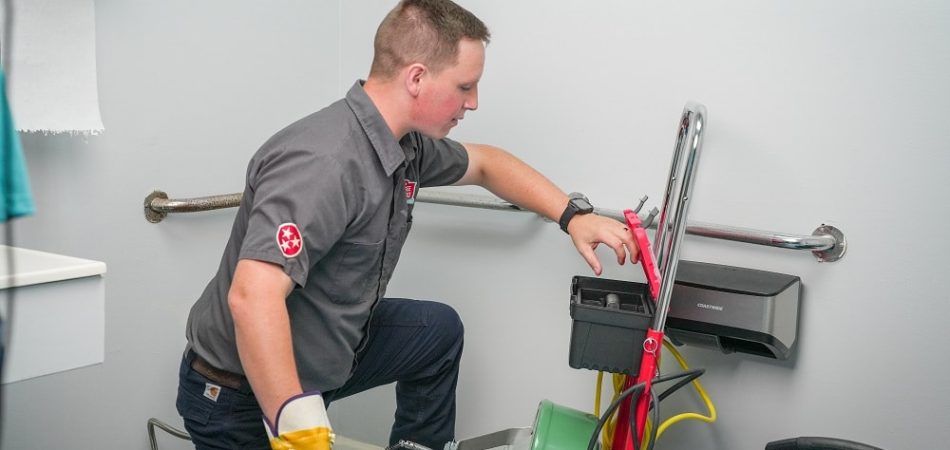
Most Knoxville homeowners should schedule professional drain cleaning every 12 to 18 months. Homes with older pipes, heavy household use, or hard water from the KUB supply may need service every 6 to 12 months. Professional cleaning removes biofilm, grease deposits, and pipe wall scaling that standard drain clearing misses. Slow drains at multiple fixtures, gurgling sounds, or foul odors are signs you need service now.
Most Knoxville homeowners do not think about their drains until something goes wrong. By the time water is pooling in a shower or backing up at the kitchen sink, the underlying buildup has often been accumulating for months or years. Slow-developing pipe wall scaling and biofilm accumulation rarely cause visible symptoms until a drain is close to full blockage.
Tennessee Standard Plumbing has served Knoxville and the surrounding East Tennessee area for over 13 years, with a team of 50+ licensed plumbers and a 5.0 Google rating backed by more than 1,000 reviews. Our plumbers see firsthand what builds up inside residential drain systems across the region and how quickly conditions can shift from manageable to serious. If you are looking for expert drain clearing or want to get ahead of a developing issue, we are ready to help.
Scheduling a professional drain cleaning service on a consistent cycle is the most reliable way to protect your plumbing system, avoid emergency calls, and extend the life of your pipes. The right cleaning frequency depends on your home’s age, pipe material, household size, and local water quality factors specific to Knoxville.
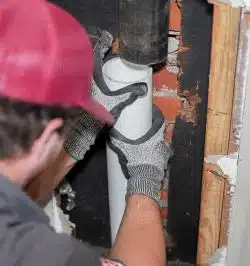 Most residential drain systems benefit from professional cleaning every 12 to 18 months. Homes with higher occupancy, older pipe materials, or elevated mineral content in the water supply may need service every 6 to 12 months. Waiting longer than 18 months between cleanings allows biofilm layers and scale deposits to thicken, reducing pipe flow velocity and increasing the likelihood of a complete blockage.
For a household of two to four people in a home built after 1980 with PVC or ABS drainpipe, annual professional cleaning is a sound baseline. These homes tend to generate consistent volumes of soap residue, organic matter, and grease that accumulate steadily at pipe joints, p-traps, and drain gradients. A once-per-year cleaning cycle prevents minor accumulation from reaching obstruction-level thickness.
Pre-1980 homes throughout Knoxville, including many neighborhoods along Central Avenue Pike, Fountain City, and Holston Hills, commonly contain cast iron drains and clay tile sewer laterals.
Cast iron pipe interiors develop surface oxidation and corrosion pitting that accelerates biofilm adhesion, while clay tile joints are prone to root infiltration from tree and shrub root systems. These homes typically require professional drain cleaning every 6 to 12 months and benefit from annual sewer camera inspection to monitor joint condition.
Homes with five or more occupants, short-term rentals, or households that regularly cook with oils and fats place higher-than-average loads on the drain system. Grease saponification deposits, the soap-like calcium salt compounds that form when fats combine with alkaline water, build up faster in high-use kitchens. A cleaning interval of every 6 months keeps these systems running efficiently and prevents the type of grease-and-scale bonded blockages that require hydro jetting to fully clear.
Professional drain cleaning addresses deposits and biological material that household drain cleaners, plungers, and consumer-grade snake tools cannot fully remove. A thorough professional service clears pipe wall scaling, removes biofilm colonies, and restores the full internal diameter of the drain to its designed flow velocity. Partial removal of these materials leaves a rough interior surface that collects new debris faster than a clean pipe would.
Biofilm is a structured colony of microorganisms, primarily bacteria and fungi, that adheres to pipe interior surfaces and secretes a protective extracellular matrix. In drain pipes, biofilm accumulation feeds on organic matter including hair, soap residue, skin cells, and food particles.
Over time, biofilm layers in kitchen and bathroom drains can reach several millimeters in thickness, significantly reducing the effective interior bore of the pipe. Biofilm also generates hydrogen sulfide gas as a metabolic byproduct, which is the source of the sulfurous odors that often rise from slow drains.
Kitchen drain lines accumulate fats, oils, and grease (FOG) that congeal along cooler pipe wall surfaces below the p-trap. When these fatty acids react with calcium and magnesium ions present in Knoxville’s moderately hard municipal water supply, the process of saponification converts them into calcium and magnesium soap compounds. These compounds bond tightly to pipe surfaces and resist dissolution by hot water or liquid drain cleaners. The resulting deposits narrow the pipe’s internal diameter and provide a sticky substrate that traps additional debris.
KUB (Knoxville Utilities Board) water is sourced from the Tennessee River and its tributaries and carries moderate levels of dissolved calcium and magnesium carbonate. As water flows through pipes and evaporates at drain surfaces, calcium carbonate scale precipitates onto pipe walls in a process called mineral precipitation.
In older galvanized steel or cast iron drains, this pipe wall scaling combines with corrosion products to form dense deposits that reduce flow velocity and create recurrent partial blockages. Professional cleaning removes this scale mechanically or through high-pressure flushing.
Tree and shrub roots naturally migrate toward the moisture and nutrient gradients present around sewer lateral pipes. In East Tennessee’s clay-heavy soils, root infiltration through clay tile pipe joints is one of the most common causes of recurring drain slowdowns in older Knoxville neighborhoods. Once roots enter a pipe joint, they expand and branch, eventually forming a dense fibrous mass that captures solids and accelerates full blockage.
Professional cleaning using a mechanical cutting tool or water jet is required to remove root masses, and a sewer camera inspection is recommended afterward to assess whether drain repair services are needed.
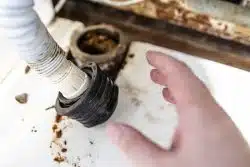 Drains that need immediate professional attention typically show at least one of four observable symptoms: slow drainage, gurgling sounds, persistent odors, or clogs that return within days of clearing. Any single symptom points to partial blockage or venting issues that will worsen without professional intervention. Multiple symptoms appearing at the same time indicate a systemic problem affecting the main drain line or sewer lateral rather than a single fixture.
A single slow drain is usually a localized clog at or near that fixture’s p-trap. Slow drainage appearing at two or more fixtures at the same time points to a partial blockage further down the shared drain stack or main sewer lateral. This pattern is particularly common in two-story Knoxville homes where upstairs bath drains and downstairs kitchen drains share a common vertical stack before exiting the foundation.
A gurgling sound from a drain or toilet after water drains from a nearby fixture is a reliable indicator of a venting or partial blockage issue. When a partial obstruction reduces pipe flow velocity, water flowing past it creates turbulence that draws air back through adjacent fixture traps, producing the audible gurgle. This symptom in East TN winters can also signal a partial freeze in an exterior drain or vent stack, which deserves prompt inspection before the restriction worsens.
Persistent sulfurous or sewage-like odors from drain openings typically originate from one of two sources: established biofilm accumulation generating hydrogen sulfide gas or a dry p-trap that is no longer blocking sewer gas from entering the living space. Odors that persist after running water in the affected fixture and allowing the trap to refill are most likely caused by biofilm colonization inside the drain line itself. Regular preventive drain maintenance disrupts biofilm colonies before they reach odor-producing density.
A drain clog that returns within a week or two of clearing signals that the obstruction was only partially removed, or that the underlying pipe surface is rough enough from corrosion or scale to re-accumulate debris rapidly. Consumer-grade drain augers typically penetrate a blockage to restore partial flow without removing the material adhered to the pipe wall. Professional cleaning addresses the pipe wall surface itself, restoring smooth interior conditions that resist rapid re-accumulation.
Professional drain cleaning uses three primary methods: mechanical snaking, high-pressure hydro jetting, and video sewer camera inspection. Each method addresses different conditions, and the appropriate choice depends on the type of material causing the blockage, the pipe material, and the severity of restriction. A licensed plumber will assess the drain condition before selecting the most appropriate technique.
A mechanical drain snake, or drain auger, uses a rotating cable fitted with a cutting head to penetrate and break through or retrieve soft clogs. Electric-powered professional augers generate significantly more torque than consumer cable tools and carry larger cutting heads capable of clearing root masses and compacted organic blockages. Mechanical snaking is well-suited for clearing localized obstructions at drain inlets, p-traps, and upper stack sections, particularly in homes where older pipe materials require a less aggressive approach than high-pressure water.
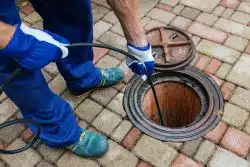 Hydro jetting delivers water at pressures between 1,500 and 4,000 PSI through a specialized nozzle that simultaneously cuts forward and flushes debris back toward the cleanout access point. The radial spray pattern from the nozzle scours the pipe wall surface, removing biofilm, saponified grease deposits, calcium carbonate scale, and fine root tendrils in a single pass.
Hydro jetting restores the full internal diameter of the drain and leaves a smooth pipe wall that resists rapid re-accumulation, making it the preferred method for homes on a preventive drain maintenance schedule.
A sewer camera inspection uses a waterproof camera mounted on a flexible cable to transmit real-time video of pipe interior conditions to a monitor at the surface.
Camera inspection identifies the precise location and nature of blockages, reveals root infiltration at joint separations, detects pipe wall corrosion or saponification deposits, and confirms whether cleaning was fully effective. For pre-1980 homes with clay tile or cast iron laterals in Knoxville, camera inspection before and after cleaning provides the most complete picture of pipe health.
For most Knoxville homeowners, scheduling professional drain cleaning every 12 to 18 months is the right starting point. Homes with older infrastructure, heavy household use, or a history of drain problems should move to annual service as a standard maintenance practice.
Catching buildup early prevents the progression from minor accumulation to full blockage, sewage backup, or structural pipe damage, all of which carry significantly higher repair costs than routine preventive service. Tennessee Standard Plumbing’s team of 50+ licensed plumbers serves Knoxville and the surrounding East Tennessee area with drain clearing and comprehensive drain maintenance that keeps your system functioning properly through every season.
Call us at (865) 352-9003 or contact our team online to schedule your professional drain cleaning in Knoxville today.
Most Knoxville homes benefit from professional drain cleaning every 1-2 years. Households with 5 or more occupants, older cast iron or clay tile pipes, or a history of recurring clogs should schedule annual service to prevent buildup from reaching blockage level.
Professional drain cleaning in Knoxville typically ranges from $150 to $500 depending on the method used, the number of drains serviced, and the severity of the obstruction. Hydro jetting service is priced higher than mechanical snaking but provides a more thorough clean of the pipe interior.
Household drain cleaners and DIY snake tools can address minor surface-level clogs near the drain trap. They cannot remove established biofilm accumulation, mineral scale deposits, grease solidification deeper in the line, or root infiltration. Professional-grade equipment is required for thorough drain maintenance.
Multiple slow-draining fixtures, gurgling sounds after flushing, foul sulfur or sewage odors from drains, and recurring clogs in the same drain are all indicators that professional service is needed now rather than at the next scheduled interval.
Hydro jetting delivers pressurized water at 3,500 to 4,000 PSI through a specialized nozzle that scours the full interior circumference of a drain pipe. It is safe for modern PVC, ABS, and copper pipe systems. A plumber will assess pipe condition before recommending hydro jetting on older or deteriorated lines.
Yes. KUB water contains dissolved calcium and magnesium carbonate that precipitates as mineral scale on drain pipe walls over time. This scale roughens the pipe interior, reduces flow rate, and creates a surface where organic material accumulates faster, which is one reason Knoxville homeowners often benefit from annual rather than biennial drain service.
Drain clearing typically refers to removing an active blockage to restore flow. Drain cleaning is a broader, more thorough process that removes accumulated biofilm, grease, and scale from the pipe walls to prevent future blockages. Preventive drain cleaning is recommended even when no active clog is present.
Most professional drain cleaning appointments take between 45 minutes and 2 hours depending on the number of drains serviced, the method used, and whether a sewer camera inspection is performed beforehand. Hydro jetting of a main sewer line typically takes longer than a single fixture drain cleaning.
Root removal through hydro jetting or mechanical cutting clears the pipe but does not prevent regrowth. Roots will typically re-enter through the same joint or crack within 1-3 years without a permanent repair. A sewer camera inspection after root clearing helps identify whether pipe repair or sewer line replacement is needed to prevent recurrence.
Recurring backups, sewage odors that persist after cleaning, water pooling in the yard above the sewer lateral, or multiple fixture backups that don’t resolve with clearing all suggest possible pipe damage. A sewer camera inspection is the definitive diagnostic tool for distinguishing between an obstruction and a structural pipe problem.
Same-day Service Available
Mon – Fri: 7:30 am – 5:00 pm