
Same-Day Service Available
00
Hrs
00
Mins
00
Secs
Need a Plumber in Knoxville? We’re Ready to Help!
Same-Day Service Available
Need a Plumber in Knoxville? We’re Ready to Help!
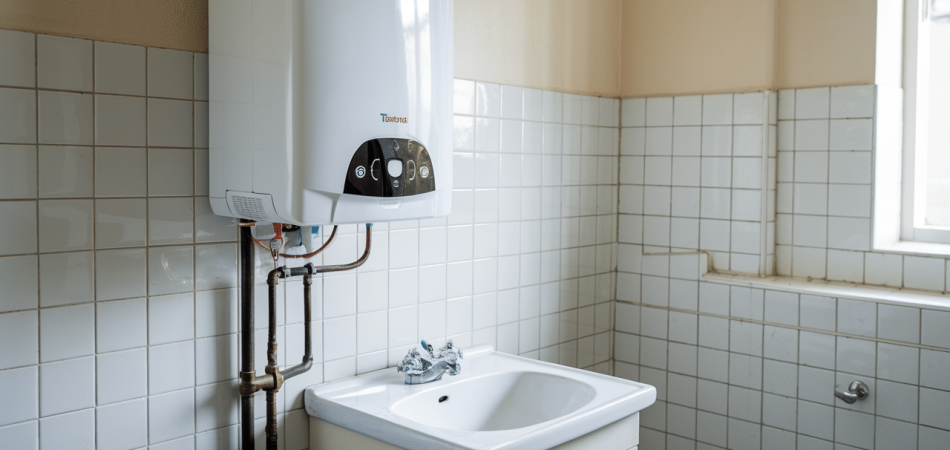
Tankless water heater installation in Maryville, TN replaces a conventional storage tank with an on-demand system that heats water only when a fixture opens, eliminating standby heat loss. The U.S. Department of Energy reports tankless units are 24 to 34 percent more energy efficient than storage tanks in homes using 41 gallons of hot water or less per day.
Switching from a conventional storage tank to a tankless water heater is one of the most impactful upgrades a Maryville homeowner can make to their home’s plumbing system. The change eliminates the standby energy losses that account for a significant share of monthly utility costs, delivers continuous hot water on demand, and installs in a fraction of the space a tank unit occupies.
But tankless installation is not a straightforward swap. Gas-fired tankless units draw 140,000 to 200,000 BTUs at peak demand, far exceeding the capacity of the half-inch gas lines that serve most conventional tank water heaters. Venting requirements differ entirely from tank systems. Sizing errors that go unnoticed at installation result in cold water sandwiches, flow restrictions, and chronic homeowner frustration. At Tennessee Standard Plumbing, our licensed plumbing technicians handle tankless water heater installation for Maryville and Blount County homeowners every week. This guide covers everything you need to know before scheduling your installation.
Call us at (865) 352-9003 to schedule a complimentary in-home sizing visit and upfront quote for your Maryville home.
The case for going tankless has strengthened considerably as unit costs have declined and energy efficiency standards have tightened. For most Maryville homeowners, the combination of operating cost reduction, space savings, and service life extension makes the upgrade financially sound over a ten to fifteen year horizon.
 A conventional storage tank water heater maintains a reservoir of 40 to 80 gallons of water at a constant set-point temperature, typically between 120 and 140 degrees Fahrenheit, twenty-four hours a day whether hot water is being drawn or not. The energy consumed to maintain this temperature against ambient heat loss is called standby heat loss, and the U.S. Department of Energy estimates it can represent up to 18 percent of a home’s total energy bill.
A tankless unit has no storage reservoir. When a fixture opens and flow reaches the unit’s activation threshold (typically 0.5 gallons per minute), the gas burner or electric heating element activates, heats the water passing through the heat exchanger, and delivers it at the target temperature. When the fixture closes and flow drops below the activation threshold, the unit shuts off entirely.
According to DOE data, tankless water heaters are 24 to 34 percent more energy efficient than conventional storage units in homes using 41 gallons or less of hot water daily. For higher-use households consuming more than 80 gallons per day, tankless units still deliver 8 to 14 percent efficiency gains. For a Maryville household paying average Tennessee utility rates for natural gas, this translates to annual operating savings of $100 to $200 compared to a mid-efficiency tank unit, with higher savings against older, lower-efficiency models.
A whole-home gas tankless unit typically measures approximately 24 inches tall by 14 inches wide by 10 inches deep and mounts on the wall, freeing the floor space previously occupied by a 40 to 80 gallon storage tank. The service life advantage is equally significant. A well-maintained gas tankless unit lasts 20 to 30 years, compared to the 10 to 15 year service life of a conventional tank water heater. Over a 30-year window, a Maryville homeowner replacing tank units at the end of each cycle may purchase two or three tank heaters in the lifespan of a single tankless installation. For homes showing signs that replacement is already overdue, the signs you need a water heater replacement in Maryville guide provides a clear checklist.
Installation complexity is the primary reason tankless water heater upgrades require a licensed plumber rather than a homeowner swap. The infrastructure requirements differ substantially from a like-for-like tank replacement.
Gas tankless water heaters operate in the 140,000 to 199,000 BTU input range at peak demand. Most conventional tank water heaters operate between 30,000 and 50,000 BTU. The half-inch gas supply lines that adequately serve tank units cannot deliver sufficient gas volume and pressure to a tankless unit at peak draw without pressure drop, which causes incomplete combustion, error codes, and unreliable hot water delivery.
Most tankless installations in Maryville require upgrading the dedicated gas supply line to three-quarter inch diameter, and in some cases a full one-inch line from the meter if the home’s existing gas distribution manifold is undersized for the combined BTU load of all appliances. Proper gas line assessment before installation is addressed in the tankless water heater installation requirements overview. Tennessee Standard Plumbing’s licensed technicians complete this assessment at the in-home sizing visit, and any necessary gas line services are quoted as part of the installation package.
Gas tankless water heaters produce combustion exhaust that must be safely expelled from the living space. Unlike conventional tank water heaters, which use atmospheric draft through a B-vent flue shared with other appliances, most modern high-efficiency condensing tankless units require dedicated PVC or CPVC direct-vent exhaust, typically two to three inch pipe routed to an exterior wall.
Non-condensing tankless units use Category III or Category IV stainless steel vent pipe. The vent termination location must comply with clearance requirements from windows, doors, and adjacent wall surfaces as specified in the manufacturer’s installation manual and the Tennessee State Plumbing Code. Existing flue penetrations from the tank unit being replaced cannot be reused for a tankless direct-vent installation, so new wall penetrations are part of most Maryville installations.
Tennessee state law requires a plumbing permit for water heater installation, including tankless unit upgrades. The permit process involves a licensed contractor submitting the work scope, and a subsequent inspection by the local authority having jurisdiction (AHJ), which for most Maryville and Blount County installations is the city or county building department. Work performed without a permit creates liability issues at the time of home sale, may void the manufacturer’s warranty, and leaves the homeowner without the code compliance verification that the permit inspection provides. Tennessee Standard Plumbing handles the permit application as part of every installation. Avoiding the common errors that create inspection failures is covered in the mistakes to avoid during water heater installation in Maryville resource.
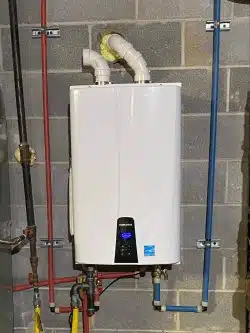 Unit sizing is the most technically demanding part of tankless selection and the area where undersizing errors most commonly occur. Two variables drive the sizing calculation: peak simultaneous flow rate demand and required temperature rise.
The first step in sizing is identifying the maximum number of hot water fixtures that may be in simultaneous use and summing their individual flow rates. A standard shower head flows at 1.5 to 2.5 gallons per minute (GPM). A bathroom faucet flows at 0.5 to 1.5 GPM. A kitchen faucet flows at 1.0 to 2.2 GPM. A dishwasher draws approximately 1.0 to 2.5 GPM at the hot water inlet.
A household of four in a Maryville home with two bathrooms might run two showers simultaneously (3.0 to 5.0 GPM combined) while the dishwasher runs after dinner (add 1.5 GPM), bringing the peak demand to 4.5 to 6.5 GPM. The selected unit must meet or exceed this peak flow rate at the required temperature rise without modulating down to a reduced output temperature. The tankless water heater sizing guide walks through this calculation in detail.
Temperature rise is the difference between the incoming cold water supply temperature and the target delivery temperature of 120 degrees Fahrenheit. East Tennessee groundwater supply temperatures average 55 to 60 degrees Fahrenheit in the summer months and can drop to 45 to 50 degrees Fahrenheit in winter.
This means a Maryville home targeting 120 degrees Fahrenheit delivery must achieve a temperature rise of 60 to 75 degrees Fahrenheit in winter conditions. A unit rated at 7.5 GPM at a 35-degree temperature rise will deliver significantly less flow at the 70-degree rise required in winter, often dropping to 4.5 to 5.0 GPM. Sizing to summer groundwater temperatures and then discovering insufficient winter flow is the most common undersizing mistake in East Tennessee tankless installations.
Natural gas tankless units are the most common choice for Maryville homeowners already on the Piedmont Natural Gas distribution system, as the high BTU input of gas units (140,000 to 199,000 BTU) supports the high flow rates and temperature rises required for whole-home coverage. Propane tankless units are specified for homes not served by natural gas distribution. Electric tankless units are practical for point-of-use applications such as a single bathroom or a kitchen sink, but typically cannot meet whole-home flow rate demands cost-effectively due to the amperage requirements for high-BTU electric heating elements.
A complete tankless water heater installation in a Maryville home, including gas line upgrade and venting, typically takes four to eight hours from start to finish.
The installation crew begins by shutting off the gas supply and water supply to the existing tank unit and draining the tank. The old unit is removed and the existing water connections, gas stub-out, and flue penetration are capped.
The new gas supply line is run from the distribution manifold or meter to the new unit location, the wall penetration for the direct-vent exhaust is cut and framed, and the mounting bracket for the tankless unit is secured to the wall. Water supply and return connections are made using the existing supply lines or new connections depending on the pipe configuration and the home’s layout.
After the unit is mounted and all water connections are made, the gas connection is completed, all fittings are checked with leak detection solution, and supply pressure at the unit inlet is verified against the manufacturer’s minimum operating pressure spec. The condensate drain line is routed to an approved drain point for condensing units. The direct-vent exhaust is installed with proper slope back toward the unit and the exterior termination is fitted with the manufacturer-supplied cap and clearance guard.
The unit is powered on and the initial purge cycle is allowed to complete before the first draw test. Flow rate and temperature delivery are verified at multiple fixtures throughout the home to confirm the unit meets the specified performance at the home’s actual groundwater temperature and peak demand.
The thermostat set-point is confirmed at 120 degrees Fahrenheit per Tennessee code recommendations for residential hot water systems. Any error codes, flow restrictions, or venting anomalies are resolved before the crew leaves the home. Ongoing maintenance and descaling service for Maryville installations is available through Tennessee Standard’s tankless water heater service in Maryville.
A properly sized and installed tankless water heater eliminates the two most common complaints Maryville homeowners have about their hot water systems: running out of hot water during back-to-back showers, and paying to maintain a tank of hot water around the clock whether anyone uses it or not. The upgrade requires more planning and infrastructure work than a tank replacement, but the 20 to 30 year service life and the year-over-year operating savings make it one of the most financially sound plumbing investments available to a Blount County homeowner.
Getting the sizing and gas line work right at installation is what separates a system that delivers on its promise from one that frustrates its owners with inadequate flow and temperature swings. That is precisely where professional assessment matters most.
Tennessee Standard Plumbing serves Maryville, Alcoa, Friendsville, and all of Blount County with complete tankless water heater installation and tankless repair and replacement services. Call our team at (865) 352-9003 or schedule your complimentary in-home sizing visit online to get an upfront, no-surprise quote for your Maryville tankless installation.
A complete tankless water heater installation in Maryville, including the unit, gas line upgrade, venting, and permit, typically ranges from $1,400 to $3,900 or more depending on the unit selected, the scope of gas line work required, and venting complexity. Homes that require a gas meter or regulator upgrade will see higher total costs. An in-home assessment is the only reliable way to produce an accurate quote for your specific home.
Yes. Tennessee state law requires a plumbing permit for all water heater installations, including tankless unit replacements. The permit includes a subsequent inspection by the local authority having jurisdiction to verify code compliance. Tennessee Standard Plumbing handles the permit application as part of every installation so the homeowner does not need to manage this separately.
Most complete tankless installations in Maryville take four to eight hours, depending on the scope of gas line work, venting configuration, and whether existing water connections can be reused. Homes requiring significant gas line upgrades or meter changes may take longer. The home will have no hot water during the installation window.
Sizing depends on your peak simultaneous fixture flow demand in GPM and the required temperature rise from East Tennessee groundwater temperature (45 to 60 degrees Fahrenheit depending on season) to 120 degrees Fahrenheit. Most three to four bedroom Maryville homes with two to three bathrooms require a unit rated at 7.0 to 9.5 GPM at a 70-degree temperature rise for reliable whole-home coverage. A licensed plumber should complete the sizing calculation based on your home’s specific fixture configuration.
In most cases, yes. Gas tankless water heaters require 140,000 to 199,000 BTU input at peak demand, compared to 30,000 to 50,000 BTU for a conventional tank heater. The half-inch gas supply lines that serve most tank units cannot deliver sufficient volume without pressure drop. Most Maryville installations require upgrading to a three-quarter inch dedicated gas supply line, and some require larger lines depending on the distance from the meter and the total BTU load of other appliances.
A properly sized tankless water heater does not run out of hot water the way a storage tank does. As long as the simultaneous fixture demand does not exceed the unit’s rated flow capacity at the current groundwater temperature, it will deliver continuous hot water. An undersized unit can be overwhelmed by simultaneous peak demand, producing temperature fluctuations or reduced flow at distant fixtures. This is why accurate sizing before purchase is critical.
A well-maintained gas tankless water heater has a service life of 20 to 30 years, roughly twice the 10 to 15 year lifespan of a conventional storage tank unit. Annual descaling maintenance is important in Maryville due to the mineral content in both municipal supply water and Blount County well systems, as calcium carbonate scale accumulation on the heat exchanger surface is the primary cause of premature efficiency loss and failure in gas tankless units.
A cold water sandwich is a brief burst of cold water that occurs between draws on a tankless unit. When a fixture is closed and then reopened shortly after, the hot water remaining in the supply lines between the unit and the fixture has cooled. The unit activates and begins heating, but the cooled water in the line reaches the fixture before the freshly heated water does. This produces a momentary cold surge before hot water resumes. It is a characteristic of tankless operation, not a defect. Recirculation pump systems can reduce or eliminate this effect.
For most Maryville homeowners, yes. The combination of 24 to 34 percent energy efficiency gains over tank units, a 20 to 30 year service life, and the elimination of running out of hot water makes tankless a financially sound upgrade over a 10 to 15 year horizon. The higher upfront installation cost is typically offset by operating savings within 10 to 15 years, and the longer service life means fewer replacement cycles over the life of the home.
Call a licensed plumber with demonstrated experience in gas tankless installations, including gas line sizing, direct-vent configuration, and Tennessee permit compliance. Tankless installation involves gas work, venting penetrations, and permit requirements that go beyond a standard tank swap. Tennessee Standard Plumbing serves Maryville and all of Blount County with complete tankless installation, gas line upgrades, and annual maintenance service backed by a 5.0 Google rating and over 1,000 customer reviews.
Same-day Service Available
Mon – Fri: 7:30 am – 5:00 pm