
Same-Day Service Available
00
Hrs
00
Mins
00
Secs
Need a Plumber in Knoxville? We’re Ready to Help!
Same-Day Service Available
Need a Plumber in Knoxville? We’re Ready to Help!
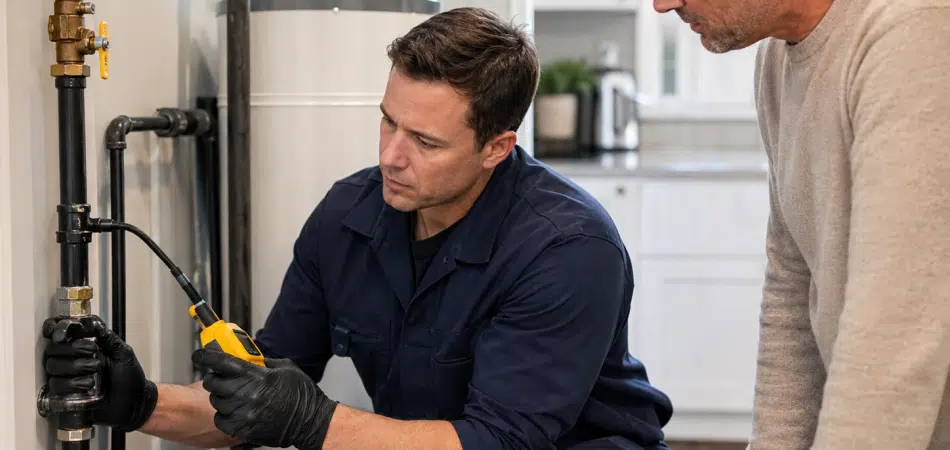
A gas smell in a Maryville kitchen, a pilot light that will not stay lit, or a rusted line running to a back-porch grill all raise the same question, and it is rarely the question homeowners expect. The hard part is not the repair. It is knowing which phone number to dial first, because the answer changes depending on where the problem sits and how urgent it is. Blount County households served by Knoxville plumbers face this split-second decision more often than they would like.
Tennessee Standard Plumbing works on gas lines across Maryville, Alcoa, Rockford, and the surrounding Blount County communities. Our team offers gas line installation, gas line repair, gas line replacement, and gas leak detection, and we handle both homes and businesses. This page lays out the order of operations so a Maryville household knows who owns which piece of the system before anyone picks up a phone.
What follows is general guidance, not a substitute for the emergency instructions published by the serving gas utility or for a determination from the City of Maryville Building Official. Anyone who suspects an active leak should act on the utility’s instructions first and read the rest later.
Leave the building before doing anything else. Atmos Energy, the natural gas provider for much of the Maryville area, instructs customers to leave immediately and then, from a safe distance, call 911 and the company’s 24-hour emergency line at 866.322.8667. No plumber, however close, comes before that call. The utility responds to suspected leaks around the clock.
Distance comes first. Getting everyone outside and well away from the structure costs seconds and removes the people from the hazard. Phones, garage door openers, and light switches all create sparks, so the call gets placed once the household is clear of the building rather than on the way out of it.
Atmos Energy’s published instruction is direct: “If you suspect a natural gas leak, leave the area immediately! From a safe distance call 911 and Atmos Energy’s 24-hour toll-free emergency number at 866.322.8667.” Households on a different gas provider should use the emergency number printed on their own bill. Service territory in Blount County varies by address, so the number on the bill is the reliable one.
Open flames, light switches, appliance controls, thermostats, and vehicle ignitions all belong on the do-not-touch list. Anything that delays getting out belongs on the same list, including opening windows, shutting off appliances, and collecting belongings. Going back inside to hunt for the source is not a homeowner task. That work belongs to the responding crew, and the property stays clear until the utility says otherwise.
Atmos Energy advises against relying on scent alone, and directs customers to use smell, hearing, and sight together when checking for signs of a leak. A hissing or roaring sound near a line, dirt blowing up from the ground, bubbling in standing water, and dead or dying vegetation in an otherwise healthy yard all belong on the same list as the sulfur odor added to the gas. Reduced sense of smell, a head cold, or a strong competing odor in the room can mask the smell entirely.
The split usually falls at the meter. The utility owns and maintains the main and the service line running to the meter set, and it responds to leaks on that equipment. Piping past the meter, the fuel lines inside the walls, the appliance connectors, and any buried yard line to a grill or generator generally belong to the property owner.
The buried service line running from the main to the meter is utility equipment in most residential arrangements. A leak on that side is reported to the gas company, and the gas company dispatches its own crew. A homeowner who calls a plumber for a leak on the utility’s side of the meter is paying for a visit that ends with the same phone call to the utility.
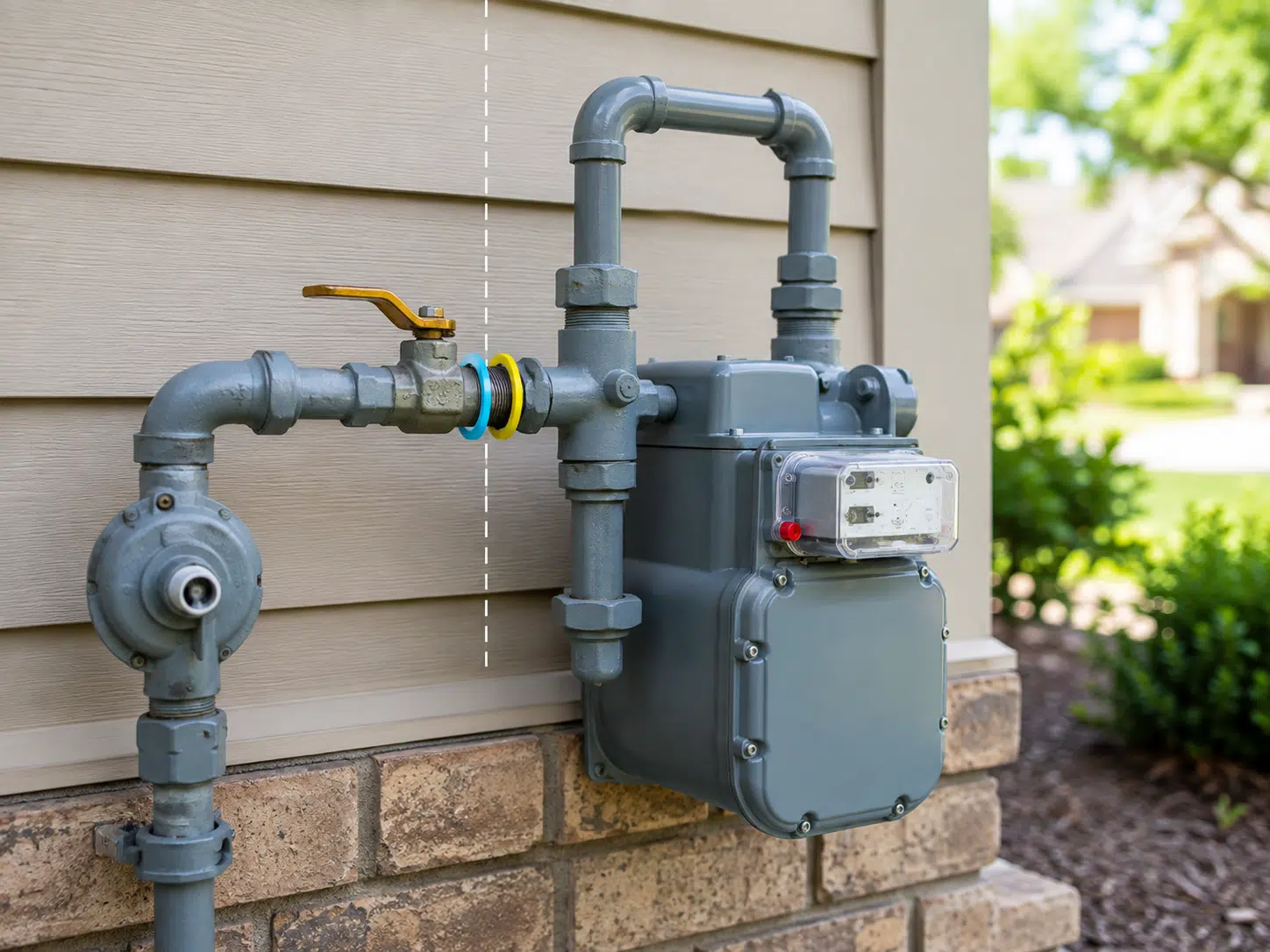 Once gas crosses the meter, it enters the building’s own fuel piping. Black iron, corrugated stainless steel tubing, and older galvanized runs all appear in Maryville homes depending on when the house was built and when it was last altered. Repairs, extensions, reroutes, and appliance hookups on this side of the meter fall to the property owner and to whoever the owner hires.
The flexible connector behind a range or dryer and the shutoff valve serving it are owner-side components. Older uncoated brass connectors have been the subject of manufacturer and safety-agency attention for decades, and connectors are generally treated as single-use parts that are replaced rather than reused when an appliance is moved.
A line running out to an outdoor kitchen, a pool heater, a fire pit, or a standby generator is a private line. The utility does not locate it, maintain it, or repair it. Blount County soil movement, landscaping projects, and fence post installation all put those runs at risk, and a homeowner who is unsure whether a yard line exists should treat the yard as though one does.
Households weighing a new appliance run rather than a repair can compare the two paths on the guide to adding a gas line for an outdoor kitchen in Maryville, which covers the same permitting questions from the installation side.
Permit rules follow the address, not the mailing city. Property inside Maryville city limits falls under the City of Maryville Building Official, who enforces the codes the city has adopted. Property in unincorporated Blount County falls under the county’s Development Services department. Requirements vary by scope, and the applicable codes office is the reliable source for a specific job.
Maryville’s plumbing code amendments place enforcement with the Building Official, and the city’s own guidance for residential construction lists separate underground, rough-in, and final plumbing inspections. The Codes office sits in the Municipal Building at 400 West Broadway. The city publishes 865-273-3500 for permit information and 865-273-3510 for the Building Official.
This is a detail that trips up guidance written for other Tennessee cities. In its local amendments to the building code, Maryville deletes every reference to the International Fuel Gas Code and states plainly that “The International Fuel Gas Code is specifically not adopted in the City of Maryville.” Any statement that gas work in Maryville is governed by the IFGC does not match the city’s own adopting ordinance. Which provisions do apply to a given project is a question for the Building Official, and it is worth asking before work is scoped rather than after.
A Maryville mailing address does not put a property inside Maryville. Blount County Development Services handles construction permits for unincorporated territory from 1221 McArthur Road, and publishes 865-681-9301. Households that are unsure which jurisdiction they sit in should confirm before assuming that city rules apply.
Tennessee’s Limited Licensed Plumber credential covers plumbing projects under $25,000 per project, with general maintenance work under $500 exempt, and the state notes that it is “only required by plumbers performing work in a municipality utilizing the Division of Fire Prevention for permits or inspections.” Maryville runs its own permits and inspections, and the city’s residential construction handout states that “Any person, firm, or corporation engaged in contracting, in the City of Maryville, shall be required to submit evidence that such person, firm or corporation is qualified to engage in contracting and shall be licensed.” The practical step is to confirm the credential requirement with the city for the specific job.
Tennessee law requires advance notice before excavation. Under the Underground Utility Damage Prevention Act, anyone planning to dig must contact Tennessee 811 at least three full business days ahead so member utilities can mark their buried facilities. The service costs nothing. Striking a gas line turns a fence project into an emergency in seconds.
The notice covers hand digging, grading, augering, boring, and demolition, not just heavy equipment work. Member utilities or their contract locators mark their lines during that window. Homeowners planting trees, setting posts, or trenching for low-voltage yard lighting fall under the same rule as contractors.
Locating marks the utility’s own facilities. It establishes where the buried service line runs, which is the piece of information most likely to prevent a serious strike. Marks are approximate rather than surveyed, and careful hand digging near a mark is the standard practice.
The buried run from the meter out to a detached garage, pool heater, generator, or outdoor kitchen is private property, and it typically falls outside the free locate. Properties with known private lines often need a private locate arranged separately. This gap causes more surprises in Blount County yards than the main service line does.
The projects that damage gas lines are rarely plumbing projects. Fence post holes, mailbox posts, retaining walls, deck footings, tree removal, and driveway widening account for a large share of yard strikes. Anyone hiring a landscaper or fence company should confirm that the 811 ticket was placed and that the marks are still valid, since tickets expire.
Four points carry most of the weight here. An active leak goes to 911 and the gas utility before anyone else. The meter is the usual dividing line between utility equipment and homeowner piping. Permit and code questions belong to the City of Maryville Building Official or to Blount County Development Services, depending on the address. And any dig, however small, starts with a Tennessee 811 ticket three business days out.
Tennessee Standard Plumbing offers gas line repair, gas line installation, gas line replacement, and gas leak detection for homes and businesses. Once the utility has cleared a property and the hazard is resolved, we can take a look at the owner-side piping and talk through what the repair involves. Call us at (865) 352-9003 or book an appointment online.
We serve Maryville, Alcoa, Rockford, Friendsville, and communities across Blount County and East Tennessee.
Leave the building first, then call 911 and the gas utility’s emergency line from a safe distance. Atmos Energy publishes a 24-hour emergency number of 866.322.8667 and instructs customers to leave the area immediately before calling. Households on a different provider should use the emergency number on their own gas bill.
The utility generally owns and maintains the main and the service line up to the meter, and it responds to reported leaks on that equipment. Piping past the meter is usually the property owner’s responsibility. The exact dividing line is set by the utility’s own tariff and service rules, so the utility is the reliable source for a specific address.
It depends on the scope of the work and on whether the address sits inside Maryville city limits or in unincorporated Blount County. The City of Maryville enforces its adopted codes through the Building Official, reachable at 865-273-3510, and Blount County Development Services handles unincorporated territory at 865-681-9301. Confirm with the applicable office before work begins.
No. Maryville’s local amendments to the building code delete every reference to the International Fuel Gas Code and state that it “is specifically not adopted in the City of Maryville.” Guidance written for other Tennessee cities often cites the IFGC, which does not match Maryville’s adopting ordinance. The Building Official is the correct source for which provisions apply to a given project.
At least three full business days. The Tennessee Underground Utility Damage Prevention Act requires anyone planning excavation to notify Tennessee 811 so member utilities can mark buried facilities. The notice covers hand digging, augering, boring, grading, and demolition, and there is no charge for the markings.
Usually not. The free locate covers utility-owned facilities, and a buried line running from the meter to a grill, pool heater, generator, or detached garage is normally private property. Owners who know a private line exists often arrange a separate private locate before digging.
The City of Maryville’s residential construction guidance states that anyone engaged in contracting in the city must submit evidence of qualification and be licensed. Tennessee’s Limited Licensed Plumber credential covers plumbing projects under $25,000, but the state notes it is required in municipalities that use the Division of Fire Prevention for permits or inspections, and Maryville runs its own. Confirm the requirement with the city for the specific job.
Natural gas is odorized so it can be detected by a person with a normal sense of smell, and the added scent is often described as sulfur or rotten eggs. Atmos Energy advises against relying on smell alone and points to sound and sight as well, including hissing near a line, blowing dirt, bubbling in standing water, and dead vegetation in an otherwise healthy area.
The utility’s published instruction for a suspected leak is to leave the area and call from a safe distance, not to stay and operate equipment. Restoring service after a meter shutoff generally requires the utility to relight appliances and check the system. Anyone considering shutting off gas at the meter for a non-emergency reason should ask the utility what its procedure is first.
A Maryville mailing address does not settle it, because postal boundaries and city limits differ. The City of Maryville permit office at 865-273-3500 and Blount County Development Services at 865-681-9301 can both confirm which jurisdiction an address falls in. This determines the permit authority, the inspection process, and in some cases the applicable requirements.
Same-day Service Available
Mon – Fri: 7:30 am – 5:00 pm