
Same-Day Service Available
00
Hrs
00
Mins
00
Secs
Need a Plumber in Knoxville? We’re Ready to Help!
Same-Day Service Available
Need a Plumber in Knoxville? We’re Ready to Help!
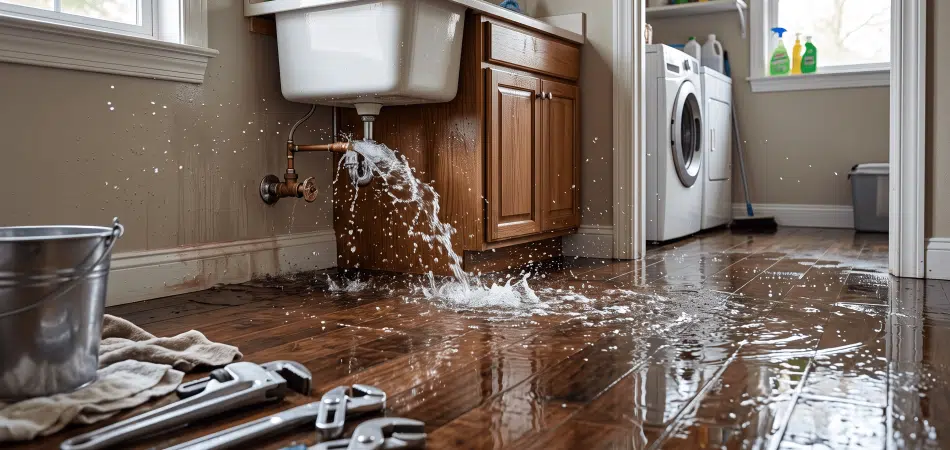
Plumbing emergencies do not arrive with instructions. Water is moving where it should not be, the household is trying to decide whether this is a call-someone problem or a wait-until-morning problem, and the clock is running on the damage. The good news is that the first few minutes follow the same pattern for almost every scenario, and knowing that pattern in advance is worth more than knowing any single repair.
Tennessee Standard Plumbing works across Maryville, Alcoa, Rockford, and Blount County, and our team handles burst pipes, sewer backups, water heater failures, and leak detection. This page covers what to do in the moment, which number to call for which problem, and what the City of Maryville handles versus what falls to the property owner.
One note before the list. This page is general guidance for a household deciding what to do next. It is not a substitute for calling 911 when there is a fire, gas, or electrical hazard, and it does not replace the instructions published by the serving utility.
Check for hazards first, then stop the water, then protect the property. Gas, fire, electricity, and water near live circuits outrank the plumbing problem. Once the scene is safe, closing the main is the move that limits damage, and it comes before any attempt to save belongings from water that is still running.
A plumbing failure can arrive with a second hazard attached, and that hazard sets the response. A gas odor means leaving the building and calling from a safe distance rather than looking for a shutoff. Water reaching outlets, an appliance, or the panel is an electrical hazard. Where either is present, the water can wait.
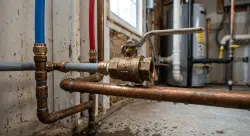 The main shutoff is the single most useful thing to know about a house. In most Blount County homes it sits where the service line enters the building, often in a crawl space, a utility closet, a garage, or near the water heater. There is also a valve at the meter. The City of Maryville states that during normal business hours a call to 273-3300 will bring city personnel out to shut off water, and notes that after normal business hours there is a fee for that service.
Water reaching outlets, a panel, or an appliance turns a plumbing problem into an electrical one. If the breaker panel can be reached safely and without standing in water, cutting power to the affected circuits removes that hazard. If reaching the panel means walking through standing water, that is a call to an electrician or the fire department rather than a task to attempt.
Once the water is off, containment is about limiting how far the damage spreads. Towels at doorways, buckets under an active drip, and moving rugs and furniture off wet flooring all buy time. Ceilings that are bulging with trapped water are a hazard rather than a cleanup task, and are best left to the responding professional.
Photographs and short videos taken before anything is moved cost a minute and can matter later. Insurance coverage depends on the policy, the cause of the failure, and any endorsements the policyholder carries, so the record of what happened and what was affected is worth having regardless of how the claim eventually goes.
The right number depends on which side of the meter the problem sits and whether there is a safety hazard. Gas goes to 911 and the utility. City-owned water and sewer equipment goes to the City of Maryville. Everything past the meter and inside the building is the property owner’s, which is where a plumber comes in.
The city publishes 273-3300 for water shutoffs during business hours and 865-982-7990 for the water plant after hours. On the ownership split, the city states that it “repairs meter leaks and lines on the supply from meter to street side of the water meter” and directs customers to call their own plumber for problems on the customer’s line.
A gas odor is not a plumbing call. Atmos Energy, the natural gas provider for much of the Maryville area, instructs customers to leave the area immediately and then call 911 and the company’s 24-hour emergency number at 866.322.8667 from a safe distance. Households served by a different provider should use the emergency number printed on their own gas bill.
Supply piping inside the building, fixtures, the water heater, and the building sewer running from the house toward the main are the property owner’s responsibility in most residential arrangements. Anyone unsure which side a problem falls on can start with the utility, since the utility can often determine that quickly and at no cost. More detail on leak location is covered under water leak detection.
Notifying the insurer is a step for after the water is off and the property is safe, not before. Whether a specific loss is covered depends on the policy terms, the cause of the failure, exclusions, and any endorsements. The insurer or the agent is the only reliable source for what a particular policy covers, and a certificate or summary is not the policy itself. Households comparing local providers can start from Knoxville plumbers once the immediate hazard is handled.
Different emergencies call for different first moves after the water is off. A sewer backup and a burst supply line look similar from the hallway and are handled very differently. Knowing which one is happening changes both the immediate response and which number gets dialed first.
The first move is to stop adding water, since every flush and every load of laundry adds to what has nowhere to go. Contact with sewage is a health matter and cleanup is not an ordinary mopping job. On cost, the City of Maryville states that if a sewer stop is on the customer’s service line, meaning the section from the connection at the main to the house, there will be a service charge of $70.00.
A tank that is leaking from the body is generally at the end of its life rather than repairable, while water coming from the temperature and pressure relief line points to a pressure or temperature condition that needs investigation. Closing the cold supply valve on top of the heater stops the refill. Gas or electrical supply to the unit is handled according to the manufacturer’s instructions.
Closing the stop valve behind the bowl is faster than anything else and stops the immediate overflow. An overflow limited to one toilet is usually a fixture clog. An overflow accompanied by gurgling in a tub or a floor drain, or by slow drainage elsewhere in the house, points further down the line toward the building sewer and is a different problem.
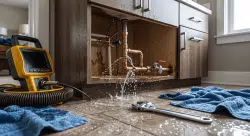 A burst pipe is the scenario most Blount County households picture first, and it is covered in detail in the guide on what to do about a burst pipe in Maryville. A total loss of water is the opposite problem and often has a simple explanation. Checking whether the outage is area-wide, whether the main valve was left partly closed, and whether a frozen section is involved narrows it quickly.
Most emergency calls trace back to something that could have been found earlier or handled faster. Knowing where the shutoffs are, testing that they actually work, watching for the warning signs a system gives before it fails, and preparing for the seasonal risks specific to East Tennessee cover most of the ground.
Hunting for a main shutoff in the dark with water running is a bad time to learn the house. Locating the main, the meter valve, the water heater supply valve, and the stops at every toilet and sink takes one afternoon. Households often photograph each one and keep the photos somewhere everyone can reach them.
A valve that has not moved in fifteen years may not close when it is finally needed. Operating the main occasionally keeps it from seizing, though a valve that is already stiff or weeping is better replaced under calm conditions than forced during an emergency. Older gate valves in particular tend to fail in the open position.
Freezing weather drives a share of East Tennessee emergency calls, and the exposures are predictable: hose bibbs, crawl space runs, garage walls, and lines in unheated spaces. Preparing those points ahead of a cold snap is far cheaper than repairing them afterward. Frozen pipe repair is a recurring winter category rather than a rare event.
Systems tend to signal before they fail. A water bill that climbs without a change in habits, a drain that has needed clearing more than once, a toilet that runs intermittently, and rust-colored staining at a fitting are all worth investigating while they are inexpensive. Repeated drain clearing on the same line in particular is a reason to look at the line itself rather than to keep clearing it.
Four points are worth committing to memory. Hazards come first, so a gas odor goes to 911 and the utility before anyone touches a valve, and water near live circuits is an electrical problem before it is a plumbing one. Once the scene is safe, stop the water, which means knowing where the main shutoff is before an emergency makes it urgent. The City of Maryville handles the meter and the line to the street side of it, and publishes 273-3300 during business hours and 865-982-7990 for the water plant after hours. Everything past the meter is the property owner’s.
Tennessee Standard Plumbing handles burst pipe repair, leak detection, sewer line repair, water heater work, and drain clearing across Maryville, Alcoa, Rockford, and Blount County. If a household has stopped the water and needs someone to look at what failed, we can take it from there. Call us at (865) 352-9003 or schedule your service online.
We serve Maryville, Alcoa, Rockford, Friendsville, and communities across Blount County and East Tennessee.
Rule out hazards first, then shut off the water, then protect property. A gas odor means leaving the building and calling from a safe distance, and water near outlets or the electrical panel is an electrical hazard before it is a plumbing one. Once the scene is safe, the main shutoff is usually where the service line enters the building, often in a crawl space, utility closet, garage, or near the water heater.
Yes. The city states that during normal business hours a call to 273-3300 will bring city personnel out to shut off the water, and it notes that after normal business hours there is a fee for that service. The city advises calling early rather than waiting if a leak is suspected.
The City of Maryville directs after-hours callers to the water plant at 865-982-7990. That covers city-owned water and sewer equipment. Problems on the customer’s own side of the meter go to a plumber, and a gas odor goes to 911 and the gas utility before anyone else.
It depends on where the stop is. The City of Maryville states that if the sewer stop is on the customer’s service line, meaning the section running from the connection at the main to the house, there will be a service charge of $70.00. Charges can change, so confirm the current amount with the city.
Treat it as one. Sewage entering living space is a health matter, and continuing to run water adds to what has nowhere to go, so the first step is to stop using water in the house. Cleanup involving sewage is not an ordinary mopping job and is usually handled by a remediation professional.
Do not walk into standing water to reach a panel. If the panel can be reached safely and on dry footing, cutting power to the affected circuits removes the hazard. If it cannot, that is a call to 911 or an electrician before any plumbing work begins.
It depends on the policy, the cause of the failure, exclusions, and any endorsements carried. A certificate or a summary document is not the policy. The insurer or the agent is the reliable source for what a specific policy covers, and photographs taken before cleanup are worth having regardless of the outcome.
Check whether neighbors are affected, which points to a utility issue rather than a house issue. If the outage is limited to one property, common explanations include a main valve left partly closed, a frozen section in cold weather, a failed pressure regulator, or a break on the service line. The utility can usually confirm quickly whether the problem is on its side.
Closing the cold supply valve on top of the heater stops the tank from refilling, which limits how much water reaches the floor. A tank leaking from the body itself is generally at the end of its service life rather than repairable. Handle gas or electrical supply to the unit according to the manufacturer’s instructions.
Locate and photograph the main shutoff, the meter valve, the water heater supply valve, and the stops at each fixture, and keep the photos where everyone can reach them. Operating the main occasionally keeps it from seizing. Preparing the freeze-prone points, including hose bibbs and crawl space runs, ahead of cold weather addresses a large share of winter calls.
Same-day Service Available
Mon – Fri: 7:30 am – 5:00 pm