
Same-Day Service Available
00
Hrs
00
Mins
00
Secs
Need a Plumber in Knoxville? We’re Ready to Help!
Same-Day Service Available
Need a Plumber in Knoxville? We’re Ready to Help!
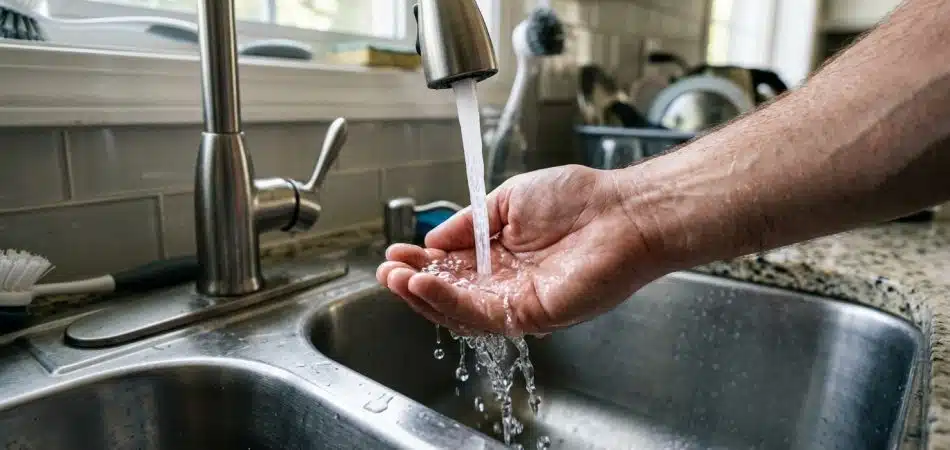
Homeowners across Maryville often notice small clues that make them pause and wonder about their water. Maybe it shows up as a chalky film on the shower door, spots that will not rinse off the glassware, or towels that feel stiffer than they should after washing. These everyday observations lead to the same common question. Is the water in Maryville hard or soft? The honest answer depends on a handful of factors, and it is not always the same from one house to the next, even within the same neighborhood.
At Tennessee Standard Plumbing, our team fields this question often from homeowners across the greater Knoxville area, including through our Maryville plumbing page. Rather than guess based on a single symptom, it helps to understand what hard and soft water actually mean, what general signs tend to show up around a home, and why hardness can vary so widely from one water source to another.
Water hardness is simply a way of describing how many dissolved minerals, mainly calcium and magnesium, are present as water moves through the ground and into a home. Water is not inherently good or bad because of this. It is a natural characteristic that comes from the path the water took before it reached the tap, and it shows up differently depending on where a home gets its water.
Hard water carries a higher amount of dissolved minerals. As it passes through soil and rock on its way into a water supply, it picks up trace amounts of calcium, magnesium, and other minerals along the way. Those minerals do not make water unsafe to use, but they can change how the water feels and how it interacts with soap, appliances, and fixtures over time.
Soft water, by contrast, carries a much lower mineral content. It tends to feel different against skin, often described as smoother or slicker, and it generally allows soap and shampoo to lather more easily. Naturally soft water is more common in areas where the ground contains fewer mineral deposits, or where water comes from a source that has not passed through mineral-rich rock.
Because water hardness is not something you can see directly from the tap, homeowners usually rely on general signs around the house to form an impression. None of these signs offer a definitive answer on their own, but taken together they can point toward a pattern worth looking into further.
Again, these are general observations rather than a formal diagnosis. Plenty of homes show a mix of signs, or signs that seem to shift depending on the season or the specific fixture being used.
Water hardness is shaped largely by geology and water source, and both can vary within a fairly small area. Much of the broader East Tennessee region sits on limestone and other mineral-rich rock formations, which can influence groundwater and well water as it filters through the earth. That said, this is a general regional pattern rather than a rule that applies evenly to every property.
Homes on a private well often experience different water characteristics than homes connected to a municipal water system, simply because the water is following a different path before it reaches the house. Even among homes on the same general water system, hardness can shift depending on the specific source feeding a neighborhood, the time of year, and changes in the surrounding watershed. This is exactly why it is difficult to make a blanket statement about any single town, Maryville included. The most accurate picture comes from looking at an individual property rather than the area as a whole.
Not at all. Hardness is about mineral content, not safety. Water that leans hard is still generally considered fine for everyday use and drinking. The minerals responsible for hardness are naturally occurring, and hardness alone does not indicate a problem with water quality or cleanliness. The concerns homeowners raise about hard water usually relate to comfort and the long-term appearance of fixtures rather than health.
Yes, and this happens more often than people expect. Homes on the same street can draw water from different points in a system, sit at different elevations, or have plumbing of different ages, all of which can influence how hardness is experienced. A well on one property can also produce noticeably different water than a well only a short distance away, since underground mineral deposits are not evenly distributed. This is part of why general regional information only goes so far, and why looking at an individual home tells a more complete story.
General signs around the house can hint at hardness, but the only reliable way to know is to have the water tested. A straightforward water test looks at the actual supply coming into your specific home and removes the guesswork. This is especially helpful for homes on a private well or for anyone who has recently noticed a change in how their water feels or behaves.
It varies from home to home. Much of East Tennessee sits on limestone and other mineral-rich rock, which can push groundwater and well water toward the harder end, but this is a general regional pattern rather than a rule for every property. Because the specific source, the neighborhood, and whether a home is on a well or city water all play a role, the most accurate answer comes from testing an individual home.
Neither is inherently better. Hard water is generally safe for everyday use and drinking, while soft water tends to feel smoother and lets soap lather more easily. Which one a household prefers often comes down to comfort and how the water interacts with fixtures and appliances, rather than a question of safety.
Whether water leans hard or soft is not a matter of safety on its own, but it can shape everyday comfort and the way a home ages over time. Homeowners with harder water sometimes notice more frequent cleaning around fixtures or a preference for adjusting how much soap they use. Homeowners with softer water sometimes notice the opposite, along with a different feel to their skin and hair after bathing. Over the long run, mineral content can also play a role in how appliances and plumbing fixtures perform, which is one reason some homeowners look into whether a water softener makes sense for their home.
General signs are a helpful starting point, but they are observational by nature and can overlap between hard and soft water conditions. The only way to know with confidence what a specific Maryville home is dealing with is to have the water looked at directly rather than relying on guesswork. A straightforward water test removes the uncertainty and gives homeowners a clear, personalized picture instead of a generalized regional guess.
This is particularly useful for homeowners who are new to a property, who rely on a private well, or who have simply noticed a change in how their water feels or behaves. A professional evaluation looks at the actual water coming into that specific home, rather than drawing conclusions from what neighbors or nearby towns experience.
If you are curious about your own home’s water and want an answer based on your actual property rather than a general assumption, the team at Tennessee Standard Plumbing is glad to help. Homeowners throughout Maryville can reach out by phone at (865) 352-9003 or schedule an appointment online at a time that works for their household. Our team is part of the local community and understands how much water quality can vary from one neighborhood to the next.
If a test shows your home leans hard, we can walk you through practical next steps, including water treatment options suited to your supply. Understanding whether your home leans toward hard or soft water starts with a conversation and a proper look at your specific water supply. Reach out whenever it is convenient, and let a real evaluation replace the guesswork.
Same-day Service Available
Mon – Fri: 7:30 am – 5:00 pm