
Water Line Boring vs. Open Trench for Knoxville Commercial Properties
Key Takeaways Directional boring and open trenching both install the same pipe. What separates them is how much of the surface above the r... Read More

Same-Day Service Available
Need a Plumber in Knoxville? We’re Ready to Help!




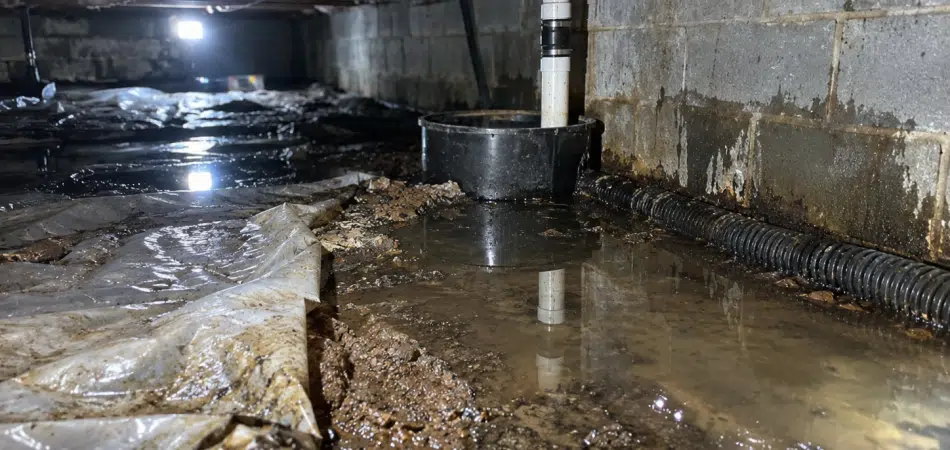
Homes sitting close to the Little River corridor generally have a shallower water table than homes on higher ground a mile away. When rainfall recharges that water table faster than the soil can drain, water finds the lowest opening it can reach, which is often a crawl space or a basement wall joint. USGS describes East Tennessee groundwater as moving through fractured carbonate rock with widespread karst development, meaning water travels through openings in the rock rather than seeping evenly. That geology explains why two houses on the same street can behave very differently in the same storm.
Two houses in Alcoa can sit half a mile apart and have entirely different relationships with heavy rain. One goes through a wet November without anyone thinking about it. The other has a damp corner in the crawl space by the second week and a sump pump that runs more than the owner would like, which is often what sends somebody looking for Knoxville area plumbing services.
Same weather. Same builder, sometimes. Different ground.
What separates them is generally not the house at all, and understanding that changes what is worth spending money on. Equipment for the wetter case is covered under sump pump installation and repair.
The water table is the top of the saturated zone underground, and USGS describes it as the upper surface of the water-filled area beneath the land. Near a river, that surface generally sits closer to grade than it does on a hillside. A shallower starting point means less rainfall is needed to bring saturation up to a foundation.
USGS explains that precipitation adds water to an aquifer through recharge, and that water table levels change naturally with weather cycles and precipitation patterns. In practice, that means the same house can be dry in a normal October and wet in a saturated one, with no change to the building at all. The rock and soil around it simply hold more water than they did.
Rivers and the groundwater beside them exchange water in both directions depending on conditions. USGS operates streamgages on the Little River near Alcoa, near Maryville, and at Townsend, and rising river stages during a wet stretch usually accompany rising groundwater in the corridor. Homeowners watching only the river surface miss half the story, because the part affecting a crawl space is underground.
A few feet of elevation between two lots changes the margin between a saturated water table and a crawl space floor. That is why neighbors report opposite experiences of the same storm, and both are telling the truth. The relevant number is not distance from the river; it is height above the seasonal high water table, and that is not visible from the driveway.
Nothing published counts groundwater intrusion events by neighborhood in Blount County. The mechanism described here is well established. The rate is not measured, and any article claiming a percentage of Alcoa or Rockford homes affected is inventing it.
East Tennessee sits on fractured carbonate rock with widespread karst development. USGS defines karst terrain as created from the dissolution of soluble rocks, principally limestone and dolomite, producing springs, caves and sinkholes. Water in that setting moves through openings rather than percolating evenly through soil.
USGS describes karst systems as interconnected networks of fissures, fractures, and conduits inside low-permeability rock, where most of the groundwater flow and transport happens through the network of openings while most of the storage happens in the matrix. The practical translation is speed. Water can arrive somewhere quickly through a conduit rather than slowly through soil, which is why intrusion can start hours after a storm rather than days.
Springs, sinkholes, and caves are the visible evidence of direct connection between what happens on the ground and what happens below it. USGS notes karst aquifers are highly productive and also extremely vulnerable to contamination for the same reason. For a homeowner, the same connectivity means a saturated field two hundred yards uphill can deliver water to a foundation without any visible surface flow.
Uniform soil lets a French drain intercept water predictably. Karst does not behave that way. A drain that solves one property can miss the path feeding the next one, which is why local drainage work is more empirical than a catalog suggests. This is covered further in this look at how local soil conditions affect underground plumbing.
USGS reports that roughly 40 percent of drinking water in the United States comes from karst aquifers and about 20 percent of the country’s land area is karst terrain. East Tennessee is squarely inside that picture, and the USGS karst aquifers program publishes the underlying material.
Groundwater does not force its way through sound concrete. It arrives through the openings that already exist: crawl space vents at grade, gaps at the sill, cold joints in a foundation wall, penetrations for pipes, and the space around a footing where backfill settled. Finding the entry point matters more than measuring the volume.
Most homes in this part of Blount County sit on crawl spaces rather than full basements, and a crawl space floor is often close to the seasonal water table. Standing water there raises humidity through the whole house, and the moisture consequences arrive long before anyone notices the water itself. Vapor barriers, grading, and vent condition all belong in the conversation.
Saturated soil pushes against foundation walls. Where a cold joint exists between footing and wall, that pressure finds the seam. Seepage along the base of a wall in a consistent line, rather than a single spot, generally points to this rather than a plumbing leak.
Timing is the cleanest test. Water that appears within a day of heavy rain and dries out during a dry spell is groundwater. Water that persists through dry weather, or that shows up with no rain at all, points to a supply line, a drain line, or a failed fixture. Chasing the wrong one wastes a season, and homeowners across Alcoa and nearby Blount County communities often need both possibilities ruled out.
Clear water with silt after a storm is consistent with groundwater. Water carrying sewage odor points to a drain problem and calls for a different response. Clean water appearing on a dry week points at supply piping. None of these is conclusive alone, but together they narrow the field before anyone starts excavating.
Water management works from the outside in. Roof drainage, grading, and surface flow get corrected before any pump is considered, because a pump handling water that should have been diverted runs constantly and fails early. The cheapest fixes sit furthest from the house.
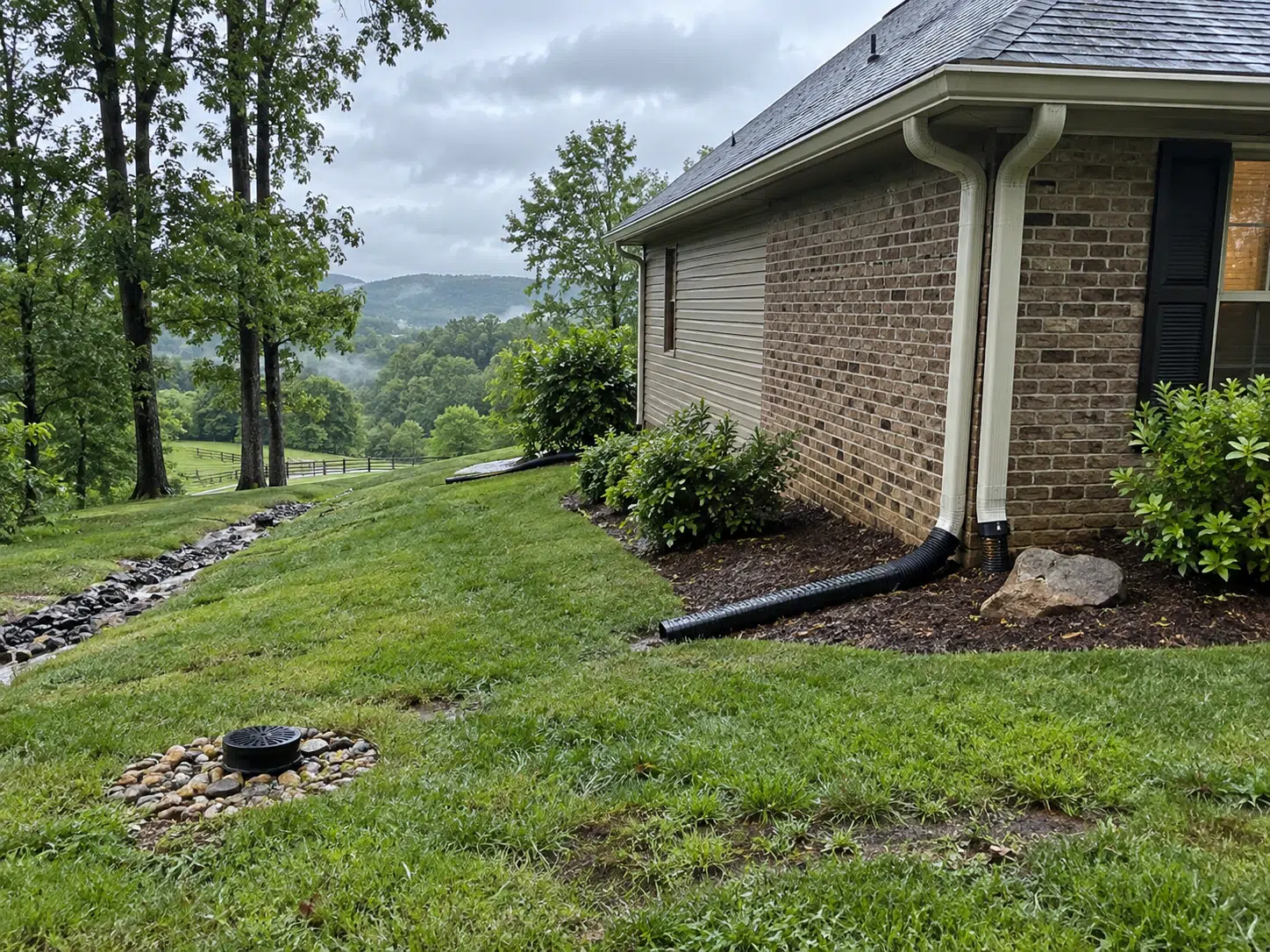 A roof concentrates a large volume of rainfall into a few discharge points. Downspouts emptying within a few feet of a foundation put that volume directly into the soil that is already saturated. Extending discharge well away from the building, and keeping gutters clear through leaf season, resolves a meaningful share of crawl space complaints at low cost.
Ground should fall away from a foundation rather than toward it. Settlement over the years reverses that slope quietly, particularly along walls where backfill was placed. Walking a property during an actual downpour, rather than on a dry day, shows where surface water is heading in a way no drawing does.
Where the water table genuinely rises above the crawl space floor, exterior work alone will not hold it. A perimeter drain feeding a sump basin, with a pump discharging well away from the structure, is the standard response. Sizing depends on how much water arrives and how fast, which is a site-specific judgment rather than a catalog choice. A backup power arrangement matters because the wettest storms are also the ones that take out power.
Drainage improvements manage water. They do not repair a failing drain line, a leaking supply line, or a foundation problem, and treating them as a cure for those is how households end up doing the same work twice. Ruling out plumbing causes before investing in drainage is the sequence that saves money, and details on how the water table itself behaves are published through the USGS aquifers and groundwater material.
Our team at Tennessee Standard Plumbing has served Alcoa, Rockford, Maryville, and the surrounding East Tennessee communities for more than 13 years on drainage, sump pumps, leak detection, and water lines. The company reports a 5.0 Google rating across more than 1,000 reviews, HomeAdvisor Elite Service recognition, and a team of more than 50 technicians.
Four things are worth holding onto. Homes near the Little River corridor generally sit above a shallower water table. Karst geology moves water through openings quickly rather than evenly through soil. No published dataset counts intrusion by neighborhood, so the mechanism is the useful part. And roof drainage, grading, and downspout discharge get corrected before any pump gets sized.
Homeowners tired of a wet crawl space every wet season can reach our team at (865) 352-9003 or contact our team online. We serve Alcoa, Rockford, Maryville, Knoxville, and communities across Blount County, Knox County, and East Tennessee. Peaceful Pipes, Peaceful Life.
A few feet of elevation, a different backfill history, and a different path through the rock underneath can produce opposite results in the same storm. The number that matters is height above the seasonal high water table rather than distance from the river, and that is not visible from the street.
Sometimes, and that is worth ruling out first. Water that appears within a day of heavy rain and dries during a dry spell behaves like groundwater. Water that persists through dry weather or shows up with no rain points toward a supply line, a drain line or a fixture, and that is a different repair entirely.
USGS defines karst as terrain created by the dissolution of soluble rock, principally limestone and dolomite, producing springs, caves and sinkholes. Water moves through openings in that rock rather than percolating evenly through soil, so it can arrive at a foundation quickly and from an unexpected direction.
Not as the first move. Roof drainage, downspout discharge distance, and grading are cheaper to correct and resolve a meaningful share of complaints. A pump handling water that should have been diverted runs far more than the situation calls for. Where the water table genuinely rises above the floor, a pump belongs in the plan.
No public dataset counts groundwater intrusion by neighborhood in Blount County. Any specific percentage quoted for Alcoa or Rockford is not coming from a measured source. What can be described honestly is the mechanism and the conditions that make a property more exposed.
It raises humidity throughout the structure, and the moisture consequences usually appear before anyone notices the water. Vapor barrier condition, vent arrangement, and grading all belong in the assessment alongside any pump discussion.
A consistent line at the base of a foundation wall generally points to the cold joint between footing and wall, where saturated soil pressure finds the seam. A single wet spot in the middle of a wall is a different pattern and deserves a separate look.
It depends on whether the address sits inside a city limit or in unincorporated county territory. Alcoa and Maryville administer their own codes and inspections, and unincorporated property goes through Blount County. Knox County requirements do not apply to a Blount County address, so asking the office that actually governs is the reliable step.
It can, and it can also miss. In uniform soil, an intercepting drain works predictably. In karst, water can travel through a conduit that the drain does not cross, which is why local drainage work depends on observing where water actually arrives rather than on a standard layout.
Water table levels change with weather cycles and precipitation patterns, as USGS describes, so a wetter run of seasons can expose a margin that had been thin all along. Settlement that reversed the grade along a wall, a downspout that came loose, or nearby development changing surface drainage can all shift the picture without anything failing inside the house.


Key Takeaways Directional boring and open trenching both install the same pipe. What separates them is how much of the surface above the r... Read More

KUB administers grease control requirements for Knoxville food service facilities through its Fats, Oils, and Grease program. KUB determines the ty... Read More

Corrosion inside plumbing systems is an electrochemical process that occurs when metal pipes react with elements in the water or the surrounding en... Read More