
5 Reasons Why Water Leaking From the Base of the Toilet When Flushed
A leaking toilet often stems from worn components such as a damaged flush valve, deteriorated flapper, faulty wax ring, cracks in the bowl or tank,... Read More
Same-Day Service Available
Need a Plumber in Knoxville? We’re Ready to Help!




Last Updated: October 29, 2026
Key Takeaways
Maryville’s adopted residential code calls for pipe in crawl spaces to be protected from freezing by insulation or heat or both, because the city’s local climate table lists a winter design temperature of 19 degrees. The code states the outcome rather than a specific product or thickness. Vented crawl spaces leave pipes in air that follows outdoor conditions, while unvented, insulated crawl spaces can help protect pipes from freezing, according to Department of Energy research guidance. The condition of any particular crawl space is best judged by looking at it rather than by the age of the house.
The crawl space hatch in an older Maryville house tends to live somewhere inconvenient. A panel low on the back foundation wall, a square cut in a closet floor, a door behind the heat pump. It sticks a little, and when it comes open the air underneath smells of damp earth and old wood.
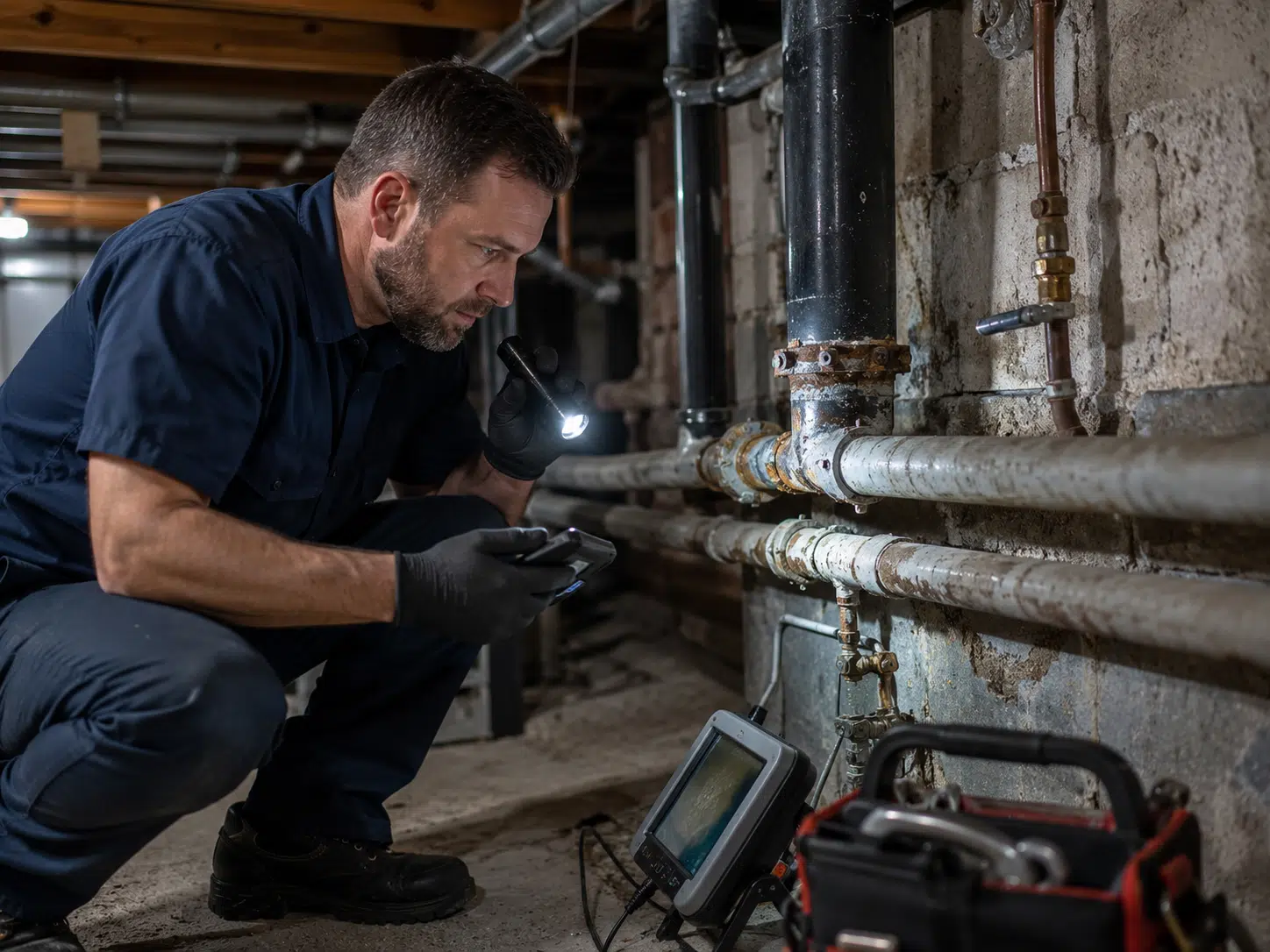
A flashlight does the rest. Floor joists overhead, a vapor barrier or bare red clay underfoot, and running between them the supply lines, copper or plastic, some wrapped in gray foam sleeves and some not. Near the vents, a sleeve has slipped down to the bend. Further back, one has come off entirely and lies on the ground.
That view is where the question of standards becomes practical. What does the code actually ask for down there, and how would anyone know whether this crawl space meets it?
On This Page
Maryville’s adopted residential code calls for water, soil and waste pipe in crawl spaces to be protected from freezing by insulation or heat or both. The city adopted the 2024 International Residential Code effective January 1, 2026, and its local climate table sets a winter design temperature of 19 degrees, which triggers that provision.
Section P2603.5, headed Freezing, reads: "In localities having a winter design temperature of 32°F (0°C) or lower as shown in Table R301.2 of this code, a water, soil or waste pipe shall not be installed outside of a building, in exterior walls, in attics or crawl spaces, or in any other place subjected to freezing temperature unless adequate provision is made to protect it from freezing by insulation or heat or both." Crawl spaces are named in the text itself.
The provision turns on the winter design temperature listed in Table R301.2. Maryville’s municipal code fills in that local table and inserts "19 degrees Fahrenheit" for winter design temperature, along with a frost line depth of 12 inches. Since 19 degrees sits below the 32 degree trigger, the freezing section applies to pipe installed in Maryville crawl spaces.
Inside city limits, the City of Maryville Codes office in the Development Services Department handles permits and inspections, at 416 W. Broadway Avenue, (865) 273-3500. Addresses in unincorporated Blount County go to Blount County Development Services instead. At the state level, the Tennessee State Fire Marshal’s Office lists the 2018 residential code with amendments, so the edition in force can differ by address.
The freezing section names an outcome: adequate protection by insulation, heat or both. It does not name a product, a sleeve thickness or a brand in that text. Whether a particular installation counts as adequate is a judgment for the building official at the office that inspects work at that address, which is why a homeowner question about a specific crawl space is best taken there.
The residential code allows two main approaches to the space under a house. A vented crawl space uses foundation openings to move outside air through it. An unvented crawl space closes those openings and covers exposed earth with a continuous vapor retarder, plus a listed means of conditioning or drying the air.
Section R408.1 in the 2024 code states that the under-floor space shall comply with either Section R408.2 or Section R408.3. R408.2 covers ventilation openings through the foundation, and it permits operational louvers. R408.3 covers the unvented crawl space, which starts with a continuous Class I vapor retarder over exposed earth and then adds one of several listed options for the air in the space.
In a vented crawl space, supply lines sit in air that is exchanged with the outdoors by design. That arrangement serves moisture control, and on a cold night it also brings outside air across the piping. This is the situation the freezing provision has in mind, and it is where pipe sleeves and the continuity of their coverage matter most.
The Building America Solution Center, a Department of Energy resource, states that "insulated crawlspaces can keep floors warmer and help protect HVAC equipment and plumbing pipes from freezing temperatures in cold climates." Converting a vented crawl space involves moisture, air sealing and mechanical questions well beyond plumbing, so it is a project for the appropriate building professionals and the codes office.
Because the code permits operational louvers, some vented crawl spaces have vents that can be partly closed in cold weather. Whether closing them suits a particular house depends on how that crawl space manages moisture the rest of the year. When a crawl space line has already split, the burst pipe repair page describes that service.
Insulation, heat and air sealing do different jobs under a house. A pipe sleeve slows heat loss from the pipe. Heat cable adds heat, subject to its listing and the manufacturer’s instructions. Air sealing cuts down the cold air that moves across the piping. Many crawl spaces rely on more than one of these at once.
The American Red Cross recommends that both hot and cold water pipes in unheated areas such as crawl spaces be insulated, and it names the "pipe sleeve" as one product made for the purpose. A pipe sleeve slows heat loss rather than supplying heat, so on a long, cold night it buys time rather than holding the pipe at a set temperature. Continuous coverage at elbows, tees and valves matters as much as the straight runs.
The Red Cross also names UL-listed heat tape or heat cable as an option for exposed pipe. The U.S. Consumer Product Safety Commission’s 1996 heat tape guidance advised applying the tape directly on the pipe rather than over insulation, avoiding covering it with insulation unless the manufacturer advises it, using a GFCI-protected outlet, and inspecting tapes each year. The manufacturer’s current instructions for the specific product govern.
ENERGY STAR lists common crawl space air leaks, including around plumbing pipes and around a crawl space door that opens to the outside. Cold air moving across a pipe draws heat away faster than still air. Sealing those paths, and keeping the access door closed and fitted, supports whatever insulation is already in place. Questions about a particular house can go to the Maryville-area plumbing team or to the codes office.
| Approach | What it does | What to watch for | Source of the guidance |
|---|---|---|---|
| Pipe sleeve on supply lines | Slows heat loss from the pipe | Gaps at bends, valves and cut ends; sleeves that slipped or fell | American Red Cross; IRC P2603.5 ("insulation") |
| UL-listed heat cable | Adds heat to the pipe | Cracked or discolored covering, insulation placed against the product’s instructions, no GFCI | CPSC 1996 guidance; product instructions; IRC P2603.5 ("heat") |
| Air sealing around pipes and the access door | Reduces cold air moving across piping | Open penetrations, a crawl door that does not close fully | ENERGY STAR crawlspace sealing guidance |
| Vented crawl space with operable louvers | Allows vents to be partly closed in cold weather | Moisture management the rest of the year | IRC R408.2 |
| Unvented, insulated crawl space | Brings the space closer to indoor conditions | Vapor retarder, air sealing and a listed air option all in place | IRC R408.3; Building America Solution Center |
Each approach covers a weakness in the others. A sleeve does little against a strong draft from an open vent, and heat cable depends on power staying on. Air sealing alone leaves a bare pipe in cold still air. That is one reason the code language offers insulation or heat or both, rather than naming a single answer.
An older Maryville home can have well-protected crawl space piping or none at all, and the build year alone rarely tells which. Repairs, additions, earlier owners and past freeze events all change what is under the floor. A direct look, with a flashlight and a short list, gives a far better answer than the age of the house.
Two houses on the same Maryville street, built the same year, can look completely different underneath. One may have had its supply lines replaced and sleeved a few years ago, and the other may still carry the original runs. No conclusion about pipe material or pipe condition follows from age alone, and none is offered here.
A first look usually covers a handful of things. Whether supply lines are sleeved along their full length. Whether sleeves have gaps at elbows, tees and valves. Which runs pass closest to foundation vents or the access door. Whether any insulation is wet, crushed or hanging loose, and whether heat cable is present and in visibly good condition.
A crawl space that stays damp raises separate questions about drainage, the vapor retarder and ventilation. Wet or sagging insulation on pipes can be a sign of condensation or a slow leak nearby, and it is worth finding the source before replacing anything. Habits that help above the floor on cold nights are covered in these tips for preventing frozen pipes.
Adopted code generally governs new construction and permitted work. How it applies to an existing crawl space, a repair, or a conversion from vented to unvented is a question for the office that inspects work at that address. For Maryville addresses, that is the City of Maryville Codes office at (865) 273-3500, and requirements vary by address, so confirming before work starts is a sensible step.
Tennessee Standard Plumbing works in homes across Maryville, Alcoa, Blount County and the greater Knoxville area. A fifth-generation, family-owned Knoxville company serving the area since 2020, Tennessee Standard employs 34 licensed plumbers as of October 2026, each holding an individual state plumbing license, and is backed by thousands of 5-star reviews. Our team handles burst pipe repair, frozen pipe repair and pipe leak repair when crawl space piping gives trouble.
Homeowners with questions about piping under a Maryville house can reach us at (865) 352-9003. Scheduling online works too, through the page to schedule your service. We serve Maryville, Alcoa, Friendsville, Knoxville, and communities across Knox County and East Tennessee.
Yes, in the sense the code uses. Maryville adopted the 2024 residential code, and its local table lists a winter design temperature of 19 degrees. Under Section P2603.5, pipe in crawl spaces in such a locality is to be protected from freezing by insulation or heat or both.
None in the freezing section. Section P2603.5 calls for adequate protection by insulation or heat or both without naming a thickness or product. The building official for the address judges whether a specific installation is adequate.
Inside city limits, the City of Maryville adopted the 2024 International Residential Code, effective January 1, 2026. Addresses in unincorporated Blount County fall under Blount County Development Services, which may use a different edition. Confirming the jurisdiction for the specific address is the first step.
An unvented, insulated crawl space generally keeps pipes in milder conditions. Department of Energy guidance notes that insulated crawlspaces can help protect plumbing pipes from freezing. Both are code paths, and converting one to the other involves moisture and air questions beyond plumbing.
It depends on the house. The code permits operational louvers on vents, so partly closing them in cold weather is an option some homes use. How the crawl space handles moisture the rest of the year decides whether that suits a particular house.
Only where the product’s instructions allow it. Consumer Product Safety Commission guidance from 1996 advised against covering heat tape with insulation unless the manufacturer advises it, and against foam or vinyl insulation over a tape that could fail. The instructions for the specific product govern.
Some do and some do not. Repairs, replacements and past owners change what sits under the floor, so the build year says little about current condition. A direct look at the crawl space answers the question for a specific house.
Yes, according to the American Red Cross. Its frozen pipe guidance states that both hot and cold water pipes in unheated areas like crawl spaces should be insulated. A hot water line can sit idle and cool for long stretches, especially overnight.
The City of Maryville Codes office in the Development Services Department, at 416 W. Broadway Avenue, (865) 273-3500. Requirements vary by address and scope of work, so confirming with that office before work starts is sensible.



A leaking toilet often stems from worn components such as a damaged flush valve, deteriorated flapper, faulty wax ring, cracks in the bowl or tank,... Read More
Bathroom sink leaks often result from loose pipe connections, deteriorated seals or washers, and clogged drains that increase pressure. Simple solu... Read More
Plumbing issues frequently emerge after renovations because the process of remodeling—such as moving walls, updating fixtures, or changing floor he... Read More