
Same-Day Service Available
00
Hrs
00
Mins
00
Secs
Need a Plumber in Knoxville? We’re Ready to Help!
Same-Day Service Available
Need a Plumber in Knoxville? We’re Ready to Help!




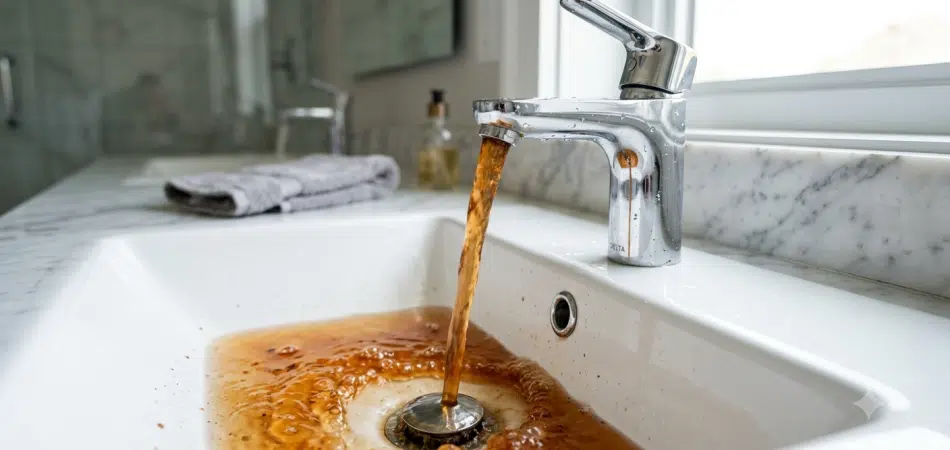
Rusty or discolored hot water in a Knoxville home is diagnosed by comparing the hot tap to the cold tap at the same fixture. When only the hot water is discolored, the source is the water heater or the hot side piping, and a depleted anode rod allowing the tank’s steel to corrode is the most frequent cause. When both hot and cold run discolored, the source is upstream: galvanized supply piping, iron or manganese in the water, or a disturbance in the distribution system. Timing matters as much as color, since a brief episode after hydrant flushing is a different problem from a daily one.
Discolored water gets treated as one problem when it is really four, and the four have almost nothing in common except the color. A homeowner who calls about rust in the shower could be looking at a fifteen-year-old tank, a section of galvanized pipe from 1954, manganese in a well, or a crew that opened a hydrant two streets over that morning. Those four cost wildly different amounts to fix, and three of them get misdiagnosed as the fourth.
Tennessee Standard Plumbing has diagnosed discolored water across Knoxville and Knox County for more than 13 years, holds a 5.0 Google rating across over 1,000 reviews, carries HomeAdvisor Elite Service recognition, and fields a team of more than 50 technicians. Our team starts every one of these calls the same way, with a test any homeowner can run in ninety seconds before the phone is even picked up.
The sections below cover that test, what it means when the water heater is at fault, what it means when the piping or the incoming water is at fault, and how to read the specific color and timing of the discoloration.
The test is simple and it splits the problem in half. Run the cold tap at a bathtub for two minutes and watch the water. Then run the hot tap at the same fixture for two minutes. Discoloration on the hot side alone isolates the fault to the water heater or the hot distribution piping. Discoloration on both sides moves the fault upstream of the heater.
Cold water arrives directly from the service line and the cold distribution piping, so it reports the condition of the incoming supply without the heater in the picture. A bathtub spout is the preferred fixture because it has no aerator screen to trap particles and no filter cartridge to mask them. Two minutes matters as well, since the first several seconds only report what was sitting in the last few feet of pipe.
Running the same test at a second and third fixture distinguishes a whole-house condition from a localized one. Discoloration confined to one bathroom generally means a branch line, a fixture supply, or a stop valve in that area. Discoloration at every fixture in the house means the heater, the main, or the supply. In two-story Knox County homes it is worth testing both floors, since a single corroded riser can affect only the fixtures it serves.
Timing separates causes as reliably as color does. Discoloration that appears on the first draw of the morning and clears after a minute suggests corrosion products settling in a pipe overnight. Discoloration that appears suddenly at midday and clears within hours suggests something happened in the distribution system. Discoloration that never clears regardless of run time suggests a source that is continuously feeding it, which is where a tank in the last stage of its life usually sits.
A tank water heater is a steel vessel with a glass lining, and the lining always develops flaws. The system that protects the steel at those flaws is a sacrificial anode rod, and it has a finite life. When it is consumed, corrosion moves to the tank wall, which is the point at which hot water starts arriving discolored.
The anode rod is a magnesium or aluminum rod threaded into the tank that corrodes preferentially so the steel does not. Once it is depleted, the exposed steel at every flaw in the glass lining begins to rust, and those particles travel out with the hot water.
Anode life depends on water chemistry and use, which is why manufacturers specify inspection intervals in their documentation rather than a single universal number. In hard water areas the rod tends to go earlier than owners expect. Households comparing repair against replacement can review water heater services in Knoxville against the age of the unit.
 Hard water leaves mineral scale on the tank bottom and on electric elements. That sediment layer traps corrosion products, insulates the bottom of the tank from the burner, and creates local hot spots that accelerate lining failure.
A tank that has never been flushed in eight years in Knoxville water can hold a substantial sediment bed, and disturbing it, by refilling after an outage for example, releases discoloration into the hot side. The connection between local water chemistry and tank life is covered in this look at how hard water shortens a water heater’s life.
The dip tube carries incoming cold water to the bottom of the tank so it heats before being drawn off the top. When a dip tube cracks or breaks, incoming water enters high in the tank and mixes straight into the outlet, which produces lukewarm water and can stir settled sediment into every hot draw.
A broken dip tube therefore shows up as two complaints at once: hot water that does not last and hot water that is not clear. It is a repair rather than a replacement on an otherwise sound tank.
Discoloration on both hot and cold sides moves the investigation upstream of the heater to three candidates: the home’s own piping, the composition of the incoming water, and events in the distribution system. Each produces a recognizable pattern, and the age of the house narrows the list quickly.
Homes built in Knoxville before the mid-1960s were frequently piped in galvanized steel, and the zinc coating that protects that steel wears through from the inside. What follows is interior rust that both restricts flow and releases particles, which is why galvanized homes often report discolored water and weak pressure together. Bearden, Fountain City, and North Knoxville hold a large share of that housing stock. Where testing confirms galvanized supply lines as the source, repiping the water lines addresses the cause rather than the symptom.
Iron and manganese occur naturally in East Tennessee groundwater and are the two minerals responsible for most color complaints on private wells. EPA’s National Secondary Drinking Water Regulations set non-enforceable aesthetic limits of 0.3 mg/L for iron, 0.05 mg/L for manganese, and 15 color units for color. These are guidance values for appearance, taste, and staining rather than health limits, and visible discoloration typically begins right around them. Well owners in Union, Blount, and outer Knox County see this pattern most often, and it is confirmed by testing rather than by inspection.
Hydrant flushing, a main break, or repair work in the area changes flow direction and velocity in the distribution mains, and that lifts settled deposits that normally sit undisturbed. The result is discoloration at every tap that clears within minutes to hours once flow stabilizes. It is the least alarming version of the problem and the one that resolves without intervention. Residents who see it recur weekly rather than occasionally should have the household side checked by a Knoxville plumbing company, since a repeating pattern usually has a local cause.
Color narrows the cause once the hot versus cold test has located the general area. Iron, manganese, dissolved air, and organic material each present differently, and the distinctions are visible in a clear glass held against white paper. Two minutes of observation frequently saves a diagnostic step.
 Orange to reddish brown indicates iron, and its origin depends on which side of the test showed it. On the hot side alone it points to the tank interior or an anode rod that is gone. On both sides in an older home it points to galvanized piping. On both sides in a home on a private well it points to iron in the groundwater. Staining on porcelain and laundry accompanies all three versions and does not by itself distinguish them.
Black or very dark brown flecks usually indicate manganese, which stains more aggressively than iron at far lower concentrations. Its EPA aesthetic limit sits at 0.05 mg/L, six times lower than iron’s, and homeowners often notice manganese staining on fixtures and laundry before they notice any color in a glass. Black particles that feel rubbery rather than gritty are a different matter entirely and typically indicate a deteriorating supply hose or gasket, which is a parts replacement.
Cloudy white water that clears from the bottom of the glass upward within a minute is dissolved air, not contamination. It shows up after any interruption in service and on cold winter mornings when incoming water is cold enough to hold more air, and it is harmless. Cloudiness that does not clear, or that leaves a residue in the glass, is a different finding and warrants testing. The distinction is easy to make and worth making before a homeowner starts pricing treatment equipment.
Discolored water is one of the few plumbing problems where the homeowner can complete the first diagnostic step alone, and it is genuinely useful when they have. Our team at Tennessee Standard Plumbing works these calls faster when a homeowner can say which side of the fixture ran discolored, at how many fixtures, and for how long.
Four points carry most of the value here. Run the cold tap and the hot tap at the same tub spout before calling. Hot only means the heater or the hot piping. Both sides means the supply, the piping, or the utility. Color narrows it further, with orange pointing to iron and black pointing to manganese.
Homeowners with discolored water can reach our team at (865) 352-9003 or schedule your service online. Peaceful Pipes, Peaceful Life.
We serve Knoxville, Bearden, Seymour, and communities across Knox County and East Tennessee.
Rusty or discolored hot water is most often caused by a depleted anode rod inside your water heater tank. The anode rod is a sacrificial metal component, typically made of magnesium or aluminum, designed to corrode in place of the steel tank lining. Once it’s fully consumed, the tank itself begins to rust from the inside, and that rust shows up in your hot water.
If only your hot water is rusty, the problem is almost always inside the water heater tank itself, not your home’s pipes. The anode rod has likely worn down, allowing internal corrosion. If your cold water is also discolored, the issue is more likely in your home’s supply pipes or the municipal line, not the water heater.
Rusty water is generally not a health hazard in small amounts, but it can stain fixtures, laundry, and skin, and it signals that your tank is actively corroding. Continued use without addressing the cause can lead to pinhole leaks or a full tank failure. If discoloration is severe or accompanied by a metallic odor, avoid using the water for drinking or cooking and contact a licensed plumber.
Knoxville’s municipal water, supplied by KUB, is classified as moderately hard, in the 60 to 120 PPM range, due to the region’s limestone-rich Appalachian geology. While KUB treats the water to meet EPA safety standards, it doesn’t remove hardness minerals. Elevated calcium and magnesium levels accelerate anode rod depletion and internal tank corrosion, so rust-related discoloration tends to develop faster here than in areas with softer water.
Yes. A whole-home water softener or filtration system reduces the mineral load reaching your water heater, which slows anode rod depletion and limits the scale buildup that accelerates corrosion. It won’t reverse existing tank damage, but it can meaningfully extend the life of a new or recently serviced unit.
Tankless water heaters don’t have a steel tank to rust, so true rust discoloration is uncommon. However, cloudy or discolored water from a tankless unit usually points to mineral buildup inside the heat exchanger rather than corrosion, and it’s still worth a professional inspection.
Once rust-colored water appears, it typically means the anode rod is depleted and the tank has begun corroding internally. Most tank water heaters last 8 to 12 years overall, and once corrosion starts, failure often follows within months to a couple of years depending on usage and water conditions. A licensed plumber can assess whether the tank shell is still sound enough for repair or if replacement is the safer option.
A flush can remove loose sediment and may temporarily improve water clarity, but it won’t repair a corroding tank or replace a depleted anode rod. If discoloration returns shortly after a flush, that’s a strong sign the anode rod needs replacement or the tank itself is failing.
Rusty hot water often shows up together with other signs of water heater trouble, including popping or rumbling sounds during heating cycles, water pooling around the base of the unit, inconsistent hot water temperature, or a sudden increase in energy bills. If you notice several of these signs at once, the unit likely needs a professional evaluation soon.
Contact a licensed plumber as soon as you notice consistent rust-colored or discolored hot water, especially if your unit is more than 8 years old. A professional inspection can confirm whether the anode rod needs replacement, whether a flush will help, or whether the tank has corroded enough to warrant replacement before it leaks.


