7 Signs of Hard Water in Knoxville Homes
Knoxville is situated within the Appalachian watershed, meaning local water utility boards (like KUB) supply the area with moderately hard to hard ... Read More

Same-Day Service Available
Need a Plumber in Knoxville? We’re Ready to Help!




Key Takeaways
Walk-in showers have replaced bathtubs as the preferred primary-bathroom fixture for over 60% of homebuyers, according to the National Association of Realtors. The benefits Knoxville homeowners notice most fall into four categories: easier and safer daily use, improved bathroom appearance and resale value, more efficient use of bathroom space, and lower water use per shower. Over 20% of Knox County residents are 65 or older, which makes low-threshold and curbless designs especially relevant locally. The right walk-in shower decision depends on the home, the household, and resale considerations specific to the property.
Walk-in showers have become the standard for new bathroom builds and primary-bathroom remodels across Knoxville. Homeowners considering a walk-in shower upgrade usually have a sense that “everyone is doing it” but want to know the specific benefits before committing. The team at Tennessee Standard Plumbing in Knoxville has handled walk-in shower installations across Knoxville, Maryville, Oak Ridge, and the wider Knox County area, and the benefits homeowners report consistently cluster around four areas.
This guide covers what makes walk-in showers worth the investment, who benefits most, and which trade-offs Knoxville homeowners should weigh before deciding.
The single biggest benefit Knoxville homeowners report is how much easier walk-in showers are to use day to day. The step-over barrier of a standard bathtub becomes a fall risk over time, especially for older adults. Walk-in showers with low or zero threshold designs eliminate that risk and make the daily use of the bathroom safer and easier for everyone in the household.
A standard bathtub requires stepping over a 14 to 18 inch wet barrier every time. For older adults, 1 in 4 over the age of 65 falls each year, and the bathroom is one of the most common locations. Over 20% of Knox County residents are 65 or older, which makes low-threshold shower design particularly relevant locally. For more on the aging-in-place angle specifically, see Tennessee Standard Plumbing’s detailed guide on walk-in showers for aging in place.

Walk-in showers have fewer surfaces that collect soap scum and hard-water deposits than tubs with surrounding walls. The single-floor footprint is easier to clean, the glass enclosures wipe down faster than tub surrounds, and the absence of a tub edge eliminates one of the harder-to-clean spots in any bathroom.
Most adults shower daily and bathe rarely. A walk-in shower matches the actual daily use pattern of the bathroom. Homeowners often discover after installing a walk-in shower that they barely missed the tub, especially in primary bathrooms where the tub was rarely used for actual baths.
Walk-in showers consistently rank as one of the highest-impact bathroom upgrades for both resale value and homeowner satisfaction. The visual impact transforms older bathrooms, and the resale data supports the investment for primary bathrooms specifically.
According to the National Association of Realtors, more than 60% of homebuyers prefer a shower over a tub in the primary bathroom. Walk-in showers add approximately 5 to 10% to home resale value when well-installed. The key for Knoxville homeowners is keeping at least one bathtub in the home if families with young children are likely buyers, since families generally prefer at least one tub for child bathing.
Frameless glass enclosures, custom tile or solid-surface walls, and contemporary fixtures give walk-in showers a clean, modern look that immediately updates the bathroom. Zillow’s 2026 Home Trends Report shows spa-inspired bathrooms appear 22% more frequently in Knoxville-area home listings this year, with walk-in showers as a recurring feature.
Walk-in showers, especially with glass enclosures, let light pass through the bathroom in ways tubs with shower curtains cannot. The result is a brighter, more open-feeling bathroom even when the actual square footage has not changed. This benefit is particularly noticeable in smaller bathrooms typical of older Knoxville homes.
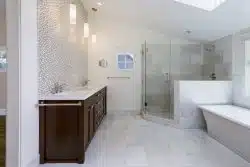
Walk-in showers use the same floor footprint as a standard tub but with completely different functional characteristics. The space becomes more usable, more flexible, and easier to outfit with features like built-in benches, storage shelving, and improved drainage.
A walk-in shower built into the existing tub footprint provides the same square footage in a more usable configuration. The vertical space inside the shower becomes available for shelving, multiple showerheads, or a built-in bench. The tub footprint that was mostly unused on a daily basis becomes a fully functional shower space.
Built-in seating, multiple showerheads with adjustable settings, ADA-compliant grab bars, niche storage, and anti-slip flooring all become standard options on walk-in showers. A standard bathtub-shower combination cannot accommodate most of these features without major modification.
Walk-in showers are easier to update over time than tubs. Fixtures swap out, glass enclosures can be replaced, tile or solid-surface walls can be refreshed, all without removing the underlying shower base. This makes the walk-in shower a more adaptable long-term investment for Knoxville homeowners planning to stay in the home.
Walk-in showers use noticeably less water per use than baths in a standard tub, and the savings add up across years of daily use. Modern low-flow showerheads further reduce water use without affecting the shower experience.
A standard tub bath uses approximately 36 gallons of water. A standard 10-minute shower uses 17 to 20 gallons. For homes that switch from frequent tub use to shower-only use, the water savings translate to lower KUB water bills and reduced water heater load over time.
Walk-in showers work well with low-flow showerheads (rated at 1.5 to 2 gallons per minute) that maintain pressure and shower experience while reducing water use further. The fixtures are easier to install and replace on a walk-in shower than on a tub-and-shower combination.
Less hot water used per shower means less load on the water heater, which extends water heater service life and reduces energy bills over time. The savings are modest per month but add up across the years of use the new shower will see.
| Benefit Category | Specific Benefit | Who Notices It Most |
|---|---|---|
| Daily Use | Eliminates step-over fall risk | Older adults, families with mobility considerations |
| Daily Use | Easier cleaning and maintenance | Everyone, but especially in busy households |
| Resale | 5–10% home value increase | Homeowners planning to sell in 1–5 years |
| Resale | Preferred by 60%+ of homebuyers | Knoxville sellers in any price range |
| Space | Same footprint, better functionality | Smaller bathrooms in older Knoxville homes |
| Space | Built-in seating and storage | Households wanting spa-style features |
| Water | ~15–19 gallons saved per use vs bath | Households that previously took daily baths |
| Water | Lower water heater load | KUB customers focused on utility bills |
The benefits of a walk-in shower stack up consistently across Knoxville homeowner profiles: easier and safer daily use, better resale value, more efficient space, and lower water use. The decision usually comes down to whether the home has another bathtub elsewhere for resale flexibility and what the household’s daily use pattern looks like. For most primary bathrooms in Knox County homes, the walk-in shower is the right call.
Tennessee Standard Plumbing handles walk-in shower installation across Knoxville, Maryville, Oak Ridge, and surrounding communities. The team works with homeowners on design choices, fixture selection, and the practical considerations specific to each home.
Call (865) 352-9003 or schedule a walk-in shower consultation to get started.
In primary and master bathrooms, yes. A quality walk-in shower adds 5 to 10% to resale value and is preferred by over 60% of homebuyers. Keep at least one tub elsewhere in the home if families with young children are likely buyers.
More than 60% of homebuyers prefer a shower over a tub in the primary bathroom, according to the National Association of Realtors. The preference is even stronger among buyers 50 and older, where accessibility ranks higher.
Yes. Walk-in showers are built to fit the same footprint as the removed tub in most cases. No walls need to be moved and no floor plan changes are required for a standard conversion.
A curbless or low-threshold shower with built-in seating, ADA-compliant grab bars, and slip-resistant flooring is the standard aging-in-place recommendation. These features eliminate the step-over fall risk and allow safe, independent use for years to come.
Yes, often better than a tub. Walk-in showers use the existing tub footprint efficiently and the glass enclosure makes the bathroom feel larger by letting light pass through. Smaller bathrooms in older Knoxville homes are common candidates for tub-to-shower conversions.
A standard 10-minute shower uses 17 to 20 gallons of water. A standard tub bath uses approximately 36 gallons. Homes that switch from frequent baths to showers see noticeable reductions in water use.
Yes. Walk-in showers work well with low-flow showerheads rated at 1.5 to 2 gallons per minute, which maintain pressure and feel while reducing water use further.
Yes. Tennessee Standard Plumbing installs walk-in showers across Knoxville, Maryville, Oak Ridge, and surrounding Knox County communities, with design support and fixture options to fit each home.


Knoxville is situated within the Appalachian watershed, meaning local water utility boards (like KUB) supply the area with moderately hard to hard ... Read More