
What Bearden’s 1950s Homes Reveal About Galvanized Supply Line Failure
Key Takeaways Galvanized steel supply pipe fails from the inside out, so a line can look sound from the crawl space while its interior diamete... Read More

Same-Day Service Available
Need a Plumber in Knoxville? We’re Ready to Help!




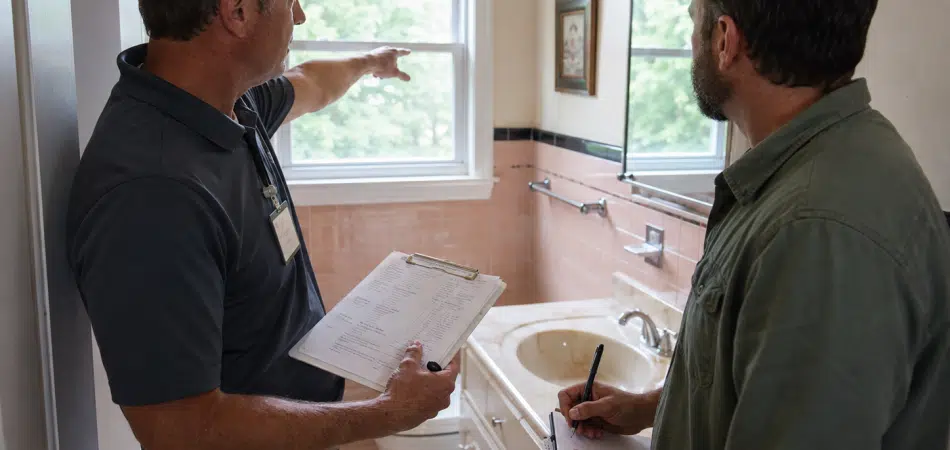
A bathroom remodeler in Knoxville should show a state license number, proof of liability and workers’ compensation insurance, a written list of specific fixtures and materials, and explain who takes care of the plumbing permit. Homeowners who check those four things before signing can avoid the most common reasons for remodel arguments: unexpected change orders, unapproved work found when selling, and unfinished projects. Older homes in Knox County carry an added risk because original supply and drain piping is often found to be in poor condition when walls are opened.
A bathroom remodel is one of the few home projects where the expensive part is completely hidden until demolition day. Tile and vanities are visible choices. The supply lines, drain slope, and vent connections behind the wall are not, and those are where budgets get broken.
Bathroom bids can vary substantially when contractors make different assumptions about concealed piping, demolition, waterproofing, materials, permits, and finish work. Comparing written scopes, allowances, exclusions, and change-order terms is more useful than comparing bottom-line prices alone. Anyone weighing quotes should start with Knoxville plumbing services that can speak to both the finish work and the rough-in.
Tennessee Standard Plumbing has worked on bathrooms in Knoxville and Knox County for more than 13 years, earning a 5.0 Google rating from more than 1,000 reviews and HomeAdvisor Elite Service recognition. Our team reports that homeowners who clarify the scope, materials, permits, payment schedule, and change-order process before work begins are better positioned to compare bids and manage unexpected conditions.
We handle bathroom remodel packages across the region, and the questions below are the ones we wish every homeowner asked our competitors and us alike.
What follows is not a sales script. It is a practical checklist any Knoxville homeowner can carry into three separate estimate appointments and use to compare bids on something other than the bottom-line number.
Bathroom remodels in older Knox County housing stock carry more unknowns than new construction. Homes built before 1980 may contain galvanized steel supply lines, cast iron drain components, or other older plumbing materials, but construction date alone does not establish the condition or installation standard of the existing system. None of that is visible during an estimate walkthrough, so a bid written without allowance for it is a bid that will change.
Galvanized steel was widely used in many older homes. It corrodes from the inside, narrowing the interior diameter over decades until flow at the fixture drops noticeably. When a bathroom wall opens during demolition and galvanized pipe is found, a plumber should assess the pipe’s remaining capacity, corrosion, connections, and expected service life. Replacement may be appropriate, particularly when walls are already open.
Service life varies widely with installation, corrosion, soil, water chemistry, support, and maintenance. Damage is not always visible from the side, so exposed sections and accessible pipe should be inspected during demolition. A remodeler who mentions inspecting the stack during demolition is planning realistically.
In Tennessee, major plumbing changes such as relocating drains, toilets, or sinks generally require permits, while cosmetic updates typically do not. Tennessee contractor licensing generally applies before bidding or contracting for projects valued at $25,000 or more, while Knox County residential remodeling projects from $3,000 through $24,999 generally require a Home Improvement Contractor license; plumbing work may also require the appropriate plumbing credential, such as a Limited Licensed Plumber license, depending on the municipality and scope of work. You can review Tennessee’s licensing and permitting regulations by checking with your local codes office.
Tennessee defines certain general-maintenance work with labor costs of $500 or less as exempt from the Limited Licensed Plumber requirement, but that exemption does not automatically eliminate all permit, code, or other licensing requirements.
Credential verification is a relatively quick step that can help homeowners identify licensing problems before signing a contract. Tennessee maintains a public license lookup through the Department of Commerce and Insurance, and Knox County Codes Administration can confirm local requirements by phone at 865-215-2325. Homeowners should treat any hesitation to provide a license number as a complete answer.
The number matters less than the classification. A contractor credentialed for general construction is not automatically cleared to perform the plumbing rough-in, and a Limited Licensed Plumber credential may apply to qualifying plumbing work under $25,000 in municipalities where Tennessee’s LLP program applies; homeowners should confirm the local requirement before work begins.
When the applicable project or contracting value reaches $25,000 or more, the responsible contractor generally needs a Tennessee contractor license with the appropriate classification and monetary limit; the plumbing portion may also require the appropriate plumbing classification. Homeowners should ask which entity performs the plumbing portion and confirm that entity separately.
Two separate policies do two separate jobs. General liability covers damage to the home, which matters when a supply line is opened above finished flooring on a lower level. Workers’ compensation covers injury to the crew. If a worker is injured, the legal and financial consequences can depend on the worker’s employment status, the contractor’s business structure, the insurance policy, and Tennessee law; homeowners should verify coverage and obtain professional legal advice for project-specific concerns. A certificate of insurance is evidence of reported coverage, but it is not the insurance policy and does not itself guarantee coverage.
Ask who will apply for the permit, who will be listed as the permit holder or responsible contractor, and who will schedule and attend inspections. Permit requirements and application procedures depend on the work and the jurisdiction, so confirm the details with the City of Knoxville, Knox County, or the applicable municipal codes office before construction begins. In Tennessee’s residential permit system, the permit holder is generally responsible for requesting inspections.
Many remodeling disputes arise when the written scope, allowances, exclusions, and change-order process are unclear. A scope naming model numbers, square footage, and finish grades gives both parties the same picture. A scope reading “install new shower and vanity” gives them two different pictures, and the gap between those pictures becomes an argument in week three.
A usable scope names the toilet model, the valve brand, the tile square footage and grade, the waterproofing method for the shower assembly, and the disposal plan for demolition debris. It also states what is excluded. Exclusions are as informative as inclusions, because they reveal what the contractor expects to find and what will become a change order.
Change orders are normal in older homes. Unwritten change orders are not. The contract should state that no additional work proceeds without written homeowner approval and a stated price. Verbal approvals during demolition can create billing disputes, so homeowners should document every change in writing with the price and scope clearly stated.
A full bathroom remodel may take several weeks from demolition to final inspection, depending on layout changes, concealed damage, material availability, subcontractor scheduling, permit inspections, and curing requirements. Homeowners should request a phase-by-phase schedule and ask how inspection delays or newly discovered conditions will affect the completion date. Homeowners should ask for the timeline broken into demolition, rough-in, inspection, tile, and finish phases, with the understanding that inspector availability is outside anyone’s control.
A written payment schedule should identify the deposit, material payments, progress payments, retainage, and final payment. Tennessee’s Home Improvement law generally prohibits a contractor from requiring or receiving an initial payment of more than one-third of the contract price, subject to statutory exceptions; a smaller deposit and milestone-based payments may provide additional consumer protection.
A deposit amount varies by contractor, project size, and material requirements, so the contract should explain exactly what it covers. A request for a large upfront payment before work or materials are provided deserves careful review, and the homeowner should confirm that the amount complies with Tennessee law and is protected by clear cancellation and refund terms. Homeowners should also ask what happens to the deposit if the project is canceled before demolition, and get that answer in writing rather than as a reassurance.
Labor-warranty periods vary by contractor, project scope, materials, and contract terms, so the homeowner should request the warranty in writing before signing. The written warranty should state what triggers a callback at no charge, what is excluded, and how a claim is made. A written warranty is easier to understand, document, and enforce than a verbal promise, particularly if the original crew or project manager is no longer available. Homeowners weighing fixture upgrades can compare durability tradeoffs in this walk-in shower planning guide before committing to a finish package.
Manufacturer warranty conditions vary by product and brand. Before installation, homeowners should review whether the warranty requires professional installation, specifies approved components, limits homeowner-supplied fixtures, or assigns registration responsibilities. The contract should state who supplies each fixture and who registers the warranty.
Bathroom projects go well when the plumbing questions are settled before the tile questions. Our team at Tennessee Standard Plumbing has spent 13-plus years in Knoxville bathrooms, and we would rather a homeowner ask us every question on this page than discover the answers halfway through demolition.
Four points are worth carrying into any estimate appointment. First, confirm the contractor’s Tennessee license, Home Improvement license, plumbing credential, and classification match the project and jurisdiction. Second, request current certificates of insurance and verify coverage with the issuing agency. Third, require a written scope identifying models, materials, allowances, exclusions, permits, and change-order procedures. Fourth, use a written payment schedule that complies with Tennessee law and ties progress payments to clearly defined milestones.
Homeowners ready to talk through a bathroom project can reach our team at (865) 352-9003 or schedule your service online. Peaceful Pipes, Peaceful Life.
We serve Knoxville, Maryville, Oak Ridge, and communities across Knox County and East Tennessee.
Layout changes generally do. Moving a toilet, relocating a shower drain, adding a fixture, or altering supply and drain routing typically requires a plumbing permit. Direct replacement of a fixture in the same location often does not. The jurisdiction is either the City of Knoxville or Knox County depending on the property address.
In Knox County, a residential remodeling project from $3,000 through $24,999 generally requires a Tennessee Home Improvement Contractor license. A project valued at $25,000 or more generally requires a Tennessee contractor license with the appropriate classification and monetary limit; homeowners should also verify the plumbing credential of the entity performing the plumbing work. If the remodeler performs minor plumbing tasks under $25,000 in specific municipalities, a Limited Licensed Plumber (LLP) credential may apply, though general maintenance under $500 is exempt.
There is no single Tennessee deposit percentage that applies to every bathroom remodel. The contract should explain the deposit and payment schedule, and Tennessee’s Home Improvement law generally prohibits an initial payment above one-third of the contract price, subject to statutory exceptions. Milestone-based payments and a meaningful final payment can help protect both parties.
A remodel involving layout changes often takes longer than a cosmetic update, but the schedule varies by scope, permit requirements, concealed conditions, materials, and crew availability. Homeowners should compare the contractor’s written schedule rather than rely on a universal three-to-five-week estimate.
The spread usually reflects what each bid assumes about conditions behind the wall. A bid that includes an allowance for possible piping repairs or replacement may be higher than one that assumes the existing plumbing can be reused, so homeowners should compare each bid’s assumptions and exclusions. Comparing written scopes rather than totals reveals the difference.
Supplying fixtures yourself may affect pricing, scheduling, compatibility, warranty coverage, and responsibility for damaged or missing items. Many fixture manufacturers condition full warranty coverage on professional installation, and homeowner-supplied components often fall outside the contractor’s labor warranty. The contract should state clearly who supplies each fixture and who registers the manufacturer warranty.
Homeowners should ask whether the remodeler carries current general-liability and workers’ compensation coverage appropriate to the business and project. General liability may cover certain covered property damage, while workers’ compensation generally addresses covered workplace injuries; the certificate of insurance is not the policy and does not guarantee that every claim will be covered. The certificate of insurance should arrive directly from the insurance agency rather than as a photocopy from the contractor.
Unpermitted bathroom work can delay a sale, create questions for the buyer or lender, or require additional inspections and corrective work. The required remedy depends on the jurisdiction, the nature of the work, and the applicable building and plumbing codes.
Homes built before 1980 may contain galvanized steel supply lines, cast iron drain components, or other older plumbing materials, but construction date alone does not establish their condition. If demolition exposes deteriorated piping, the plumber should document the condition and explain whether repair, partial replacement, or broader replacement is appropriate.
Obtaining several comparable bids can help homeowners identify differences in scope, assumptions, allowances, and exclusions; the value comes from comparing written scopes rather than totals. Asking each contractor the same set of credential, scope, and warranty questions produces bids that can be evaluated side by side. A single bid provides no reference point for what is normal.


Key Takeaways Galvanized steel supply pipe fails from the inside out, so a line can look sound from the crawl space while its interior diamete... Read More
A sump pump is a pump used in a basement or crawl space to remove water that accumulates in a sump pit. It prevents flooding by pumping collected w... Read More

Tankless water heaters heat water instantaneously without the use of a storage tank. When a hot water faucet is turned on, cold water flows through... Read More