
How Long Does a Battery Backup Sump Pump Last? Types and Factors Explained
A battery backup sump pump system will often serve you for about 5–10 years, while the battery itself usually needs to be replaced every 3–5 years.... Read More

Same-Day Service Available
Need a Plumber in Knoxville? We’re Ready to Help!




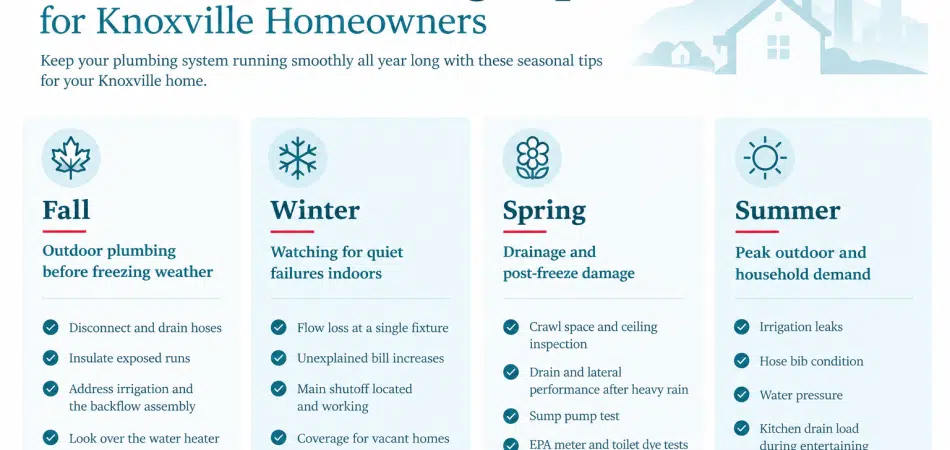
Seasonal plumbing maintenance in Knoxville follows East Tennessee’s weather patterns rather than a generic national calendar. Fall focuses on outdoor plumbing before the cold weather hits. The National Weather Service office in Morristown says freezing temperatures usually come to the Tennessee Valley from mid-October to mid-November. Winter shifts indoors, toward the quiet failures that cold weather causes behind walls and under floors. Spring is about drainage, since rainfall loads sewer laterals, yard drains, and sump systems. Summer brings peak outdoor demand, and hose bibs, irrigation lines, and backflow assemblies tend to reveal their faults under it.
Most plumbing emergencies in Knoxville are not surprises. They are small conditions that sat unnoticed through a mild stretch of weather and then met the first cold night, the first heavy rain, or the first week of houseguests. The repair bill arrives in one day, but the problem took a season or two to build.
Tennessee Standard Plumbing has served Knoxville, Knox County, and the surrounding East Tennessee communities for more than 13 years. The company carries a 5.0 Google rating across more than 1,000 reviews, holds HomeAdvisor Elite Service recognition, and fields more than 50 technicians. We handle drain work, water line and repipe work, water heaters, leak detection, water treatment, and frozen pipe repair throughout our service area. Seasonal work is where that experience is most useful, because the timing matters as much as the task.
Tennessee Standard Plumbing offers a free plumbing evaluation for homeowners in the service area whose water bill has climbed. This offer runs through the end of September.
*EXCLUSIONS APPLY, CALL FOR DETAILS
This offer cannot be combined with any other offer, discount, or promotion.
Fall is the working season for anything outdoors. The National Weather Service Morristown office reports that freezing temperatures generally reach the Tennessee Valley somewhere between mid-October and mid-November, and the exact date moves year to year. Work done before that window is planned work. Work done after it is usually repair work.
A garden hose left connected through a cold night is the most common reason an outdoor spigot fails. Water trapped between the hose and the valve has nowhere to expand, and the split often opens inside the wall rather than at the visible fitting. Disconnecting and draining hoses in fall costs nothing. Homes with frost-free hose bibs still benefit, because a connected hose defeats the drain feature those valves rely on.
Crawl spaces, attics, garages, and exterior walls hold the runs that freeze first in Knox County homes. Foam sleeves and wrap are inexpensive and easy to fit, and the useful step is finding the runs rather than buying the insulation. A crawl space that has open vents, missing insulation, or a door that no longer closes is carrying more risk than the pipe material alone suggests. Households that have already had a line freeze can read what frozen pipe repair involves before the next cold snap arrives.
Irrigation systems carry water in shallow lines and in an assembly mounted above grade, which makes them among the first components to suffer in a freeze. Early fall, before the first freezing night, is generally the better time to address them. The specific question of timing is covered in this look at when to winterize a backflow preventer, which goes deeper than a general seasonal list can.
Household hot water demand climbs as the incoming water gets colder, so a water heater that coped through summer can struggle in December. Fall is a reasonable time to look at the unit: check for moisture at the base, corrosion at the fittings, and rusty or discolored hot water. Maintenance intervals differ by brand and model, and the unit’s own manual is the document that governs, not a general rule of thumb.
 Winter problems in Knoxville tend to be quiet. A line does not usually burst dramatically at the moment it freezes. It cracks under pressure, then leaks when it thaws, often into a wall or a crawl space where nobody looks. Watching for small signals through the cold months catches the damage while it is still small.
A single fixture losing flow while the rest of the house runs normally is a classic sign of a frozen section rather than a supply problem. The affected run is usually the one nearest an exterior wall or an unheated space. Opening the cabinet doors under sinks on exterior walls lets household heat reach the pipe, and leaving a slow trickle running relieves pressure in that section. Applying open flame to a frozen line is a fire risk and is a common cause of far worse damage than the freeze itself.
EPA’s WaterSense program reports that the average household’s leaks can account for more than 9,300 gallons of water wasted every year, and that nine percent of homes have leaks wasting 50 gallons or more per day. Nationally, EPA puts household leaks at nearly 1 trillion gallons annually. Worn toilet flappers, dripping faucets, and leaking valves are the three sources EPA names most often, and none of them announce themselves. A rising winter bill with no change in household routine is worth investigating rather than absorbing, and it is one of the more common reasons households start comparing Knoxville plumbing services in the middle of winter.
The value of a main shutoff comes down to whether someone in the house can find it under stress. Locating it, confirming it turns, and showing it to more than one person in the household is a winter task worth doing before it is needed. Valves that have not moved in years can seize, and discovering that during an active leak is the worst possible time. Knoxville Utilities Board restricts operation of its own utility valves at the meter to KUB and its contractors, so the valve that matters to a homeowner is the one inside the property line.
Houses sitting empty over the holidays lose the two things that protect plumbing in winter: heat and water movement. Holding the thermostat at a moderate setting rather than shutting it off, and having someone check the house periodically, cuts the exposure. Second homes around Norris Lake and rental properties between tenants carry the same risk in a sharper form, because nobody notices a failure for days.
Spring work in East Tennessee is drainage work. Rainfall loads sewer laterals, yard drains, and sump systems in a way freezing weather does not, and the failures that show up in April usually started as winter damage nobody could see. The checks here are about water leaving the property rather than water reaching it.
A pipe that cracked in January often stays quiet until the section thaws and pressure returns. Water stains on ceilings, a musty smell in a crawl space, soft spots in flooring, and a water bill that stayed high after the cold ended are the usual first signals. Walking the crawl space and the perimeter after the last freeze is a short job that catches what winter left behind.
Heavy spring rain is the load test for anything that carries water away from a house. Slow drains inside, standing water in the yard, gurgling from a floor drain, or backups after a storm are worth treating as a drainage question rather than a single fixture question. The origin can sit in a fixture branch, in the building drain, in the private lateral, or in the public sewer, and heavy rain points toward water entering the system somewhere along that chain without identifying which part. Older neighborhoods across North and South Knoxville have laterals old enough that root intrusion and joint separation are ordinary findings, which is one reason the lateral is a common suspect rather than an automatic answer. Households that want to get ahead of it can look at preventive drain maintenance rather than waiting for the first backup.
A sump pump that sat idle through a dry winter is an unknown until it runs. Pouring a bucket of water into the pit confirms the float rises, the pump starts, and the discharge line actually carries water away from the foundation. Homes near the Tennessee River, the Little River, and the creek bottoms across Blount and Knox counties see enough groundwater in spring that this check earns its place.
EPA’s method is simple enough for any household to run. Read the water meter, use no water for two hours, then read it again. Movement with nothing running points to a leak somewhere on the property. For toilets specifically, EPA suggests placing a few drops of food coloring in the tank and checking the bowl after ten minutes; color in the bowl means the flapper is passing water. Spring is a good time to run both, because the results are clearer once irrigation is not yet in use.
Summer raises outdoor water use sharply, and that is when the parts of a plumbing system that sat unused all winter get pushed hardest. Irrigation, hose bibs, outdoor spigots and the pressure feeding all of them come under real load. Faults that hid through cooler months tend to appear within the first few weeks of heavy use.
A summer water bill climbing faster than the watering schedule explains usually points at something other than the lawn. Irrigation lines run underground, so a break can water a patch of yard for weeks without any visible sign except a bill and a green spot. Reading the meter before and after a full irrigation cycle separates system demand from a leak. Households on well systems see the same problem as a pump that runs more often than it used to.
Outdoor spigots take physical abuse in summer, and a bib that weeps at the handle or the wall is worth addressing while the weather is warm. High household water pressure adds strain everywhere at once, shortening the life of supply lines, valves, and appliance connections. Pressure that varies noticeably between fixtures, or that spikes at night, is a condition to have measured rather than estimated.
Summer entertaining puts unusual volume through a kitchen drain. Grease that pours easily when hot congeals in the lateral as it cools, and disposals get fed fibrous scraps they handle poorly. Running cold water during and after disposal use, and keeping grease out of the drain entirely, prevents most of what shows up as a slow kitchen sink in August.
The table below condenses the routine into the order the East Tennessee calendar actually asks for it. Timing is approximate on purpose, since freeze arrival and rainfall vary year to year.
Our team at Tennessee Standard Plumbing works across Knoxville, Knox County, and the surrounding East Tennessee communities on drains, water lines, water heaters, leak detection, water treatment, and frozen pipe repair. Most of what we see in January could have been handled in October, which is the honest argument for a seasonal routine rather than a reactive one.
Four things are worth holding onto. Fall is the window for outdoor plumbing, because the freeze arrives on the weather’s schedule and not the household’s. Winter problems announce themselves quietly, usually as a bill or a single slow fixture. Spring is drainage season, and heavy rain is the test that finds the weak lateral. And summer is when irrigation and outdoor spigots show what the winter did to them.
Homeowners who want a seasonal check on the calendar can reach our team at (865) 352-9003 or schedule your service online. We serve Knoxville, Maryville, Oak Ridge, Farragut, Powell, and communities across Knox County and East Tennessee. Peaceful Pipes, Peaceful Life.
Knoxville homeowners should start fall plumbing prep in September or early October, well before the first freeze arrives in late autumn.
Yes, garden hoses must be disconnected before freezing winter weather to prevent burst pipes and damaged spigots.
A household can detect a hidden water leak by performing a simple water meter test or watching for physical signs like unexplained bill increases and damp spots.
EPA’s WaterSense program reports that the average household’s leaks can account for more than 9,300 gallons of water wasted every year, and that nine percent of homes have leaks wasting 50 gallons or more per day. Those are national averages rather than a figure for any particular home. Worn toilet flappers, dripping faucets, and leaking valves are the sources EPA names most often.
Runs in unheated spaces carry the most exposure: crawl spaces, attics, garages, and lines routed through exterior walls. Outdoor spigots and irrigation components sit above grade and are also early casualties. Finding those runs matters more than the insulation product chosen to protect them.
If only one fixture loses water during the winter while the rest of the house functions normally, a localized pipe freeze has likely occurred. Because water expands when it turns to ice, you must act quickly to relieve the pressure and thaw the line before the pipe splits and causes a major leak.
Plumbing problems often appear in spring because winter weather causes hidden stress and structural damage that only becomes visible when temperatures rise and water use increases.
A sump pump is tested before spring rains by pouring water into the sump pit to trigger the float switch and verify that the pump activates, empties the basin, and pushes water out through the outdoor discharge line.
A summer water bill climbs faster than expected because high outdoor temperatures amplify everyday water use and trigger hidden leaks or irrigation inefficiencies.
Yes, a vacant house needs specialized winter care because it lacks daily human presence, routine heating, and active water use that normally prevent damage.


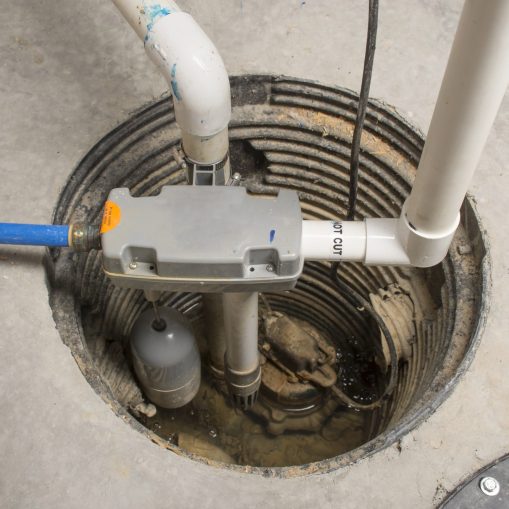
A battery backup sump pump system will often serve you for about 5–10 years, while the battery itself usually needs to be replaced every 3–5 years.... Read More

Household drains are often overlooked until a clog disrupts your daily routine. From grease and coffee grounds in the kitchen to wipes and paper to... Read More

Choosing a walk-in shower installer in Knoxville comes down to three things: a verified plumbing license, a written and fixed price, and a workmans... Read More