
Signs Your Whole-Home Water Filter Needs Replacement in Knoxville
A whole-home water filter that works correctly is invisible. The water tastes clean, the fixtures stay clear of scale, and the system runs without ... Read More

Same-Day Service Available
Need a Plumber in Knoxville? We’re Ready to Help!




Key Takeaways
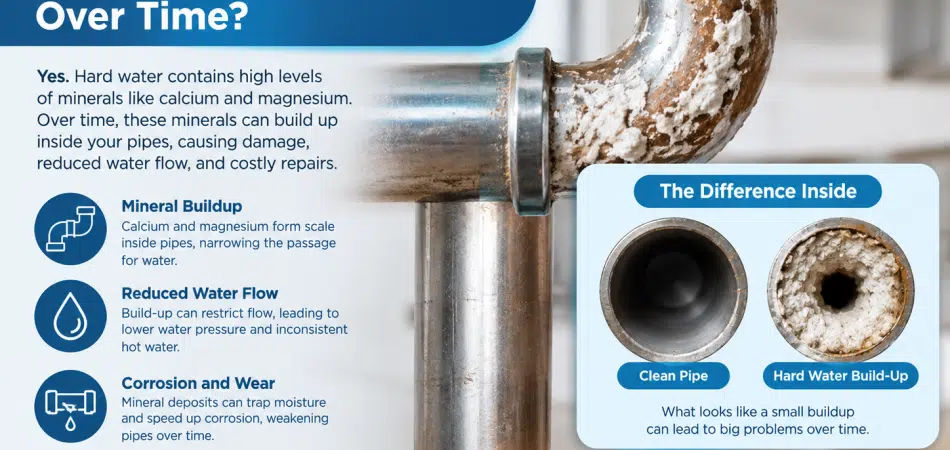
Hard water can affect plumbing over time, but the damage is uneven, and it does not fall equally on every part of a system. USGS reports that heated hard water forms deposits that reduce equipment life, raise heating costs, lower the efficiency of electric water heaters, and clog pipes. Scale accumulates fastest where water is hot, which puts water heaters, hot supply runs, and fixture components ahead of cold water lines. Pipe material matters as well, since galvanized steel accumulates corrosion products together with mineral deposits while copper, PEX and CPVC each behave differently. EPA sets no enforceable standard for hardness and treats it as a nuisance rather than a health concern.
Hard water gets blamed for a lot in Knoxville, and some of the blame lands in the wrong place. Spotty glassware and stiff towels are easy to see, so the assumption tends to be that the pipes behind the wall are filling up at the same rate. What actually happens is slower, more selective, and worth understanding before anyone spends money on it.
Tennessee Standard Plumbing has worked on water lines, water heaters, and water treatment across Knoxville, Knox County and the surrounding East Tennessee counties for more than 13 years. Our company carries a 5.0 Google rating across more than 1,000 reviews, holds HomeAdvisor Elite Service recognition, and fields more than 50 technicians. We handle water quality testing, filtration systems, whole home water treatment, softeners, point-of-use reverse osmosis and repipe work. Hard water questions come up often here, and the answer usually depends on what a test and a look at the system actually show.
Tennessee Standard Plumbing offers a free plumbing evaluation to anyone in the service area dealing with a high water bill. This offer runs through the end of September.
*EXCLUSIONS APPLY, CALL FOR DETAILS
This offer cannot be combined with any other offer, discount, or promotion.
Hardness is the measure of dissolved calcium and magnesium in water. USGS classifies 0 to 60 mg/L as calcium carbonate as soft, 61 to 120 mg/L as moderately hard, 121 to 180 mg/L as hard, and more than 180 mg/L as very hard. The minerals enter groundwater as it moves through carbonate rock, which East Tennessee has in abundance.
Limestone and dolomite dissolve slowly as water passes through them, and the Ridge and Valley region that Knoxville sits in is built largely of those rocks. Water that has spent time in contact with carbonate formations picks up calcium and magnesium along the way. That is the reason hardness is a regional trait rather than a household one, and the reason two homes on the same street generally see similar readings when they share a supply.
Hardness varies by source, so the answer differs by address. Homes on Knoxville Utilities Board water, Maryville or Alcoa city water, Oak Ridge water, or one of the smaller utility districts across Union and Anderson counties each draw from different sources with different treatment. Homes on private wells in Corryton, Maynardville, Seymour or Strawberry Plains are drawing directly from that carbonate groundwater with no utility treatment at all, and well readings tend to run higher and vary more.
Two routes give a usable figure. Utilities publish annual water quality reports covering their service area, though hardness is not a federally required reporting item, so it may or may not appear in a given report. Where it is absent, the utility can generally supply the figure on request. A test at the tap gives the number for one specific house, which matters where a water heater, a softener, or an old service line may be influencing what arrives at the fixture. Households curious about what hardness looks like day to day can read this rundown of what hard water leaves behind in a home, which covers the visible side in more detail than this article does.
EPA sets no drinking water standard for hardness. Its secondary standards, which EPA states it does not enforce, cover aesthetic, cosmetic, and technical effects, and scale falls under the technical category alongside total dissolved solids at 500 mg/L. USGS is direct about the health question: hardness “is a property of water that is not a health concern, but it can be a nuisance.” Treating hard water is therefore an equipment and comfort decision rather than a safety one.
Scale is what dissolved minerals become when they come out of solution and bond to a surface. USGS states that heated hard water forms deposits that can reduce the life of equipment, raise the costs of heating the water, lower the efficiency of electric water heaters, and clog pipes. The word doing the work in that sentence is heated.
Calcium carbonate becomes less soluble as water temperature rises, which is the opposite of how most substances behave. That single property explains the pattern seen in homes. Deposits appear on water heater elements, in hot supply runs, inside showerheads, and at faucet aerators, while the cold line feeding the same fixture stays comparatively clear. A cold water main in a moderately hard supply can run for a long time without meaningful restriction, while the hot side of the same house shows deposits much sooner.
Scale does not coat a pipe evenly like paint. It builds where flow slows, where the surface is rough, and where temperature is highest, which means elbows, valve seats, threaded joints, and fixture components collect it before straight runs do. The practical result is that a household usually notices a specific fixture underperforming rather than the whole house losing pressure at once. Whole-house pressure loss points more often at the service line, a pressure regulator, or a partially closed valve than at hardness alone. A water softener installation addresses the mineral load before it reaches any of it.
The smallest openings suffer the most from a given thickness of deposit. Aerator screens, showerhead nozzles, toilet fill valves, angle stops, and the ceramic cartridges inside modern faucets all have tolerances measured in fractions of an inch. Deposits that would barely register inside a half-inch supply line can stop a cartridge from seating, which is why dripping faucets and running toilets are frequently the first hard water complaint in a house, well ahead of anything involving the pipes themselves.
Being clear about the limits keeps the diagnosis honest. Hardness alone is not the explanation for pinhole leaks in copper, which relate to water chemistry factors including pH, dissolved oxygen, velocity, and installation conditions rather than to calcium content. Hardness does not cause rusty water either; iron and aging galvanized steel do that. And hardness is not a reason on its own to replace a plumbing system that is otherwise sound.
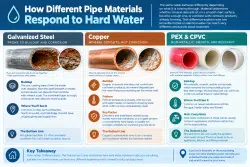 The same water behaves differently depending on what it is running through. Material determines whether mineral deposits sit on a smooth inert surface, bond to a rough one, or combine with corrosion products already forming. That difference explains why two Knoxville homes on identical water can reach very different conclusions about treatment.
Galvanized steel supply lines are the material most associated with internal buildup, and hardness is only part of the story. The zinc coating wears from the inside over decades of service, after which the steel beneath corrodes and produces rust deposits that accumulate together with mineral scale. The combined layer is rough, which gives new deposits more to grab. Homes in older parts of Bearden, North Knoxville, and Oak Ridge that still have original galvanized supply lines are generally dealing with a material condition first and a water condition second.
Copper is smooth and does not contribute corrosion products the way steel does, so mineral deposits are the main thing accumulating on the inside wall. The pattern follows temperature closely, with hot runs and the water heater connections showing scale while cold runs stay comparatively clean. Copper’s real vulnerabilities in East Tennessee tend to be chemistry and installation-related rather than hardness-related, so a copper system in a moderately hard supply is usually not a repipe candidate on hardness grounds alone. That distinction tends to surface once a homeowner starts pricing options with Knoxville’s local plumbing team.
PEX and CPVC are non-metallic, smooth, and do not corrode, which removes the compounding factor that steel brings. Mineral deposits can still form in hot runs and at brass or metal fittings within those systems, since the fitting material and the temperature drive deposition more than the pipe body does. Newer subdivisions across Farragut, Hardin Valley and Powell are largely plumbed with these materials, and hard water complaints in those homes usually center on appliances and fixtures rather than on the supply piping.
The table below summarizes how each material tends to behave under hard water and where the practical attention belongs. It describes general material behavior rather than the condition of any specific house.
Diagnosis beats assumption here, because the fixes point in different directions and cost different amounts. A hardness number, a pressure reading, and a look at the fixtures give a household most of what it takes to decide. Buying equipment before any of that is how the wrong system ends up installed.
A hardness result puts the house somewhere on the USGS scale, which turns a vague complaint into a specific reading. Homes on public water can start with the utility’s annual water quality report, then ask the utility directly if hardness is not among the items it lists. Homes on wells have no such report, so a tap test is the only route. Either way, the figure is the basis for deciding whether treatment is warranted, what capacity would suit the household, and whether hardness is even the issue in play.
When one fixture underperforms, and the rest of the house is normal, the deposit is usually local: an aerator, a cartridge, a supply stop, or a showerhead. When flow drops across the whole house at once, hardness is rarely the explanation. Service line condition, a failing pressure regulator, or a partly closed valve account for far more whole-house pressure complaints than mineral buildup does. Testing a few fixtures in turn separates the two quickly.
Since heat drives deposition, the water heater is where hardness shows up earliest and costs the most. Reduced hot water volume, popping or rumbling during heating, longer recovery, and sediment in drained water all point that direction. Addressing the heater often resolves what a homeowner had assumed was a whole-house piping problem, and it is a much smaller project.
Repiping is a decision about the pipe’s own condition, not about hardness in isolation. Original galvanized steel that is producing discolored water, restricting flow across multiple fixtures, and leaking at joints is a candidate on those grounds. A sound copper or PEX system in the same water usually is not. Households weighing it can look at what a whole home repipe involves and compare it against treating the water and servicing the heater, which is the cheaper path when the piping is still in good shape.
Our team at Tennessee Standard Plumbing handles water quality testing, water softeners, whole home water treatment, filtration systems, point of use reverse osmosis, water heaters, and repipe work across Knoxville, Knox County, and the surrounding East Tennessee counties. We would rather test a home’s water and look at its heater than sell a system on a guess about what the pipes are doing.
Four things are worth holding onto. Hardness is measured, not estimated, and USGS provides the scale that gives the number meaning. Scale forms fastest where water is heated, so the heater and the hot side come first. Pipe material changes the answer, and galvanized steel is a material condition as much as a water condition. And EPA treats hardness as a nuisance rather than a health concern, which makes treatment an equipment decision a household gets to weigh on cost.
Homeowners who want their water tested and their system looked at can reach our team at (865) 352-9003 or book an appointment online. We serve Knoxville, Maryville, Oak Ridge, Farragut, Powell, and communities across Knox County and East Tennessee. Peaceful Pipes, Peaceful Life.
Yes, hard water can physically damage pipes over time by creating a hard mineral crust known as scale.
Hard water is water that contains a high concentration of dissolved minerals, primarily calcium and magnesium. As water moves through soil and limestone, it naturally dissolves and picks up these mineral deposits. Water hardness is typically measured in grains per gallon (gpg) or parts per million (ppm), which is equivalent to milligrams per liter (mg/L).
It varies by supply and by address, so the reliable answer comes from a current source rather than a general figure. Homes on public water can check the serving utility’s annual water quality report, though hardness is not a federally required reporting item and may not appear in it. Where it is missing, the utility can generally supply the figure on request. Homes on private wells have no such report at all, which makes a test at the tap the route to a real number.
Scale forms on the hot side because dissolved minerals like calcium and magnesium have inverse solubility, meaning they become less soluble as water temperature increases.
Yes, hard water can cause low water pressure throughout a house over time by leaving mineral deposits that narrow the inside of your pipes.
USGS states that hardness “is a property of water that is not a health concern, but it can be a nuisance.” EPA sets no drinking water standard for hardness, and its secondary standards, which EPA says it does not enforce, address aesthetic, cosmetic and technical effects. Deciding whether to treat hard water is therefore an equipment and comfort question.
PEX (cross-linked polyethylene)0 handles hard water best because its smooth polymer walls resist mineral scale buildup and it does not suffer from internal corrosion or pitting.
Yes, hard water can contribute to pinhole leaks in copper pipes, though it is often a combination of mineral content, water chemistry, and velocity rather than just the hardness alone.
Yes, severe hard water can be a reason to repipe a house if it causes irreversible internal corrosion, widespread pinhole leaks, or complete blockage.
The hardness number and the water heater, in that order. A test or a utility report puts the house on the USGS scale and turns a vague complaint into a reading. The heater is where deposition concentrates, so reduced hot water volume, rumbling during heating, and longer recovery are the signals worth checking before anyone considers the piping.


A whole-home water filter that works correctly is invisible. The water tastes clean, the fixtures stay clear of scale, and the system runs without ... Read More

Household drains are often overlooked until a clog disrupts your daily routine. From grease and coffee grounds in the kitchen to wipes and paper to... Read More

Advanced plumbing tools improve repair accuracy by replacing guesswork with high-precision diagnostics, utilizing non-invasive technology to locate... Read More