
Same-Day Service Available
00
Hrs
00
Mins
00
Secs
Need a Plumber in Knoxville? We’re Ready to Help!
Same-Day Service Available
Need a Plumber in Knoxville? We’re Ready to Help!




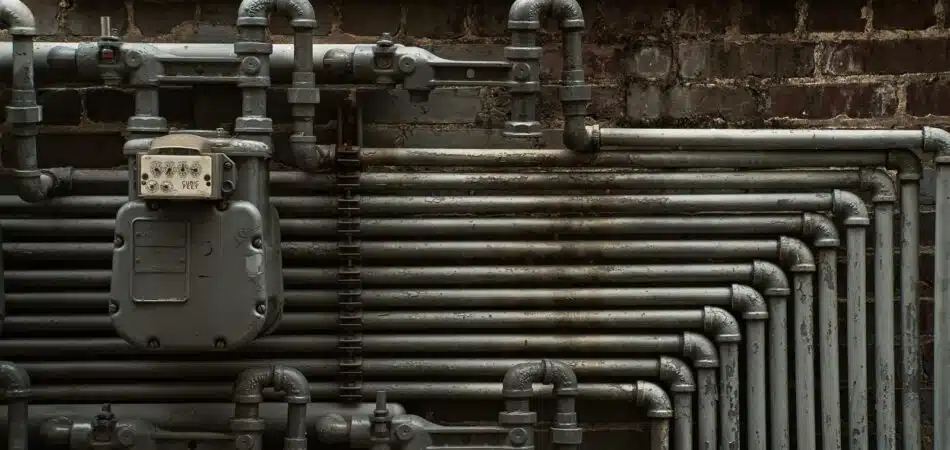
CSST and black iron are both recognized gas piping materials in the residential code, and the main practical difference between them is electrical bonding. Black iron and arc-resistant black-jacket CSST are generally considered bonded when connected to a grounded appliance. Traditional yellow-jacket CSST calls for a dedicated bonding jumper to the home’s grounding electrode system, because manufacturers and the code council link bonding to lightning-related arcing. Flexibility, fewer joints and protection inside framing also differ between the two.
Some basements tell the story of a gas system in two colors. Along one joist runs dark steel pipe, threaded together at each elbow and tee, the way it went in when the house was built. A few feet over, a newer line heading to the range or a gas fireplace is bright yellow, flexible, and curves around obstacles with barely a fitting in sight. Both are legitimate gas piping, and telling them apart is a routine first question for an East Tennessee home plumbing team.
The yellow tubing is corrugated stainless steel tubing, usually shortened to CSST. The dark pipe is black iron. They carry the same gas, yet they ask different things of the house around them, especially in how they connect to the electrical grounding. For anyone planning gas line installation to a new appliance, those differences decide more than the color of the pipe.
Black iron is rigid steel pipe joined with threaded fittings, cut and threaded to length on site. CSST is flexible corrugated stainless steel tubing covered by a plastic jacket and joined with the manufacturer’s own fittings. The residential code recognizes both, sets a material standard for each, and treats them differently for electrical bonding and physical protection.
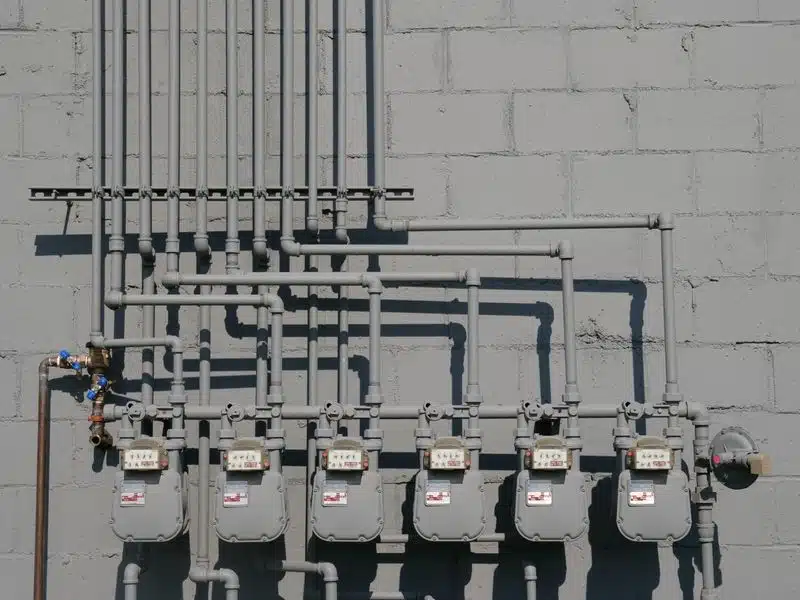
Black iron pipe is uncoated steel pipe. The 2018 residential code calls for steel gas pipe to meet the dimensional standard ASME B36.10 plus one of several ASTM material standards, including ASTM A53. Joints are threaded, so each change in direction usually means a fitting. Inside concealed spaces, the code limits fittings to certain types, and threaded elbows, tees and couplings are among those allowed.
Corrugated stainless steel tubing bends around corners and through framing in long runs, which reduces the number of joints. The code calls for CSST to be listed to the national standard ANSI LC1/CSA 6.26. Manufacturers restrict who can install it: Gastite and TracPipe both state that installers are to complete the manufacturer’s training program, on top of any local requirements.
Traditional CSST has a yellow jacket. Newer arc-resistant products use a black jacket designed to handle electrical arcing, and the International Code Council notes that certified arc-resistant black CSST is marked with the letters “AR.” Gastite lists its FlashShield+ tubing with an arc-resistant jacket rating, and Omega Flex describes the jacket on TracPipe CounterStrike as black. The jacket color matters because the code handles bonding differently for each.
A single house can use both materials, with CSST branches coming off a steel trunk line. Gastite notes that its fittings use standard pipe threads and can be combined with other approved gas piping materials. A broader look at gas piping types used in homes covers copper, polyethylene and other options that fall outside this two-way comparison.
| Point of comparison | Black iron (steel pipe) | Yellow-jacket CSST | Black-jacket arc-resistant CSST |
|---|---|---|---|
| Form | Rigid pipe, threaded joints | Flexible tubing, manufacturer fittings | Flexible tubing, manufacturer fittings |
| Standard named in the 2018 code | ASME B36.10 plus ASTM A53, A106 or A312 | Listed to ANSI LC1/CSA 6.26 | Listed to ANSI LC1/CSA 6.26 with an arc-resistant jacket |
| Bonding (2018 IRC) | G2411.1: considered bonded when connected to a grounded appliance | G2411.2: direct bonding jumper to the grounding electrode system | G2411.3: considered bonded through a grounded appliance, unless yellow CSST is also in the system |
| Protection from nails and screws in framing | Exempt from the shield plate provision | Shield or striker plates where the code and manufacturer call for them | Shield or striker plates where the code and manufacturer call for them |
| Installer training | Local requirements | Local requirements plus manufacturer training | Local requirements plus manufacturer training |
| Ranges and dryers | Through an appliance connector | Manufacturers direct a termination fitting plus an appliance connector at movable appliances | Same as yellow CSST |
Bonding connects metal gas piping to the home’s electrical grounding so that dangerous voltage differences are less likely to build up. The 2018 residential code treats black iron and arc-resistant CSST as bonded through a grounded appliance, but calls for a dedicated bonding jumper on yellow CSST. Manufacturers and the International Code Council connect that difference to lightning.
Section G2411.1 covers piping other than CSST and states that such piping “shall be considered to be bonded where it is connected to an appliance that is connected to the equipment grounding conductor.” Section G2411.2 covers CSST without an arc-resistant jacket and calls for it to be bonded to the electrical service grounding electrode system. The jumper “shall be not smaller than 6 AWG copper wire or equivalent,” and its length “shall not exceed 75 feet.” Section G2411.3 treats arc-resistant CSST like steel pipe, unless any part of the system lacks the arc-resistant jacket.
The National Weather Service explains that lightning can enter a structure through wires or pipes that extend outside it, and can travel through electrical and plumbing systems once inside.
Gastite’s installation guide warns that even a nearby strike can energize systems in a house, and that arcing between them can damage CSST, including holes. The International Code Council describes the bonding jumper as a way to reduce that arcing.
Gastite’s installation guide lists Tennessee among states it describes as having high lightning risk, alongside neighbors such as Kentucky, Virginia, North Carolina and Georgia. The same guide recommends that building owners consult a lightning safety consultant about whether a lightning protection system makes sense. That is a separate system from gas piping bonding and is covered by its own standards.
Steel pipe is not a lightning shield. Omega Flex, the maker of TracPipe, states that black iron, copper tube and CSST can all be compromised by nearby strikes that cause arcing, and that no product is immune to a direct strike. The useful comparison is how each material is bonded and protected.
The International Code Council places grounding electrode installation and inspection with the electrical contractor and electrical inspector. Gastite’s guide says direct bonding is to be performed by a person qualified under local ordinances, following the National Electrical Code. A plumber may run the gas line while an electrician makes the bonding connection.
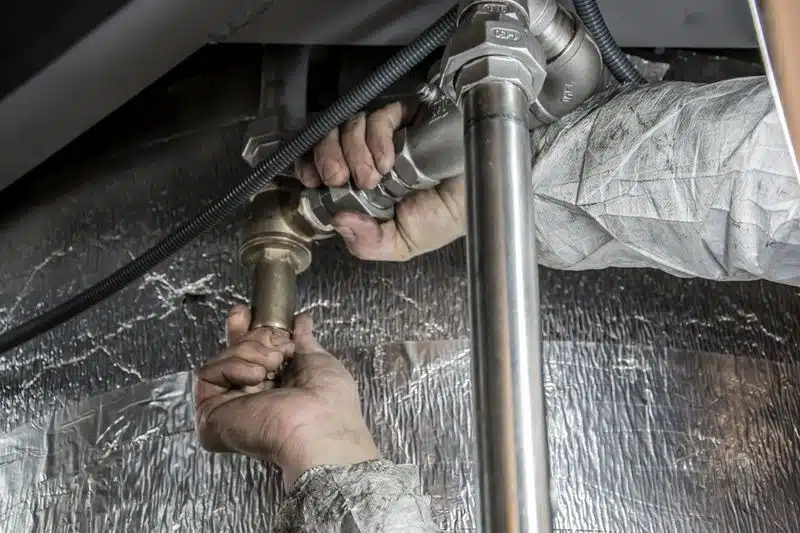
Gas work in an existing East Tennessee home tends to start with one appliance, such as a new range, gas fireplace or standby generator. The material chosen for that addition can change what the whole system calls for. Adding yellow CSST to an existing steel system brings the bonding requirement with it, according to the International Code Council.
The International Code Council’s guidance states that existing steel or copper gas piping systems are to be retroactively bonded when yellow CSST is added, regardless of how short the added length is. It adds that a system built with arc-resistant CSST and later modified with yellow CSST is to be bonded the same way as a yellow system. A small addition can therefore bring a new electrical task with it.
Section G2412.4 of the 2018 residential code states that when an additional appliance is served, the existing piping “shall be checked to determine if it has adequate capacity for all appliances served.” If it falls short, the code calls for enlarging the system or running separate piping. The material choice comes after that capacity question.
Where piping is concealed in light-frame construction, the code calls for protection against penetration by nails and screws, usually with shield plates. Black steel pipe is exempt from that provision. CSST is not, and Gastite’s guide calls for listed striker plates where tubing is concealed, cannot move, and runs close to a potential puncture threat.
Manufacturers treat movable appliances differently from fixed ones. Gastite states that its CSST should not be connected directly to movable appliances such as ranges and dryers, and TracPipe specifies termination fittings at movable appliance locations. The final connection to the appliance is generally a separate listed appliance connector.
Gas work generally falls under the local codes office, and East Tennessee has several. The City of Knoxville’s current codes list includes the 2024 residential and fuel gas codes, while unincorporated Knox County addresses go to Knox County Codes Administration at 865-215-2325. Oak Ridge, Maryville, Farragut and other municipalities run their own offices, and requirements vary by address.
An existing gas system can be sorted by what is visible: the pipe material, the jacket color on any CSST, and whether a bonding clamp and conductor are present. Those observations help a homeowner or buyer ask better questions, while the qualified trades and the applicable codes office settle whether a given installation meets current requirements.
Dark, rigid pipe with threaded fittings is steel. Flexible corrugated tubing with a jacket is CSST. A yellow jacket points to traditional CSST, while a black jacket may be an arc-resistant product; the International Code Council notes that certified arc-resistant tubing carries an “AR” marking. Jacket markings also generally name the manufacturer.
For yellow CSST, the International Code Council describes a single bonding clamp attached downstream of the meter, on rigid pipe, a malleable iron fitting, a manifold or a brass CSST fitting. The clamp does not go on the corrugated tubing itself. A heavy copper conductor then runs from the clamp to the home’s electrical grounding. The code council also describes the clamp as accessible, and its examples show clamps at the service entrance, at a manifold and at a drip leg.
A home inspection report may note CSST with no visible bond. That note is a prompt for a closer look, because a single bonding clamp can sit anywhere in the system and may simply be out of view. Gastite’s guidance says the building owner should confirm that a qualified contractor has bonded the CSST to the grounding electrode system of the premises.
Steel piping in a basement or crawl space is worth a look for heavy rust, dripping water from above, and fittings that look improvised. Age alone says little about condition. Where something looks wrong, a qualified professional can evaluate it, and the choice between repair and replacement depends on what the evaluation finds.
Our team installs, repairs and replaces gas lines for homeowners across Knoxville, Knox County and nearby East Tennessee communities, and gas leak detection is part of that same service line. We have served the area since 2020. We have 4,000+ reviews across our Google profiles and field 34 licensed plumbers (as of October 2026).
The short version of this comparison: both materials are recognized by the residential code. Black iron and arc-resistant black CSST are generally treated as bonded through a grounded appliance, while yellow CSST calls for a dedicated bonding jumper. Adding yellow CSST to an older steel system brings that requirement with it. And lightning risk is part of the reason manufacturers take bonding seriously in a state like Tennessee.
Homeowners weighing a new gas line can reach us at (865) 352-9003. We serve Knoxville, Oak Ridge, Maryville, Farragut, and communities across Knox County and East Tennessee.
Those who prefer to plan ahead online can book an appointment at a convenient time.
Yes. The 2018 residential code that Tennessee lists as adopted recognizes CSST listed to ANSI LC1/CSA 6.26 and sets bonding requirements for it. Local jurisdictions administer the code and can adopt newer editions, so the applicable codes office confirms what applies at a given address.
Jacket design. Yellow CSST is the traditional product, and the code calls for a dedicated bonding jumper on it. Black-jacket CSST listed as arc-resistant is designed to handle electrical arcing, carries an “AR” marking according to the International Code Council, and is generally considered bonded through a grounded appliance.
Generally not under the 2018 residential code. Section G2411.1 treats piping other than CSST as bonded when it connects to an appliance that is connected to the circuit’s equipment grounding conductor. Adding yellow CSST to that system changes the answer.
Nearby lightning can energize metal systems inside a house, and arcing between them can damage CSST, according to Gastite’s installation guide. The International Code Council describes the bonding jumper as a way to lower that voltage build-up. Bonding reduces risk and does not make any piping immune to a direct strike.
Neither material is safer across the board. Both are recognized by the code, and each has its own installation and bonding requirements. Omega Flex notes that black iron, copper and CSST can all be damaged by nearby lightning, so correct installation and bonding matter more than the material name.
Look for a clamp on rigid pipe or a brass fitting near where the gas enters, with a heavy copper wire leading toward the electrical service. The clamp does not attach to the corrugated tubing itself. If none is visible, a qualified electrician can trace the system and confirm.
Manufacturers generally say no. Gastite states its CSST should not connect directly to movable appliances, and TracPipe specifies termination fittings at those locations. A listed appliance connector typically makes the final connection.
Installers who meet local requirements and have completed the manufacturer’s training program. Gastite and TracPipe both state that training requirement in their installation documents. The bonding connection itself is electrical work under the National Electrical Code.
It depends on the address. Inside Knoxville city limits it is City of Knoxville Plans Review and Inspections, while unincorporated Knox County goes to Knox County Codes Administration at 865-215-2325. Oak Ridge, Maryville, Farragut and other municipalities run their own offices.