
Same-Day Service Available
00
Hrs
00
Mins
00
Secs
Need a Plumber in Knoxville? We’re Ready to Help!
Same-Day Service Available
Need a Plumber in Knoxville? We’re Ready to Help!




Last Updated: September 11, 2026
Key Takeaways
On This Page
Heating water increases its volume. Where a check valve, backflow preventer or pressure-reducing valve blocks the path back toward the water main, that extra volume has nowhere to go and system pressure rises during every water heater cycle. Thermal expansion control, usually an expansion tank, gives the volume somewhere to move. Tennessee has adopted the 2018 International Residential Code, whose section P2903.4 addresses thermal expansion control, and the same chapter puts static water pressure at not greater than 80 psi. Local offices handle permits, inspections and any amendments.
There is a small grey or blue cylinder mounted near a lot of water heaters, and a surprising number of homeowners have looked straight at it for years without knowing what it does. Most people in Clinton meet it properly for the first time when a plumber points at it during another job, or when an inspector notes that one should be there and is not, which is usually the point somebody starts reading about Knoxville area plumbing services.
It is not decoration and it is not an upsell. It exists to give heated water somewhere to go.
Whether a particular house needs one comes down to a specific condition on the supply side, and that condition is checkable. Equipment context sits with tank water heater installation.
Water occupies more space hot than cold. A storage water heater raises the temperature of dozens of gallons at a time, and that increase in volume has to go somewhere. Where the volume can travel is what separates a system that behaves from a system that stresses itself every day.
In an open system, expanding water pushes gently back through the service line toward the main, and pressure barely moves. In a closed system, a one-way device on the service blocks that path. Expansion then raises pressure inside the house instead, and it does so on every heating cycle, several times a day, for years. This look at pressure-reducing valves in Knoxville homes covers the device that most often creates the condition.
Three things commonly do it: a check valve on the water service, a backflow prevention device required by the utility, and a pressure-reducing valve that does not allow reverse flow. Utilities have installed these more widely over time, which is why houses that ran open for decades can become closed after a meter or service change with nothing else altered inside.
An expansion tank is a small vessel divided by a diaphragm, with air on one side and water on the other. As heated water expands, it compresses the air cushion instead of driving pressure up through the plumbing. The air precharge is set to match the system’s static pressure, which is why a tank installed with a factory precharge into a system at a different pressure does not do its job properly.
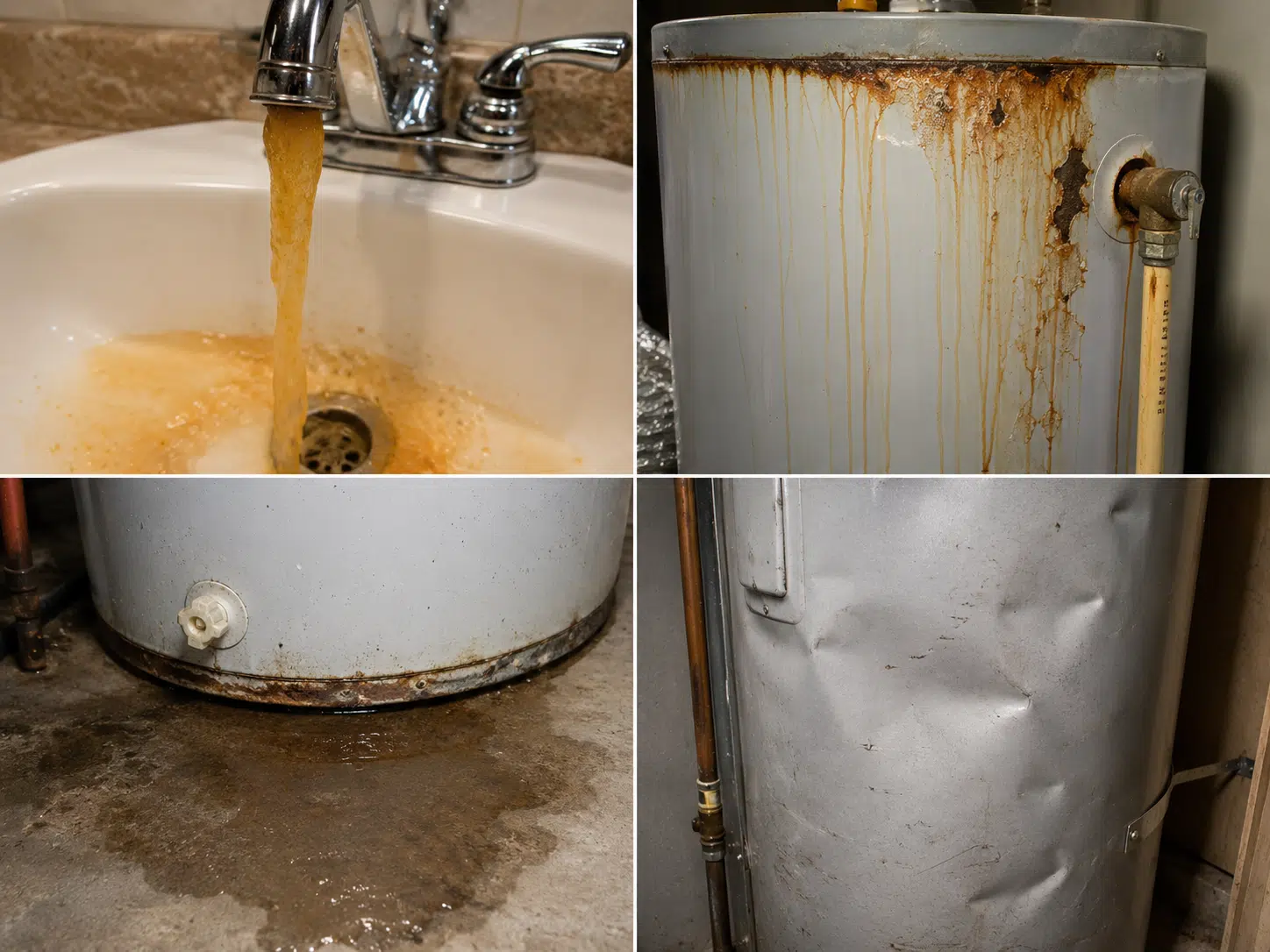
Repeated pressure spikes work on the weakest components first: supply line connections, toilet fill valves, faucet cartridges, washing machine hoses and the water heater’s own tank and relief valve. The damage is cumulative rather than dramatic, so households often replace several fixtures over a few years without connecting them to a common cause.
Tennessee adopts model codes at the state level through the State Fire Marshal’s Office. As of the current adoption effective April 17, 2025, residential construction follows the 2018 International Residential Code, and the plumbing provisions for one and two family dwellings sit in that code rather than in the commercial plumbing code.
Section P2903.4 reads: “A means for controlling increased pressure caused by thermal expansion shall be installed where required in accordance with Sections P2903.4.1 and P2903.4.2.” Those two subsections address a pressure-reducing valve on the service and a backflow prevention device or check valve on a supply system using storage water heating equipment. The condition triggering the requirement is the closed system, not the presence of a water heater on its own.
Section P2903.3.1 reads: “The static water pressure shall be not greater than 80 psi (551 kPa). Where the main pressure exceeds 80 psi (551 kPa), an approved pressure-reducing valve conforming to ASSE 1003 or CSA B356 shall be installed on the domestic water branch main or riser at the connection to the water service pipe.” The two sections interact, because installing that valve is one of the things that can close a system.
| Code | Edition adopted by the state | Where it generally applies |
|---|---|---|
| International Residential Code | 2018 edition | One and two family dwellings and townhouses |
| International Plumbing Code | 2021 edition | Commercial and other buildings outside the residential code scope |
| International Building Code | 2021 edition | Commercial and multi-family construction generally |
| International Fuel Gas Code | 2021 edition | Fuel gas piping and appliance provisions |
| Adoption effective date | April 17, 2025 | Statewide framework, administered locally |
Editions are listed by the Tennessee State Fire Marshal’s Office currently adopted codes page, checked in August 2026.
Local jurisdictions administer permits and inspections, and some adopt amendments. That is why the practical answer to “is this required at my address” comes from the office that inspects work there, and why a rule confirmed for one city does not automatically describe the next one.
Closed systems announce themselves through pressure symptoms rather than through leaks. The clues are easy to miss individually and fairly convincing together. None of them proves the condition on its own, but each one is a reason to put a gauge on a hose bib and look.
A temperature and pressure relief valve on a water heater is designed to open when pressure or temperature exceeds its rating. Intermittent dripping that stops on its own, particularly an hour or two after heavy hot water use, is a classic thermal expansion signature. Replacing the valve without addressing the pressure produces a new valve doing the same thing.
Toilet fill valves, faucet cartridges and supply line connections all wear faster under repeated pressure spikes. A household replacing these across multiple bathrooms over a few years, without any other explanation, is describing a system-level cause rather than a run of bad parts.
A simple gauge on an outside hose bib reads static pressure. On an open system that reading stays close to constant. On a closed system without expansion control it can sit normal after water use and read considerably higher after the heater has cycled with nothing drawing. Comparing two readings taken hours apart is more revealing than a single one.
Symptoms starting after utility work on the service line, or after a pressure-reducing valve was fitted, point toward a system that just became closed. Households in Clinton and the surrounding Anderson County area sometimes trace the start of a problem to exactly that kind of change.
Two questions settle most of this: whether the system is closed, and whether expansion control is present and working. Both are answerable without opening walls. The third question, whether a given installation satisfies local requirements, belongs to the office that inspects work at that address.
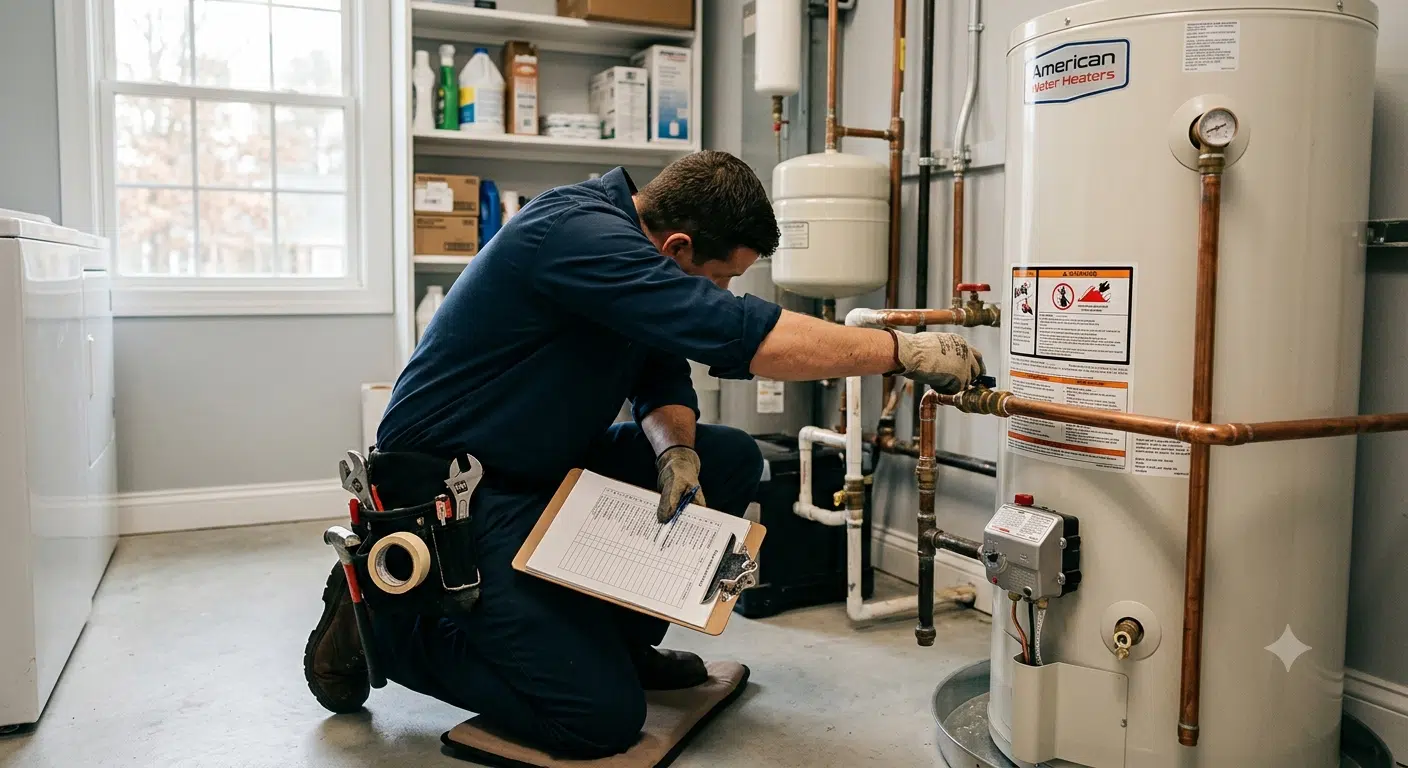
An expansion tank is typically mounted on the cold supply near the water heater, often hanging from a tee with a bracket supporting its weight. Homes without one may still be open systems and perfectly fine. Homes with one may still have a problem, because a tank with a failed diaphragm or a wrong precharge is a decoration rather than a device.
A waterlogged expansion tank feels heavy and sounds solid when tapped, and its air valve releases water rather than air when depressed. A working tank feels light for its size. Precharge is checked with the system depressurized and set against the system’s static pressure, which is why the reading is taken and the setting made by someone with a gauge rather than estimated.
State adoption gives the framework, and the local office gives the answer. Clinton sits in Anderson County rather than Knox County, so a property inside the city limits goes to the City of Clinton and a property in unincorporated territory goes to the Anderson County codes office. Applying a Knox County answer to a Clinton address is a common and avoidable mistake.
Elevated pressure quietly shortens the life of fixtures and appliance connections, and the eventual failure is usually a hose or a valve rather than the water heater itself. EPA reports on household leak losses through its WaterSense program, and the EPA WaterSense Fix a Leak Week material puts the scale of routine household leakage in context. Correcting pressure is cheaper than replacing what pressure damages.
Our team at Tennessee Standard Plumbing has served Clinton, Anderson County, Knoxville and the surrounding East Tennessee communities since 2020 on water heaters, pressure control and household plumbing. The company has earned thousands of 5-star reviews, and every job is handled by one of its 34 licensed plumbers (as of October 2026).
Four things are worth holding onto. Thermal expansion becomes a problem when a one-way device closes the system. Tennessee has adopted the 2018 International Residential Code, whose section P2903.4 addresses thermal expansion control. The same chapter puts static pressure at not greater than 80 psi. And the office that answers for a Clinton address is the city or Anderson County, not Knox County.
Homeowners who want a pressure reading and a look at the expansion tank can reach our team at (865) 352-9003 or get a free estimate online. We serve Clinton, Oak Ridge, Norris, Knoxville, and communities across Anderson County, Knox County and East Tennessee.
Related Reading
No. The requirement is tied to a closed system rather than to the water heater by itself. Tennessee Residential Code section P2903.4 calls for a means of controlling increased pressure caused by thermal expansion where the following subsections apply, and those subsections address a pressure-reducing valve or a backflow device or check valve on a system with storage water heating. The local codes office confirms the answer for a specific address.
A one-way device on the water service that stops water flowing back toward the main. In practice that is usually a check valve, a backflow prevention device required by the utility, or a pressure-reducing valve that does not allow reverse flow. Systems can become closed years after construction when utility work adds one of those devices.
Intermittent dripping that stops on its own, often an hour or two after heavy hot water use, is a common thermal expansion signature. The valve is doing its job by relieving a pressure spike. Replacing the valve without addressing the pressure generally produces a new valve behaving the same way.
Tennessee Residential Code section P2903.3.1 states that static water pressure shall be not greater than 80 psi, and that where main pressure exceeds 80 psi an approved pressure-reducing valve conforming to ASSE 1003 or CSA B356 shall be installed on the domestic water branch main or riser at the connection to the water service pipe.
One and two family dwellings generally fall under the International Residential Code, which Tennessee has adopted in its 2018 edition. Commercial buildings fall under the International Plumbing Code, adopted in its 2021 edition. The local office administering permits at the address confirms how it applies there and whether local amendments exist.
No. Clinton is in Anderson County. A property inside the Clinton city limits goes through the city, and unincorporated property goes through the Anderson County codes office. Knox County requirements do not govern a Clinton address, and assuming they do is a common source of confusion.
A waterlogged tank feels heavy for its size and sounds solid when tapped, and its air valve releases water rather than air when depressed. A working tank feels light. Precharge is checked with the system depressurized and set against the system’s static pressure, so a gauge is part of the check rather than optional.
Sizing, precharge setting, orientation and support all matter, and a tank hung without proper support puts load on the piping it hangs from. Permit and inspection requirements vary by jurisdiction and scope. Confirming with the applicable codes office before starting is the practical step for anyone considering it.
Usually the softest and cheapest components: toilet fill valves, faucet cartridges, supply line connections and washing machine hoses. The pattern to watch for is several of these failing across a house over a few years with no other explanation, whi