
My Toilet Keeps Overflowing: Different Types of Toilet Clogs
Toilets overflow due to clogs from foreign objects or excessive paper, faulty internal mechanisms like tank floats, or damaged sewer lines, with fi... Read More

Same-Day Service Available
Need a Plumber in Knoxville? We’re Ready to Help!




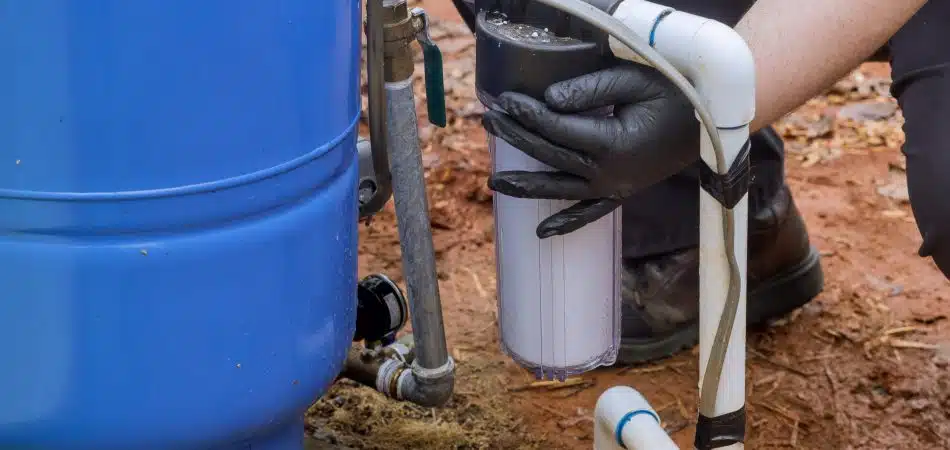
Sediment pre-filtration sits at the front of a private well treatment system and removes suspended particles before they reach the equipment behind it. Sand, silt, rust, and scale wear pump components; foul softener resin; and clog cartridge filters early and settle at the bottom of a water heater. Groundwater in East Tennessee moves through fissures and conduits in dissolved carbonate rock, so particle loading can rise sharply after heavy rain instead of holding steady. A pre-filter is protective equipment rather than a treatment for contamination, and it does not disinfect.
On a private well, there is no utility to call when something goes wrong, and no rate base quietly absorbing the cost of the equipment that keeps the water usable. The household owns all of it.
That changes the arithmetic on anything protective, and sediment pre-filtration is the clearest example of it.
A filter cartridge is a small, cheap, replaceable item sitting in front of a pressure tank, a water heater, a softener, and every fixture in the house. What it catches is grit that would otherwise end up somewhere considerably more expensive.
Sediment is suspended solid material: fine sand, silt, clay, rust flaking off older piping, and mineral scale broken loose from somewhere upstream. None of it is dissolved, which means a filter can physically catch it. Left uncaught, it works through every component the water touches on its way to a tap.
Abrasive particles moving through a pump at speed act on impellers and seals the way grit acts on any moving part. Sediment also settles in the bottom of a pressure tank, reducing its working volume over time and causing the pump to cycle more often than the system was set up to do. Neither effect announces itself early.
A softener bed is designed to exchange ions, not to strain particles. Sediment reaching it packs into the resin, channels the flow, and reduces capacity, and backwashing does not fully recover it. Downstream cartridge filters clog fast for the same reason, which is why households without a pre-filter often complain about changing cartridges constantly.
Particles that pass everything else settle in the bottom of a storage water heater. That layer insulates a gas burner or surrounds a lower element, slows recovery, and produces popping during heating cycles. Flushing intervals come from the manufacturer’s manual for the specific unit rather than from a general schedule.
Cartridge faucets and toilet fill valves have small passages and soft seats. Grit scores those seats and produces the slow drip that returns two weeks after a repair. Aerator screens clogging repeatedly across a whole house is one of the clearest indicators of a sediment problem at the source, and homes across Seymour and the surrounding area see this pattern regularly.
Groundwater here does not move the way it does through uniform sand. USGS describes karst terrain as created by the dissolution of soluble rock, principally limestone and dolomite, with flow moving through networks of fissures, fractures, and conduits. Water traveling through openings carries what those openings hold.
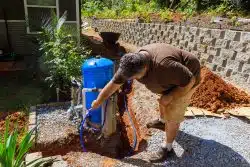 In a sand and gravel aquifer, soil filters water on its way down. In karst, a conduit can move water fast enough to keep particles suspended. That is why a well can run clear for months and then turn cloudy within a day of a heavy storm, and why the change reverses just as quickly.
Screen condition, casing integrity, grouting, and how the well was developed at drilling all affect how much material enters the system. A well producing sand rather than fine silt is often telling a story about screen or casing condition rather than about the aquifer, and that is a well contractor’s question rather than a filtration question.
A pump set close to the bottom of a well pulls from the zone where settled material sits. Heavy draw during dry months lowers the water level toward that zone and increases what gets picked up. Households noticing gritty water only during dry spells are often seeing this rather than a change in the aquifer. Sizing filtration to that pattern is part of what whole home water filtration systems get specified against.
Private wells do not report results the way a public water system does. There is no Seymour or Strawberry Plains equivalent of a municipal annual report, so any article quoting typical local sediment or iron levels is guessing. A test on the specific well is the only source of a real number.
Sediment filtration is usually built in stages rather than as one filter. A coarse stage catches the large material and protects the finer stage behind it, which then catches what the first one passed. Skipping the coarse stage means the fine cartridge does all the work and gets replaced constantly.
A larger micron rating up front holds sand and grit. A smaller rating downstream catches silt and fine particles. Running only a fine filter is the most common design error in a household system, and the symptom is obvious: cartridges loading up far faster than the manufacturer’s guidance suggests. The Knoxville plumbing team sees this arrangement often on systems installed piecemeal.
There is no universal correct rating. Too coarse, and particles pass through to the softener and heater. Too fine and pressure drops, cartridges blind off, and the household trades one complaint for another. The rating gets chosen from what the water actually contains and what the equipment behind it tolerates, which is why a water test comes before a hardware decision.
A spin-down separator with a clear housing and a flush valve handles heavy sand without cartridge replacement, and it lets a homeowner see the load building. A backwashing media filter handles higher volumes automatically. Cartridge housings remain the simplest and least expensive arrangement. Which combination fits depends on how much material the well produces and how often someone is willing to service it.
| Position | What Sits There | What It Protects |
|---|---|---|
| 1 | Spin-down separator or coarse cartridge | Everything downstream, starting with the fine filter |
| 2 | Fine sediment cartridge | Softener resin, treatment media and valves |
| 3 | Softener or treatment media, where fitted | Water heater and fixtures from scale |
| 4 | Carbon or specialty stage, where fitted | Taste and odor at the tap |
| 5 | Point of use treatment at a drinking tap | Drinking and cooking water specifically |
Order varies with the treatment fitted and the manufacturer’s installation instructions for each device, so this table describes the general logic rather than a fixed layout for every home.
Filtration equipment is only as good as the information it was sized against and the maintenance it receives afterward. A private well owner carries both jobs. Testing sets the specification, and a service routine keeps the system doing what it was specified to do.
The EPA recommends testing a private well annually for total coliform bacteria, nitrates, total dissolved solids, and pH, and testing for other contaminants where there is reason to suspect them. It also recommends testing more frequently where small children, older adults, or someone pregnant or nursing lives in the home, and testing immediately where groundwater problems are known in the area or conditions near the well have changed. Guidance is published on the EPA private wells program pages.
This is worth stating plainly. A sediment filter removes particles. It does not remove bacteria, nitrate, or dissolved contaminants, and clear water is not the same as safe water. Where a coliform result comes back positive, the response is disinfection and investigation of the cause, not a finer cartridge.
Falling pressure across the whole house with no other symptom generally means a loaded cartridge. A clear spin-down housing shows the load directly. Sudden cloudiness after a storm points at the well and the aquifer rather than at the filter. Tracking cartridge change dates turns vague impressions into a usable maintenance interval for that specific system.
Sand rather than fine silt, a sudden change in what the well produces, or grit appearing after years of clean water are signals to look at the well rather than at the filtration. Screen, casing, and pump position are well contractor questions. Broader treatment options are covered in this look at well water treatment for greater Knoxville homes, and questions about well construction or septic proximity go to TDEC and the applicable county health department.
Our team at Tennessee Standard Plumbing has served Seymour, Strawberry Plains, Knox County, and the surrounding East Tennessee communities for more than 13 years on well plumbing, filtration, pressure tanks, and water treatment. The company reports a 5.0 Google rating across more than 1,000 reviews, HomeAdvisor Elite Service recognition, and more than 50 technicians on the team.
Four things are worth holding onto. Sediment wears pumps, fouls softener resin, and settles in water heaters. Karst groundwater delivers particles in bursts rather than steadily. No published dataset describes local well sediment levels, so a test is the only real number. And a sediment filter protects equipment without disinfecting anything.
Well, owners who want a test result before buying equipment can reach our team at (865) 352-9003 or schedule your service online. We serve Seymour, Strawberry Plains, Knoxville, Maynardville, and communities across Knox County and East Tennessee. Peaceful Pipes, Peaceful Life.
A sediment pre-filter removes suspended solid particles such as fine sand, silt, clay, rust flakes, and loose mineral scale. It does not remove dissolved minerals, bacteria, or nitrate. Clear water coming out of a sediment filter does not indicate whether the water is safe to drink.
Groundwater in this region can move through fissures and conduits in dissolved carbonate rock rather than percolating evenly through soil. Water can therefore arrive quickly enough to keep particles suspended, causing turbidity to increase within a day of a storm and clear up just as quickly.
There is no single right micron rating for every well. A filter that is too coarse can allow particles to reach the softener and water heater, while one that is too fine can reduce pressure and cause cartridges to clog quickly. The rating should be based on what the water contains and what the downstream equipment can tolerate, so testing the water before purchasing a filter is important.
Replacement frequency depends on how much sediment the well produces and how much water the household uses. Instead of following a general replacement interval, track installation and replacement dates and watch for falling pressure throughout the house. A clear spin-down housing can also make it easier to see how much material the system is collecting.
The EPA recommends annual testing of private well water for total coliform bacteria, nitrates, total dissolved solids, and pH. More frequent testing may be recommended where small children, older adults, or someone who is pregnant or nursing lives in the home. Immediate testing is also recommended when groundwater problems are known nearby or conditions around the well have changed.
No. Hard water is caused by dissolved calcium and magnesium, which pass through a particle filter. Water softening or conditioning equipment addresses hardness, and sizing that equipment should start with a hardness measurement from a water test rather than an estimate.
Actual sand, rather than fine silt, can point to an issue with the well screen, casing, or pump position rather than the aquifer itself. Filtration can capture the sand, but continuously filtering large amounts treats the symptom rather than the source. A well contractor can assess the condition of the well itself.
There is no published local dataset that provides a typical sediment level for private wells in Seymour. Private wells do not have the same reporting requirements as public water systems, so any article giving a typical local figure would be an estimate. Testing the specific well is the only reliable way to determine its actual sediment level.
Repeated clogging at multiple fixtures throughout the house can indicate that particles are entering the plumbing from the water source. Grit can also damage faucet seats and toilet fill valves, which may lead to drips or other problems that appear weeks after a repair.
A clean filter of the correct size creates a modest pressure drop by design. A loaded filter or one rated too fine for the water can create a much larger pressure drop. Choosing the housing size and filter rating based on the household’s actual flow needs helps prevent pressure problems.



Toilets overflow due to clogs from foreign objects or excessive paper, faulty internal mechanisms like tank floats, or damaged sewer lines, with fi... Read More

Preparing home plumbing before a long trip starts with reducing pressure and limiting the chance of leaks or freeze damage. Closing the main shutof... Read More

At [company_name], we understand the importance of a well-functioning plumbing system for homeowners in Tennessee. As experts in the field, we aim ... Read More