
How to Diagnose and Fix Water Pressure Issues at Home
Many people suffer from terrible water pressure without realizing that it can be easily solved by a plumbing expert. Many of the homes where we ... Read More

Same-Day Service Available
Need a Plumber in Knoxville? We’re Ready to Help!




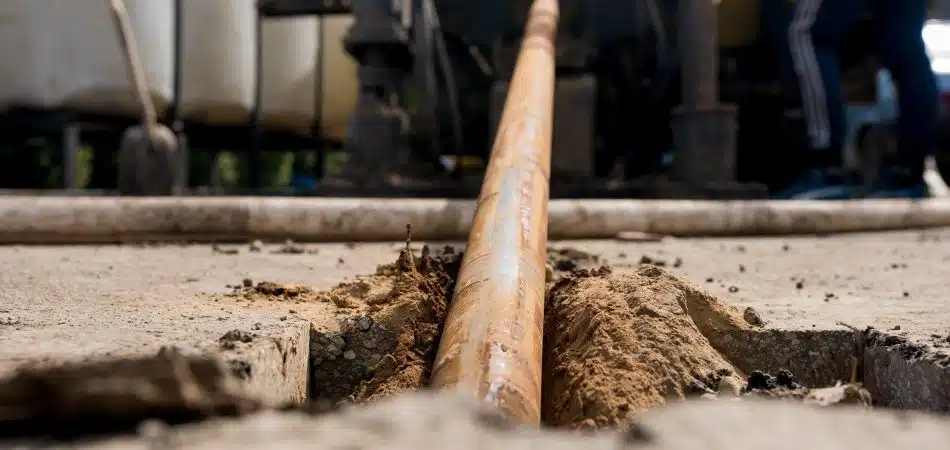
A commercial water line can be replaced by opening a trench along its route or by boring a new path underground between two access pits. Both methods put the same pipe in the ground, and the choice usually turns on what covers the route rather than on the pipe itself. Tennessee law counts boring and trenching alike as excavation, so the same utility notification window applies to each. On a working commercial property, restoration of pavement and landscaping is often the factor that settles the decision.
It usually starts with a damp patch in the parking lot that stays wet long after everything around it has dried. Maintenance drops a cone over it. A few weeks later the water bill lands with a number nobody can explain, and the damp patch is now a soft spot.
By the time a commercial water service announces itself that way, the plumbing part of the decision is already made. Something is coming out of the ground and something new is going back in. The argument that follows is rarely about pipe. It is about the forty striped spaces sitting on top of the route, the drive lane the fire marshal cares about, and the loading approach that trucks hit at six every morning.
There are two ways to get that new line in the ground, and the honest version of the comparison has less to do with plumbing than most property managers expect.
Both approaches end with the same product in the ground, which is a continuous pressurized water service running from a connection point to a building. The difference is entirely about access. One method opens the whole route from above, and the other reaches the route from two ends and leaves the middle closed.
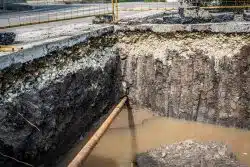 An open trench follows the pipe route on the surface. A machine removes pavement or turf, excavates to depth along the line, and the crew works in the open with the full run visible. Backfill goes in behind the work in lifts, and the surface gets rebuilt afterward. The method is old, well understood, and it gives direct eyes on every foot of the new line and every connection along it.
Directional boring starts from an entry pit and drives a steered bore head along a planned underground path toward a receiving pit. The bore is then enlarged and the new pipe is pulled back through the opening. The ground between the two pits stays closed. On a commercial site that difference can mean a parking field keeps operating while the work happens beneath it.
Real projects rarely land cleanly in one camp. A bore still calls for open excavation at the entry pit, the receiving pit and at every tie-in point, and a trench job may still bore a short segment to pass under one obstacle. Describing a project as purely one method or the other tends to oversimplify what will actually be dug up.
Pipe material selection, joint quality, depth of cover, thrust restraint and disinfection of a new potable line are governed by the applicable code and by the water purveyor’s own standards. Those requirements do not soften because a line was installed without a continuous trench. Bore or trench, the finished service answers to the same rules.
The route surface carries more weight in this decision than most other factors combined. A line crossing an open field and a line crossing a full parking area are the same plumbing problem with completely different answers, because the cost of putting the surface back is not the same in the two cases.
Asphalt and concrete have to be saw cut, removed, disposed of and replaced, and the patch has to be built back to a standard the property owner and the local jurisdiction accept. Curbing, wheel stops, striping and accessible parking markings are all part of that restoration. A bore that passes beneath the pavement avoids most of that work along the closed portion of the route, and the commercial water line boring page sets out how that scope is put together.
Root systems complicate an open cut, and cutting through a root plate can compromise a tree that took decades to establish. Root intrusion is also a common reason a line failed in the first place, and this look at signs that tree roots are damaging water lines covers the symptoms that point at it.
East Tennessee sits on terrain where rock can appear at shallow depth in one part of a property and stay well down in another. Rock affects both methods, though not identically. Boring depends on being able to steer through the material along the planned path, and an open cut depends on being able to excavate and then shore a safe working space.
Gas, electric, communications, sewer, storm drainage and irrigation all share the corridor around a commercial building. Every one of those has to be located before work begins, and the density of that congestion often decides the approach.
 Utility notification in Tennessee is a legal step rather than a courtesy, and it applies to both methods equally. A property manager who assumes a bore sidesteps the process because no continuous trench gets opened has misread how the statute defines the activity being regulated here.
The Tennessee Public Utility Commission states that notice has to be given “at least three (3), but not more than ten (10) working days prior to beginning the work.” That is a window with a floor and a ceiling, so a notice filed far in advance can age out before the work starts, and a locate ticket may have to be refreshed on a project that slips.
The same commission material defines excavation as “an operation for the purpose of the movement, placement, or removal of earth, rock, or other materials” and gives examples that include “auguring…boring…ditching…drilling…trenching.” Boring and trenching sit in the same list. The obligation to notify does not depend on which of the two a contractor selects.
Once facilities are marked, the protected strip is described as “a strip of land at least four feet (4′) wide, but not wider than the width of the utility plus two feet (2′) on either side of the utility.” Working inside that strip calls for care in how the ground gets opened, and the facility owner has a say in the methods used near its line.
Earth disturbance on a commercial site can trigger stormwater permitting. The Environmental Protection Agency describes coverage for construction reaching “1 acre or more of land, or less than 1 acre of land, but that is part of a common plan of development or sale that will ultimately disturb 1 or more acres,” and a project of that scale should confirm its obligations with the permitting authority. Commercial plumbing work in Tennessee falls under the 2021 International Plumbing Code, and the permit itself is issued by the City of Knoxville for addresses inside city limits or by Knox County Codes Administration for unincorporated addresses. Contractors handling this work are listed among Knoxville plumbing services.
A property that has to keep trading during the work is a different problem from a vacant pad. Once the plumbing question is settled, what remains is a business question about access, phasing, restoration and the risk that something unexpected turns up partway along the route.
Closing a drive lane through a lunch rush, or taking a row of spaces out of service for several days, has a cost that does not appear on a plumbing estimate. Boring tends to compress that exposure because the closed portion of the route stays closed, though the pits at each end still occupy space and still call for protection and traffic control.
Pavement replacement, curb repair, restriping and planting repair can rival the plumbing scope on a heavily finished site. Comparing two proposals fairly means checking that each one states clearly who restores what, to what standard, and whether that work sits inside the quoted figure or outside it. Buried systems beyond the water service are covered on the commercial underground plumbing page.
Open excavation keeps a real advantage where the existing line has to be inspected along its length, where multiple connections come off the run, where the route is short and unpaved, or where conditions underground are poorly documented. Visibility has value. A method that leaves the middle of the route unseen also leaves whatever is wrong in that middle unseen.
A prudent practice is to ask any bidder how the route was investigated, who files the 811 notice and when, what happens to the schedule and the price if rock or an unmarked utility appears, which surfaces get restored and to whose standard, and who holds responsibility for traffic control and site protection while the pits are open. Written answers make two proposals comparable.
Our team at Tennessee Standard Plumbing works across Knoxville, Knox County and the surrounding East Tennessee communities on commercial water lines, underground plumbing, drain repair and leak detection. Most of the commercial water line calls we take start as a pressure complaint or a wet spot in a parking area rather than as a request for a particular installation method.
Four things are worth holding onto. Boring and open cutting install the same pipe, and the surface above the route usually decides between them. Tennessee law counts both as excavation, with a notice window of at least three and not more than ten working days. The marked tolerance zone is a strip at least four feet wide. And restoration scope belongs in writing in any proposal, because that is where two bids most often stop being comparable.
Property managers weighing a water line replacement can reach our team at (865) 352-9003 or schedule a visit online. We serve Knoxville, Farragut, Powell, Oak Ridge, Maryville, and communities across Knox County, Blount County, Anderson County and East Tennessee. Peaceful Pipes, Peaceful Life.
No. Tennessee Public Utility Commission material lists boring alongside trenching, drilling, auguring and ditching in its examples of excavation. The notice window of at least three and not more than ten working days applies to a bore the same way it applies to an open cut.
It depends on the site, and no general figure holds. Boring often reduces surface restoration, which is frequently the largest cost on a paved commercial property. On an open unpaved route with a short run, an open cut can come in lower. The comparison only becomes real once both proposals state their restoration scope.
Yes. A bore needs an entry pit and a receiving pit, and open excavation at any tie-in point. The route between the pits stays closed, which is the part that protects pavement and root zones, but the ends are still open excavation and still need protection and traffic control.
Tennessee describes it as a strip of land at least four feet wide, and not wider than the width of the utility plus two feet on either side. It sets the protected area around a marked facility, and it shapes how equipment is allowed to approach a located line during the work.
It depends on the address. Properties inside Knoxville city limits go through the City of Knoxville, and properties in unincorporated Knox County go through Knox County Codes Administration. Confirming which office has jurisdiction before scheduling avoids a delay at inspection.
The Tennessee State Fire Marshal’s Office lists the 2021 International Plumbing Code among currently adopted codes, effective April 17, 2025. The residential code is a separate document and a different edition, so a commercial project should not be scoped from residential requirements.
Sometimes, though congestion raises the stakes for any method. The quality of the locate work matters more than the method chosen. Where records are poor or marks are ambiguous, additional investigation before work begins is a reasonable step regardless of which approach is planned.
It can. The Environmental Protection Agency describes construction stormwater coverage applying at one acre or more of disturbance, or less than one acre when the work is part of a common plan of development that will ultimately disturb one or more acres. The applicable permitting authority should confirm the requirement for a specific project.
That varies by length, depth, ground conditions, tie-in complexity, permitting and restoration scope, so a general duration would be misleading. A written schedule tied to a specific route and a specific restoration standard is more useful than any average.
Abandonment in place is common where a new route is bored, and it is often acceptable, but the decision belongs to the plans reviewer and the water purveyor rather than to preference. Requirements for capping, disinfection of the new line and documentation of the abandoned segment should be confirmed with the applicable office.



Many people suffer from terrible water pressure without realizing that it can be easily solved by a plumbing expert. Many of the homes where we ... Read More

The baking soda and vinegar method is a popular, eco-friendly approach for clearing minor clogs and odors in drains. This method relies on a simple... Read More

Preparing home plumbing before a long trip starts with reducing pressure and limiting the chance of leaks or freeze damage. Closing the main shutof... Read More