
Irrigation Backflow Assembly Shutdown Timing for West Knoxville and Farragut Lawns
Irrigation backflow assemblies are mounted above ground, which puts them ahead of buried pipe in the order things freeze on a property. The Nationa... Read More

Same-Day Service Available
Need a Plumber in Knoxville? We’re Ready to Help!




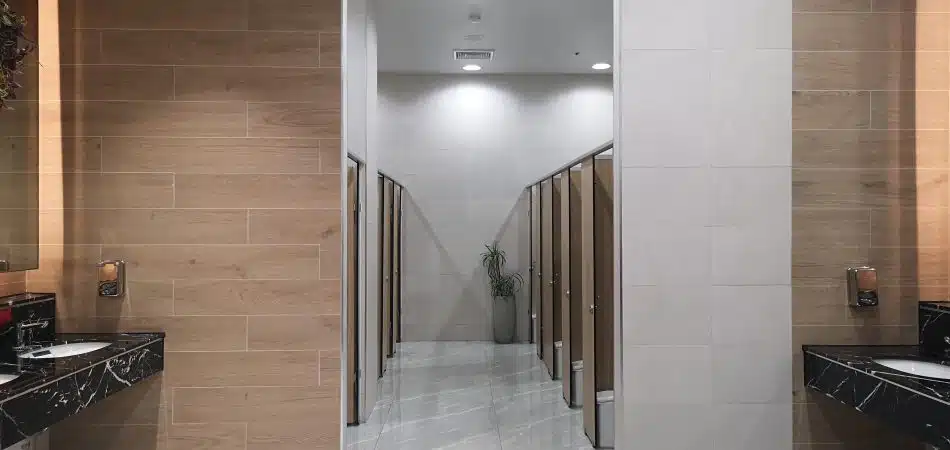
Commercial restroom requirements in Tennessee sit in three separate layers. Fixture counts come from the International Plumbing Code, adopted in its 2021 edition, using occupancy classification and occupant load rather than floor area alone. Accessibility clearances and heights come from the 2010 ADA Standards for Accessible Design and apply independently of the fixture count. Permits and inspections come from the local authority, which in Knoxville is the city for addresses inside the limits and the county for unincorporated property. Each layer answers a different question, and a project satisfies all three or none.
A lease gets signed. A layout gets drawn. Somebody orders fixtures. And then a plans reviewer asks how many water closets the occupant load calls for, and the project stops while everyone works out an answer that should have existed weeks earlier.
Restroom requirements are the part of a commercial fit-out that Knoxville business owners most often meet late, and lateness is what makes them expensive. The requirements themselves are not unreasonable. They are just driven by inputs, occupancy classification and occupant load, that a tenant rarely has to hand when the layout is being sketched.
Fixture counts are not a function of square footage. They come from the occupancy classification assigned to a space and the occupant load calculated for it, run through the minimum fixture table in the plumbing code. Two tenants in identical suites can land on different counts because their uses classify differently.
Tennessee has adopted the International Plumbing Code in its 2021 edition, effective April 17, 2025, alongside the 2021 International Building Code. Commercial work sits there rather than in the residential code that governs one and two family dwellings. Contractors and owners quoting residential sections at a commercial plans review are working from the wrong book.
 A space classified as assembly carries different fixture expectations than one classified as business or mercantile. Restaurants, retail, offices and warehouses are treated differently on purpose, because the number of people present and how long they stay are different. Classification is established through the building code and confirmed at plans review, not decided by preference. Businesses planning work can review commercial plumbing installation services alongside the design.
Section 403.1 of the plumbing code sets the minimum number of required plumbing fixtures, with the counts themselves in the accompanying table. Applying that table takes an occupancy classification and an occupant load figure, which is why an accurate answer arrives from a designer or a plans reviewer rather than from a general article. Anyone quoting a fixture count without those two inputs is guessing.
Tennessee rules include a provision under which certain business and storage occupancies not intended for use by the general public, and having the required fixtures within 500 feet of the nearest door, are not required to have the minimum toilet facilities within the structure itself. That provision is narrow and its application to a specific building is a plans review question. Facility teams should raise it rather than assume it, and confirm it against the current rule text.
Accessibility is a separate layer from fixture counts, governed by the 2010 ADA Standards for Accessible Design. A restroom can carry the right number of fixtures and still fail on clearances. The dimensions below come from the standards themselves rather than from a rule of thumb.
The standards call for clearance around a water closet of 60 inches minimum measured perpendicular from the side wall and 56 inches minimum measured perpendicular from the rear wall. Seat height sits at 17 inches minimum and 19 inches maximum above the finish floor, measured to the top of the seat. Fixtures and obstructions are kept out of the required clearance.
Lavatory rim or counter surface height sits at 34 inches maximum above the finish floor. Knee clearance runs 27 inches minimum from the floor, measured 8 inches back from the front edge. Those two dimensions together are what a vanity or counter design either accommodates or does not, and they are frequently where a stock cabinet fails.
Adding a fixture takes plumbing work. Finding 60 inches of clear width beside a water closet takes wall movement, and wall movement takes structure, electrical and mechanical coordination. That is why accessibility is worth checking at the sketch stage rather than after a layout is approved internally. The United States Access Board chapter on plumbing elements and facilities publishes the governing text.
Requirements can apply differently to an alteration in an existing building than to new construction, and the analysis depends on scope, feasibility and the specific work being done. That is a determination for the design professional and the authority reviewing the project. General Knoxville plumbing services can execute the work once that determination exists, but the determination itself belongs to the reviewer.
 Not every restroom project is a permit conversation. Replacing a faucet with an equivalent faucet generally is not. Moving a fixture, adding a fixture, altering drainage or venting, or changing what a space is used for generally is, and the difference matters before demolition starts rather than after.
Paint, mirrors, partitions and like-for-like fixture swaps sit on the cosmetic side in most cases. Anything that relocates a drain, adds a fixture to a branch, changes a vent arrangement or alters occupancy sits on the other side. Facility managers save time by asking the reviewing office where a specific scope falls rather than deciding internally.
The City of Knoxville obtains separate permits for electrical, plumbing, gas and mechanical work rather than bundling them into one. A restroom renovation frequently touches at least two of those. Sequencing the applications matters when a project has a hard opening date attached to it.
For multi-family and commercial construction exceeding $24,999.99, the City of Knoxville states that the work is performed by a general contractor holding a State of Tennessee contractor license with the appropriate classification and monetary limit. Separate permits are still obtained for the plumbing, electrical, gas and mechanical scopes within that project.
Commercial restrooms frequently involve connections that a utility cross-connection control program treats as requiring protection, and mop sinks and janitorial connections are common examples. Requirements come from the serving utility’s program rather than being uniform, and this look at why Knoxville businesses face annual backflow testing covers the reasoning.
Three offices answer three different questions, and sending a question to the wrong one wastes a week. Knowing which is which is most of the value in understanding this framework at all, particularly for an operator opening a first location.
City of Knoxville Plans Review and Inspections handles plans review, permits and inspections for addresses inside the city limits. Plumbing permit applications go to 400 W Main Street, Suite 475, Knoxville, TN 37902, or by email to the building inspections address the city publishes. The Chief Plumbing, Gas and Mechanical Inspector can be reached at (865) 215-3109.
Property outside the city limits but inside Knox County goes through Knox County Codes Administration, reachable at (865) 215-2325. City requirements and county requirements are administered separately, so an answer from one office does not describe the other.
Fixture selection affects operating cost across a building’s life, and commercial restrooms are where most of a non-industrial building’s water goes. EPA publishes guidance for commercial facilities on water use and efficient fixtures through its WaterSense commercial buildings material. Efficiency choices sit on top of code compliance rather than replacing any part of it.
Classification and occupant load first, fixture count second, accessible layout third, permit application fourth, installation last. Projects that run that order rarely get surprised. Projects that start with a layout and work backward tend to discover the constraint after the drawings are paid for. The commercial plumbing services side of a project fits into that sequence at the end rather than the beginning.
Our team at Tennessee Standard Plumbing has worked with Knoxville businesses, restaurant operators and property managers across Knox County and East Tennessee for more than 13 years. The company reports a 5.0 Google rating across more than 1,000 reviews, HomeAdvisor Elite Service recognition and a team of more than 50 technicians.
Four things are worth holding onto. Commercial restrooms fall under the 2021 International Plumbing Code, not the residential code. Fixture counts come from occupancy classification and occupant load rather than from floor area. Accessibility clearances are a separate layer and break more layouts than fixture counts do. And the office that answers a permit question depends on whether the address sits inside the Knoxville city limits.
Businesses planning a restroom build or renovation can reach our team at (865) 352-9003 or get a free estimate online. We serve Knoxville, Farragut, Maryville, Oak Ridge, and communities across Knox County and East Tennessee. Peaceful Pipes, Peaceful Life.
There is no answer that applies across businesses. Counts come from the occupancy classification assigned to the space and the occupant load calculated for it, run through the minimum fixture table in the plumbing code. A designer or plans reviewer produces the number once those two inputs exist.
The International Plumbing Code, which the State Fire Marshal’s Office lists as adopted in its 2021 edition effective April 17, 2025, alongside the 2021 International Building Code. One and two family dwellings fall under the International Residential Code, adopted in its 2018 edition. Commercial work sits in the plumbing code rather than the residential one.
The 2010 ADA Standards call for 60 inches minimum measured perpendicular from the side wall and 56 inches minimum measured perpendicular from the rear wall. Seat height sits between 17 and 19 inches above the finish floor measured to the top of the seat. Other fixtures and obstructions are kept out of that clearance.
Rim or counter surface height sits at 34 inches maximum above the finish floor, and knee clearance runs 27 inches minimum from the floor measured 8 inches back from the front edge. A stock vanity cabinet frequently fails the knee clearance requirement, which is why the dimension belongs in the design rather than in the punch list.
It depends on the scope. Paint, mirrors, partitions and like-for-like fixture swaps generally sit on the cosmetic side. Relocating a drain, adding a fixture, altering venting or changing occupancy generally does not. Asking the office that reviews work at that address, with a written scope description, settles it before demolition.
City of Knoxville Plans Review and Inspections covers addresses inside the city limits, with plumbing applications going to 400 W Main Street, Suite 475, and the Chief Plumbing, Gas and Mechanical Inspector reachable at (865) 215-3109. Unincorporated Knox County property goes through Knox County Codes Administration at (865) 215-2325.
The City of Knoxville obtains separate permits for electrical, plumbing, gas and mechanical work rather than bundling them. A restroom renovation commonly touches more than one of those trades, so sequencing the applications matters when a project has a fixed opening date.
Tennessee rules include a provision for certain business and storage occupancies not intended for use by the general public, where the required fixtures sit within 500 feet of the nearest door. The provision is narrow, and whether it applies to a particular building is a plans review question rather than an assumption to make in-house.
Requirements can apply differently to an alteration than to new construction, and the analysis turns on scope, feasibility and the specific work being done. That determination belongs with the design professional and the authority reviewing the project rather than with the installing contractor.
Janitorial and mop sink connections are common examples of connections a cross-connection control program treats as requiring protection. The specific requirement comes from the serving water utility’s program rather than being uniform, so confirming with that utility is the reliable step during design.



Irrigation backflow assemblies are mounted above ground, which puts them ahead of buried pipe in the order things freeze on a property. The Nationa... Read More

Tankless water heaters heat water instantaneously without the use of a storage tank. When a hot water faucet is turned on, cold water flows through... Read More

East Tennessee weather significantly impacts residential plumbing, primarily due to rapid temperature fluctuations, high humidity, and intense seas... Read More