
Same-Day Service Available
00
Hrs
00
Mins
00
Secs
Need a Plumber in Knoxville? We’re Ready to Help!
Same-Day Service Available
Need a Plumber in Knoxville? We’re Ready to Help!
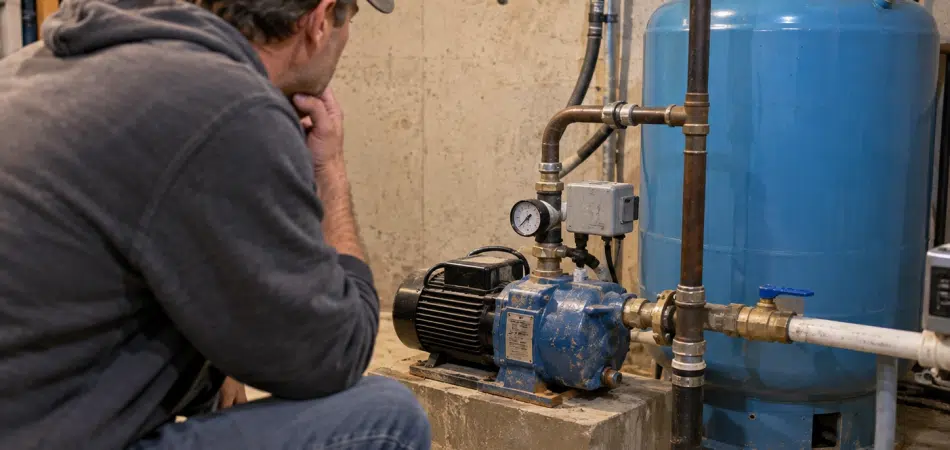
The pump gets blamed for almost everything. Weak pressure, air spitting out of the kitchen tap, a motor that starts and stops all afternoon: all of it comes out as “the pump is going.” Often the pump is fine and is being destroyed by something else.
The component that most often causes the trouble is the pressure tank sitting next to it, and the difference matters because one of those repairs is straightforward and the other is not, particularly on a well deep enough to need a submersible. Out here that also means a drive, and nobody out here wants to pay for one truck visit to diagnose and a second to fix something that could have been narrowed down on the phone.
So this page skips the general symptom list and does two harder things instead: sorting out which type of pump a property has, and separating a pump fault from a tank fault, a well that has run short, or a tripped breaker. None of it is a repair instruction. These systems combine water with circuits that are frequently 240 volts, and everything described here stops short of opening anything.
Two designs dominate private wells, and they fail differently. A submersible pump sits down in the well and pushes water up. A jet pump sits above ground, usually near the pressure tank, and draws water up by suction. The visible equipment identifies which one a property has.
A jet pump is a visible piece of machinery, typically mounted near the pressure tank in a crawl space, basement, garage, or pump house, with piping running out toward the well. It is audible when it runs and warm to the touch after it has been running.
Jet systems come in shallow-well and deep-well arrangements. The deep-well version uses two pipes to the well rather than one, which is often visible at the wellhead.
Jet pump and submersible pump systems compared
General description of the two common private well configurations. Which design is installed on a given property is confirmed by inspection.
A submersible system leaves nothing above ground except the wellhead casing, the pressure tank, the switch, and the gauge. The pump itself hangs in the water column, connected by a single pipe and a power cable.
A quiet system with no visible motor is the usual signature. Submersible installations are common on deeper wells, which cover a good deal of rural Blount County, including much of the area served from the Friendsville plumbing page.
Access is the practical difference. A jet pump can be inspected, tested, and often serviced where it stands. A submersible pump cannot be looked at without pulling it from the well, which is a different scale of job with different equipment.
The symptom sets differ too. Loss of prime, which produces a running motor delivering nothing, is a jet pump behavior. It is not something a submersible pump does, because a submersible pump sits under water.
These two get blamed for each other constantly. A pressure tank stores water under pressure so the pump does not run every time a tap opens. When the tank loses its air charge or its internal bladder fails, the pump starts cycling rapidly, and the pump gets blamed for a tank fault.
The tank holds a cushion of compressed air above the water. Drawing water lets that air expand and push water out, which is what delivers flow between pump cycles. The pump only starts when pressure falls to the cut-in point.
When the air cushion is gone, the tank holds almost no usable volume, so the pump starts and stops in quick succession every time water is used. That is rapid cycling, and the mechanism behind it is explained further in how a failing pressure tank causes air in the lines.
Starting is the hardest thing an electric motor does. A pump forced to start dozens of times when it should start once is being worn out by a fault in a different component.
That is the sequence that turns a tank repair into a pump replacement when it is left alone. Replacing a pump without addressing the tank sets the new pump on the same path.
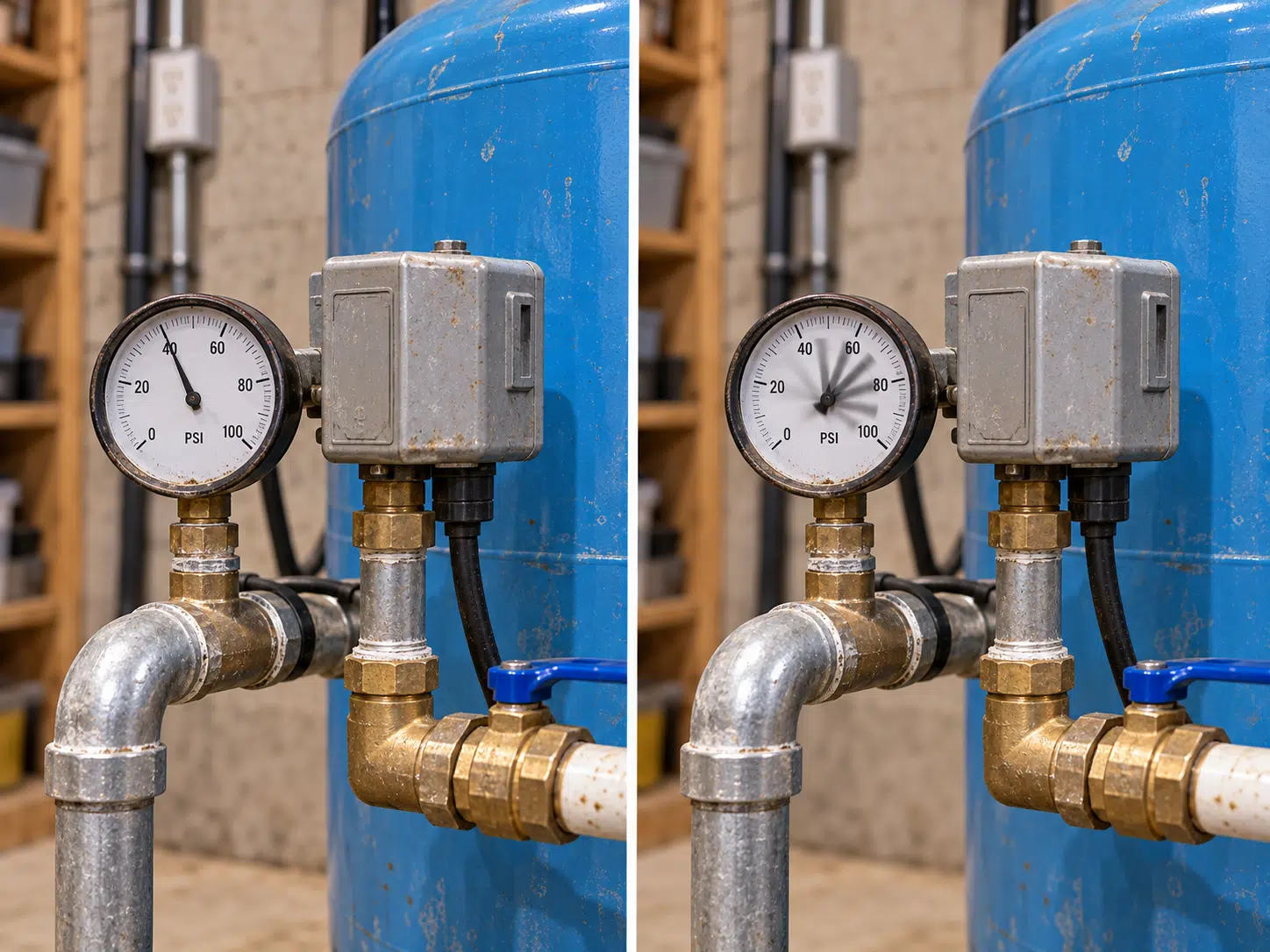 The pressure gauge on the tank shows system pressure and how it moves. Pressure that climbs steadily, holds, then falls slowly as water is used describes a system doing its job. Pressure that jumps up and drops away within seconds describes a tank with no usable storage.
What the gauge cannot show is why. Air charge, bladder condition, switch settings, and well yield all appear at the same gauge, which is why reading it is a starting point rather than a conclusion.
Two other causes account for a large share of well complaints. The first is electrical: a tripped breaker, a failed pressure switch, or a control problem. The second is the well itself. A pump cannot deliver water that the well is not producing, and low yield looks like pump failure from inside the house.
No water at all, with no noise from the system, frequently means the circuit is off rather than the pump is finished. Checking whether the breaker has tripped is reasonable. Resetting it repeatedly is not, because a breaker that keeps tripping is reporting a fault it exists to protect against.
The pressure switch is another common failure point, and it is a component that carries line voltage. Contacts inside it wear and pit over years of cycling. That is work for someone equipped to do it safely.
A well has a recovery rate, and heavy use can draw the water level down faster than the formation refills it. Symptoms cluster around laundry days, irrigation, or several showers in a row, then improve after the system rests.
That pattern points at the well, not the pump. Drought conditions and nearby drilling or construction can both change a well’s behavior, which is one reason EPA recommends retesting after “land disturbances, and new construction or industrial activity” nearby.
Grit at aerators, cloudy water, or a sudden change in taste or smell are water quality signals rather than mechanical ones, though sediment does eventually wear pump components.
A change of that kind is one of EPA’s stated triggers for testing sooner than the annual schedule, alongside flooding and repairs to the well system. Blount County publishes that it performs bacteriological analysis on private supplies on request through the Blount County Department of Environmental Health.
A short list of observations is safe and genuinely useful to whoever takes the call: whether the outage affects the whole property, what the pressure gauge is doing, whether the pump is audible, whether the breaker has tripped, and whether the trouble follows heavy water use.
Whether every fixture is affected or only some. Whether the pump can be heard starting and stopping, and how often. What the gauge reads at rest and while water runs. Whether the problem started suddenly or built up over weeks. Whether it tracks with laundry, irrigation, or a full house.
Those five answers narrow the field substantially and shorten a visit that may involve a long drive across rural Blount County.
Well systems combine water with electrical circuits that are frequently 240 volts. Opening a pressure switch, wiring a control box, adjusting switch settings, or pulling a submersible pump are not household tasks.
Adding air to a pressure tank sounds simple and is a common place for well-meaning attempts to make things worse, because the correct charge depends on the switch settings and has to be set with the system depressurized.
The distinction that matters in Tennessee is between the well and the plumbing. EPA advises hiring “a certified well driller for any new well construction, modification, or abandonment and closure.” The pump, the pressure tank, the switch, and the piping into the house sit on the other side of that line, as well as plumbing work.
On contractor credentials generally, the Tennessee Board for Licensing Contractors sets state requirements, and credentials can be checked through the state’s license verification search.
The useful question is not whether the well system has a problem. It is which component has the problem. A tank that has lost its air charge, a worn pressure switch, a tripped breaker, and a well that is running short of water all produce symptoms that look like a failing pump from inside the house.
Start by working out whether the pump is a jet or a submersible, because that changes what can be inspected without pulling anything. Rapid cycling usually points to the tank rather than the pump. And symptoms that follow heavy use and then recover point to the well itself.
Tennessee Standard Plumbing services well systems across Friendsville and rural Blount County, covering pumps, pressure tanks, switches, and the piping into the house, as part of what Knoxville’s local plumbing team handles.
Call (865) 352-9003 or book an appointment, and our team can work through what is actually failing.
We serve Friendsville, Maryville, Rockford, and communities across Blount County, Knox County, and East Tennessee.
Look for machinery above ground. A jet pump is a visible motor and pump assembly, usually near the pressure tank, with piping running toward the well, and it is audible when it runs. A submersible system leaves only the wellhead casing, pressure tank, switch, and gauge visible, because the pump hangs in the water.
Rapid cycling usually indicates the pressure tank has lost its air charge or its internal bladder has failed, so the tank holds almost no usable water. The pump then restarts every time a small amount is drawn. The pump is generally the victim of that fault rather than its cause.
Yes. Starting is the hardest thing an electric motor does, and a pump forced to start dozens of times where it should start once wears out faster. Replacing a pump without addressing the tank that caused the cycling sets the new pump on the same path.
On a jet pump system that often points to a loss of prime, because a jet pump draws water by suction and needs water in the line to do it. A submersible pump cannot lose prime because it sits under water, so the same symptom on a submersible system points elsewhere.
Checking whether a breaker has tripped is reasonable. Resetting it repeatedly is not. A breaker that keeps tripping is reporting a fault it exists to protect against, and repeated resets risk damaging equipment. That situation needs someone equipped to test the circuit.
That pattern points at well yield rather than at the pump. A well has a recovery rate, and sustained heavy use can draw the water level down faster than the formation refills it. Symptoms that appear during heavy use and improve after the system rests are the signature.
It is not as simple as it sounds. The correct air charge depends on the pressure switch settings and has to be set with the system depressurized, so guessing at it commonly makes the problem worse. This is a job for someone who can check the switch settings at the same time.
Several things can, including a pressure tank that has lost its charge, a well drawing down to the point of pulling air, or a leak on the suction side of a jet pump system. Because the causes are different in kind, the sensible next step is diagnosis rather than parts replacement.
It depends on the component. EPA advises hiring a certified well driller for new well construction, modification, or abandonment and closure. The pump, pressure tank, pressure switch, and the piping into the house are plumbing system components.
EPA lists replacing or repairing any part of the well system as one of the circumstances that calls for testing sooner than the annual schedule. The same list covers flooding, nearby land disturbance or new construction, and any change in the odor, color, or taste of the water.
Same-day Service Available
Mon – Fri: 7:30 am – 5:00 pm