
How Much Does It Cost to Install a Circulator Pump? A Simple Guide for Homeowners
The average cost to install a circulator pump ranges from $400 to over $1,500, depending on the type of system and installation complexity. A simpl... Read More

Same-Day Service Available
Need a Plumber in Knoxville? We’re Ready to Help!




Cast iron drain stacks in older homes fail from the inside out. Waste and water scour the crown of the pipe while rust builds along the bottom, and the wall thins unevenly rather than uniformly. Exterior appearance stays reassuring right up until a leak or a collapse, which is why visual checks alone give false comfort. Published lifespan ranges for cast iron drain piping differ so much between sources that they cannot be applied to one address with confidence. A camera inspection of the actual stack is what turns guesswork into a decision.
The line shows up on home inspection reports across North Knoxville often enough to have its own rhythm: cast iron drain, waste and vent piping, age consistent with original construction, further evaluation recommended. Buyers read it and reasonably want to know whether that sentence means anything expensive.
It is a fair question, and the honest answer is that the material itself does not carry an expiry date.
What it carries instead is a set of conditions worth checking, and a failure pattern that looks nothing like a burst supply line.
A drain stack is the vertical pipe carrying waste down from upper-floor fixtures and carrying air up through the roof. In pre-1970 construction, that stack is usually cast iron. It handles two jobs at once: moving waste under gravity and keeping the whole drainage system vented so traps hold their water seals.
Bathroom groups tie into the stack through branch lines, and a second-floor bathroom sitting above a first-floor bathroom typically shares one stack. That shared arrangement is why a problem inside the stack shows up at several fixtures at once rather than at a single sink. Households in North Knoxville neighborhoods with original bathrooms often have exactly this stacked layout.
The section above the highest fixture is vent rather than drain, and it lets air replace the volume of water leaving the system. Corrosion or blockage up there produces gurgling drains, traps that lose their seal, and sewer odor in rooms that were fine last year. Those symptoms get blamed on clogs and treated with drain cleaner, which addresses nothing.
Older cast iron joints were made with oakum and molten lead poured into a hub. Those joints are durable, but they are also a place where movement, settlement, or corrosion shows first. Newer work uses no-hub couplings with stainless bands, and a mixed-vintage system frequently carries both.
Cast iron is quiet, fire-resistant, and strong enough to sit inside a wall carrying loads for generations. Nothing about the choice was a mistake. The material simply has a finite service life under constant exposure to waste, moisture, and oxygen, and pre-1970 systems are working through it.
Corrosion attacks the inside surface where waste sits and moves. Rust forms, layers build, and the metal underneath thins. The pattern is uneven: the invert, meaning the bottom of a horizontal run, usually thins fastest because it stays wet. The result is a pipe that looks intact and is not.
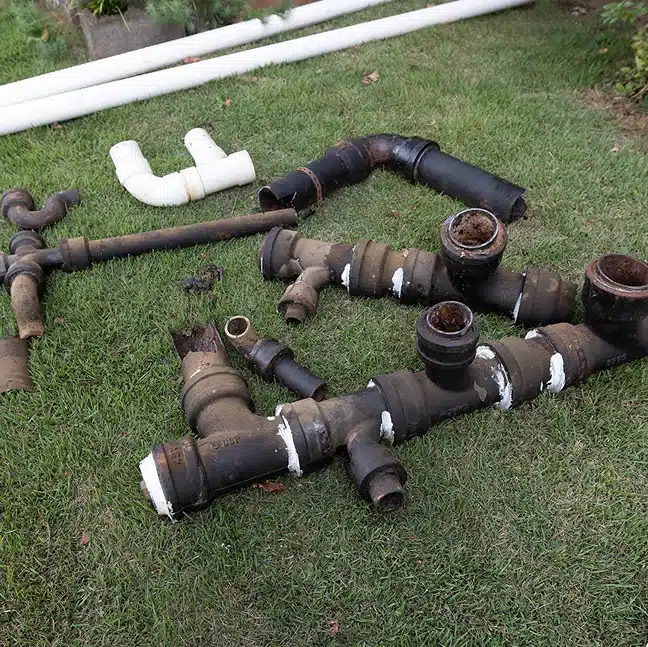 The rust layers form nodules that trade a smooth bore for a rough one. Rough walls catch solids, paper, and grease, so a stack that once cleared everything starts to hold material. Clearing a clog restores flow briefly, then the same branch clogs again because the surface that caused it is still there. That repeat pattern is the diagnostic clue.
Failures usually begin as small thin spots that weep rather than as a sudden break. Water stains on a basement ceiling underneath an upstairs bathroom, or a damp patch on a wall near a stack, deserve attention even when nothing is dripping. A camera run through the line is how that gets confirmed, and sewer camera inspection is a standard service for exactly this question.
EPA reports, in its work on fats, oils, and grease, that grease from restaurants, homes, and industrial sources accounts for 47 percent of reported blockages according to its Report to Congress on combined and sanitary sewer overflows. In a rough-walled older stack, grease has far more to cling to. Kitchen habits therefore change how quickly an aging line reaches trouble, as covered by the EPA fats, oils, and grease program.
Horizontal runs under a slab or in a crawl space sit wet longer, get less air movement, and are harder to inspect. Sources describing cast iron condition consistently treat these sections as the higher-risk part of a system, and the difficulty of access is part of why problems there go unnoticed longer.
Homeowners ask how long cast iron drain pipe lasts and expect a clean answer. The honest response is that published ranges disagree with one another by decades, and the drivers behind that spread are specific to each building. A number cannot substitute for looking. The Knoxville plumbing team gets asked this weekly.
Trade and inspection sources put cast iron drain piping anywhere from a couple of decades in unfavorable slab conditions to a century in favorable ones. That spread is not a rounding difference; it is a sign that the variables outweigh the average. Quoting the midpoint as though it applied to one house would be a guess dressed up as data.
Metal quality and wall thickness at manufacture, what has been poured down the drains for fifty years, whether the run is vertical or horizontal, whether it sits in soil or open air, and how well the system was sloped and vented at installation all matter. Two houses on the same North Knoxville street can be decades apart in real condition.
Camera inspection shows the bore, the joints, standing water, and any breaks. Combined with a record of which fixtures have backed up and when, it produces a picture worth deciding from. Replacing a sound pipe on the strength of a build year wastes money, and ignoring a failing line on the strength of the same build year costs more.
Once a condition report exists, three broad routes open up. Spot repair addresses one damaged section. Lining rehabilitates a run without full removal where the host pipe still has enough structure. Full replacement removes the old material entirely. Cost and disruption climb across that order, and so does the length of the fix.
A single failed joint or one short damaged section in accessible pipe can often be cut out and replaced with modern material joined by no-hub couplings. This works well when the rest of the run inspects cleanly. It works poorly when the camera shows similar thinning up and down the line, because the next failure is already forming.
Trenchless lining methods rehabilitate a pipe from the inside and reduce demolition. Suitability depends on the host pipe having enough remaining structure, on the diameter, and on the bends and connections along the run. It is a real option rather than a universal one, and a camera survey is what determines whether it applies to a given stack.
When a system shows widespread thinning, repeated backups across multiple branches and joints that have already begun to fail, replacing the drainage piping ends the cycle rather than postponing it. Pairing that work with a planned bathroom renovation reduces the total disruption, since opening walls is the costly part. Households facing this pattern often recognize it first through recurring backups in an older home.
Drainage replacement work generally involves a plumbing permit and inspection, and the authority depends on the address. Properties inside Knoxville city limits go through City of Knoxville Plans Review and Inspections. Properties in unincorporated Knox County go through Knox County Codes Administration at (865) 215-2325. Requirements vary by address and scope, so confirming with the applicable codes office before work starts is the practical step.
Our team at Tennessee Standard Plumbing has spent more than 13 years working on drains, sewer lines, and repipes across North Knoxville, Knox County, and the surrounding East Tennessee communities. The company reports a 5.0 Google rating across more than 1,000 reviews, HomeAdvisor Elite Service recognition, and more than 50 technicians on the team.
Four things are worth holding onto. Cast iron drain piping corrodes internally, so appearance is unreliable. Published lifespan ranges disagree too much to plan around. Repeat clogs in one branch, returning odor, and ceiling stains are the signals that earn a camera inspection. And repair, lining, and replacement are all real answers, chosen from what the camera shows.
Homeowners who want the inside of an old stack looked at can reach our team at (865) 352-9003 or schedule your service online. We serve North Knoxville, Fountain City, Halls, Powell, and communities across Knox County and East Tennessee. Peaceful Pipes, Peaceful Life.
Published ranges differ by decades depending on the source and the conditions described, so a single figure is not a reliable planning tool for one house. Metal quality, whether the run is vertical or buried, drainage habits, and installation all move the outcome. A camera inspection of the actual stack answers the question for a specific address.
Not reliably. Cast iron corrodes on the inside surface, so the exterior can look sound while the bore has thinned. Flaking rust and dampness at the base of a stack are worth noting, but they indicate an advanced problem rather than an early one. Interior condition needs a camera.
Because clearing removes the blockage but not the rough interior surface that caught it. Rust nodules inside an aging cast iron line give solids, paper, and grease something to hold onto. A repeat pattern in the same branch is one of the stronger reasons to inspect rather than clear again.
Common causes include a trap that has dried out from disuse and a vent problem that lets traps siphon their water seals away. Corrosion or blockage in the vent portion of a stack produces gurgling drains alongside the odor. Chemical drain cleaner does not address either cause.
It does, particularly in an older pipe with a rough interior. EPA attributes 47 percent of reported sewer blockages to grease, drawing on its Report to Congress on combined and sanitary sewer overflows. A smooth new pipe tolerates more than a tuberculated fifty-year-old one.
Sometimes. Lining depends on the host pipe retaining enough structure, on diameter, and on the bends and connections along the run. It reduces demolition where it applies. A camera survey is what determines whether a particular stack is a candidate.
Requirements vary by address and by the scope of the work. Properties inside Knoxville city limits go through City of Knoxville Plans Review and Inspections, while unincorporated Knox County properties go through Knox County Codes Administration at (865) 215-2325. Confirming with the applicable office before work begins avoids surprises.
Age is a reason to inspect rather than a reason to replace. Plenty of pre-1970 cast iron is still performing. Replacing a sound pipe on the strength of a build year spends money without buying reliability, and the camera report is what separates the two situations.
It often indicates weeping at a thin spot or a joint in the drainage piping above, even when nothing is actively dripping. Cast iron perforation usually begins small. Investigating while the stain is fresh is far less disruptive than waiting for a section to open up.
They tend to be the higher-risk part of a system. Horizontal runs under a slab or in a crawl space stay wet longer, get less air movement and are harder to reach. That combination is why problems there often go unnoticed until a backup forces the issue.


The average cost to install a circulator pump ranges from $400 to over $1,500, depending on the type of system and installation complexity. A simpl... Read More
Many properties in northeastern Knox County use onsite wastewater systems because public sanitary sewer is not available at every location. Northea... Read More

A whole-home repipe in Knoxville costs between $4,000 and $10,000 for PEX, while copper runs $7,500 to $15,000. Price depends on your home's square... Read More