
Is Your Tankless Water Heater Not Working? 7 Common Problems and Easy Fixes
If your tankless water heater stops working, the most common causes include power supply failures, low water flow, gas supply interruptions, minera... Read More

Same-Day Service Available
Need a Plumber in Knoxville? We’re Ready to Help!




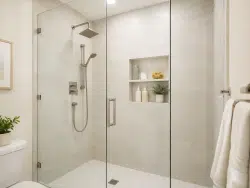
Walk-in shower features divide into three groups by return. Structural choices, like having no curb or a low entry, a space bigger than the 900 square inch code minimum, and waterproofing behind the finish, are important for the entire time the installation lasts. Fixture decisions, meaning a pressure-balancing or thermostatic valve and a handheld on a slide bar, cost little and are noticed daily. Luxury add-ons such as steam generators and multi-head spray arrays carry the highest cost and the weakest resale return in most East Tennessee homes.
Shower remodel budgets tend to get spent in the wrong order. The glass and the tile get argued over for weeks, then the valve gets picked in four minutes from whatever the supply house has in stock. Five years later, the tile still looks fine, and the shower runs cold every time the washing machine fills. A trusted Knoxville plumber will usually push the money toward the parts nobody photographs.
Tennessee Standard Plumbing has handled walk-in shower installation across Knoxville and Knox County for more than 13 years, holds a 5.0 Google rating across over 1,000 reviews, carries HomeAdvisor Elite Service recognition, and fields a team of more than 50 technicians. That volume produces a fairly clear picture of which choices homeowners are happy with a decade later and which ones they mention with a sigh.
What comes next lists walk-in shower features based on what they provide instead of what they cost. It shows what can help with resale, which changes are lasting, which fixtures are worth it, and which upgrades may not pay off.
The resale value in a shower remodel depends on things a buyer can notice quickly. These include the style of the entry, the size, how clear the glass is, and if the surfaces look modern. The 2025 Cost vs. Value Report puts a midrange bathroom remodel near 80 percent of cost recouped at resale, the strongest interior return the report tracks.
The 80 percent figure describes a midrange remodel, not an upscale one. Upscale bathroom projects usually get back less of their cost. This is because the extra money goes into materials and features that buyers may not see or appreciate at the price they paid. The practical reading for a Knoxville homeowner is that the return curve flattens well before the budget does. Money spent past the midrange point should be justified by how the shower will be used, not by resale math.
Expectations vary by neighborhood age. In Farragut and Hardin Valley construction from the 2000s onward, a walk-in shower in the primary bathroom is close to assumed, and its absence reads as a project rather than a feature. In pre-1970 housing in North Knoxville and Fountain City, where 60 by 32-inch tub alcoves are the norm, a well-executed walk-in shower still registers as an upgrade. The same remodel therefore returns differently depending on the street it sits on.
Some choices age faster than the materials they are made from. Glass block walls, 4 by 4 inch tiles with different colored grout, garden tubs and shower combos using one valve, and heavy metal framing on enclosures all make a bathroom look old quickly. Anything that visually pins the room to a specific decade shortens the window in which the remodel counts as current, which is the practical measure of whether it still returns value.
Structural features are the ones that cannot be changed later without redoing the shower. Entry threshold, compartment size, drain type, and waterproofing method are all decided during rough-in. Getting them right costs modest money once, and getting them wrong costs the price of the whole installation a second time.
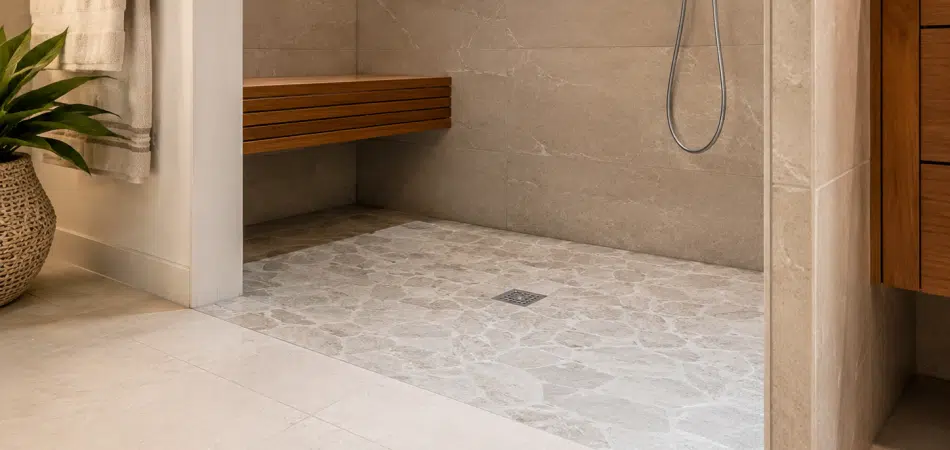
 A curbless shower eliminates the raised threshold, allowing the floor to flow seamlessly into the compartment. It looks larger, it cleans faster, and it accommodates a walker or wheelchair without modification. It also depends entirely on the slope being right. Shower floors are built to fall roughly 1/4 inch per foot toward the drain, with 1/2 inch per foot as the practical maximum, and a curbless design has no curb to catch water when that slope is off. On a slab foundation, the drain often has to be relocated or the floor built up, which is why the decision belongs at the planning stage rather than mid-project. A useful frame for the choice is this comparison of a walk-in shower against a bathtub in Knoxville homes.
Section P2708.1 of the International Residential Code sets the minimum shower compartment at 900 square inches with a minimum dimension of 30 inches, measured to the finished interior surface and excluding valves, heads, and grab bars. That is a legal floor, and a 30 by 30 inch shower feels exactly as tight as it sounds. A 36 by 48 inch compartment is a different room to stand in, and 36 by 60 inches, which is the footprint a standard tub alcove already provides, is the size most homeowners describe as correct. Buying width is one of the cheapest upgrades available during a remodel and one of the most expensive to add afterward.
Waterproofing is invisible, unglamorous, and the single most consequential item in the build. A bonded sheet or liquid-applied membrane over a properly sloped substrate is what keeps water out of the framing and the ceiling below. Failures show up as a musty smell, a loose tile, or a stain on the ceiling of the first floor. This usually happens after several years, and fixing it requires tearing down finished work. Homeowners reviewing bids should ask which waterproofing system is specified by name rather than accepting the word “waterproof” as a description.
Fixtures are where small amounts of money produce daily returns. A valve that holds temperature, a head that can be aimed, and a handheld within reach account for most of what people mean when they say a shower feels good. None of these upgrades are structural, and all of them are cheaper during a remodel than as a later retrofit.
A pressure-balancing valve reacts to a pressure drop, so when a toilet fills, or a dishwasher draws, the valve pulls back the other side to keep the mix from swinging hot or cold. A thermostatic valve holds a target temperature directly and separates temperature from volume, which means a set temperature returns each time. Thermostatic units cost more and are the upgrade homeowners in Knox County notice most, particularly in households where more than one fixture runs at once. Either is a substantial improvement over an older single-handle mixer with no compensation at all.
A handheld on a slide bar is cheap, takes up no extra space, and can clean the compartment, rinse a child, wash a dog, and allow for seated use all in one piece. It is the feature most often added within a year of a remodel by homeowners who left it out, which is a reliable signal of what it is worth. Rough-in for a second valve outlet during construction costs a fraction of adding it later.
Multiple heads change the plumbing math rather than just the fixture list. Body spray systems and dual heads can pull more water than a 1/2 inch supply line can provide at good pressure. So, proper installations often need a 3/4 inch supply line, bigger drain capacity, and a sufficient water heater recovery to sustain the flow. In an older Bearden or Fountain City home still on galvanized or undersized copper, the fixture is the least expensive part of that project. The upgrade is defensible when the supply side is upgraded with it and disappointing when it is not.
Some upgrades are pleasant and still lose money. The pattern is consistent: high installed cost, ongoing maintenance, and a narrow band of buyers who assign value to them. None of these are mistakes for a homeowner planning to stay, and all of them are weak resale arguments in East Tennessee.
A steam shower needs an enclosed area, a sloped ceiling to prevent water buildup, a special generator with its own power supply, and a door that keeps the steam in. The cost to install is much higher than a regular walk-in shower. Also, the generator needs maintenance and must be drained and cleaned regularly, which is sped up by hard water. Buyers reliably price a steam shower as a standard shower. For daily users, the enjoyment is real, but it is a personal purchase, not an investment.
Frameless enclosures in 3/8 or 1/2 inch tempered glass look better and last longer than framed units, and that upgrade is generally worth making. Past that point, the returns thin out quickly. Custom-radius panels, notched cuts around obstructions, and low-iron glass add real cost, complicate any future replacement, and read to most buyers as ordinary clear glass. Standard-size frameless panels capture nearly all of the visual benefit for a fraction of the custom price.
Mosaic accent bands, patterned feature walls, and mixed-format tile layouts raise labor costs, multiply grout lines, and tie the room to a specific moment in design. Grout is the maintenance surface in any tiled shower, and Knoxville’s hard water leaves scale on it, so more grout means more cleaning for the life of the installation. Larger-format tile with restrained accents holds its look longer and costs less to keep clean, which is a better description of value than the tile budget implies. Homeowners weighing the surface decision can compare options through shower and tub services before committing to a layout.
The best shower budgets get decided in the right order. Our team at Tennessee Standard Plumbing helps Knoxville homeowners with entry style, compartment size, waterproofing, and valve selection before choosing a tile. These four choices decide what the rest of the budget can do.
Four points are worth keeping. A midrange remodel returns better than an upscale one, so the resale argument runs out before the budget does. Size and waterproofing are permanent and cheap to get right during the build. A thermostatic or pressure-balancing valve is the upgrade people notice every day. Steam, custom glass, and elaborate tile are lifestyle purchases rather than investments.
Homeowners planning a shower project can reach our team at (865) 352-9003 or get a free estimate online. Peaceful Pipes, Peaceful Life.
We serve Knoxville, Farragut, Maryville, and communities across Knox County and East Tennessee.
Generally yes, with the return depending on the housing stock around it. In newer subdivisions, a walk-in shower in the primary bathroom is close to expected, so its absence costs more than its presence adds. In older housing with tub alcoves, it still reads as a genuine upgrade. The 2025 Cost vs. Value Report puts a midrange bathroom remodel near 80 percent of cost recouped.
The International Residential Code sets a minimum compartment of 900 square inches with a minimum dimension of 30 inches, measured to the finished interior surface. Valves, heads, soap dishes, and grab bars are excluded from that measurement. Local amendments can raise the minimum, so the governing building department confirms the figure for a specific address.
It is worth it when the floor structure allows the slope to be built correctly. A curbless design has no threshold to contain water, so the shower depends on a fall of roughly 1/4 inch per foot toward the drain. On slab foundations, the drain may need relocating, which is why the decision belongs in planning rather than mid-project.
A pressure-balancing valve reacts to pressure changes and adjusts one side to keep the mix stable when another fixture draws water. A thermostatic valve holds a target temperature directly and separates temperature control from volume, so a set temperature repeats each use. Thermostatic units cost more and are most noticeable in households running several fixtures at once.
Usually. Body spray arrays and dual heads can draw more than a 1/2 inch supply branch delivers at usable pressure, so those installations often need a 3/4 inch supply, added drain capacity, and enough water heater recovery to sustain the flow. In older homes on galvanized or undersized copper, the supply upgrade is the larger part of the project.
Rarely as an investment, often as a purchase. Steam requires a sealed enclosure, a sloped ceiling, a dedicated generator on its own circuit, and a vapor-tight door, which pushes installed cost well above a standard walk-in shower. Buyers typically value it as a standard shower, and the generator needs periodic descaling in hard water.
Most homeowners describe 36 by 48 inches as comfortable and 36 by 60 inches as correct. The larger figure matches the footprint a standard 60-inch tub alcove already occupies, which makes a tub conversion a straightforward swap in many older homes. Buying width during a remodel is far cheaper than expanding a compartment later.
A handheld on a slide bar. It costs little, adds no floor area, and covers cleaning the compartment, rinsing children and pets, and later seated use. Roughing in a second valve outlet during construction costs a fraction of adding one afterward, which is why it belongs on the original plan.
More than most homeowners expect. Grout is the maintenance surface in any tiled shower, and hard water in the Knoxville area leaves scale along those lines. Mosaic accents and mixed-format layouts multiply grout length, so larger-format tile with restrained accents means measurably less cleaning over the life of the installation.
Ask which system is specified by name, whether it is a bonded sheet membrane or a liquid-applied one, and how the substrate slope is built. The word waterproof on its own describes an intention rather than a method. Failures here appear years later as loose tile, musty odor, or ceiling staining below, and correcting them requires demolishing finished work.



If your tankless water heater stops working, the most common causes include power supply failures, low water flow, gas supply interruptions, minera... Read More

Power outages, especially during severe weather, can cause significant, costly damage to a home’s plumbing system. Because modern plumbing often re... Read More

An outdoor sump pump helps manage excess water in low-lying areas, redirects groundwater away from the foundation, and adds an extra layer of flood... Read More