
Trenchless Sewer Line Repair: Methods, Factors, and Benefits
Trenchless sewer line repair offers a faster, less disruptive alternative to traditional excavation by fixing pipes without digging up the yard. Al... Read More

Same-Day Service Available
Need a Plumber in Knoxville? We’re Ready to Help!




Key Takeaways
Last Updated: November 4, 2026
The sewer line is buried, so its condition is hard to judge from inside a house, and the property owner is responsible for the lateral. A sewer camera inspection records the inside of the pipe and shows roots, sags, cracks and breaks along with their location. Footage reflects the pipe on the day of the inspection and cannot see past blockages or standing water. Buyers who ask about past backups and repairs and review the footage with their agent can weigh the line’s condition before closing.
A house can look sound from the roof to the foundation and still have a sewer line in poor shape, because the pipe runs underground where no walk-through can reach it. Buyers often check the roof, the furnace and the water heater, then find out about the sewer line only after a backup. Knowing what the line is, who owns it and how it can be checked gives a Knoxville buyer one more piece of information before closing.
Tennessee Standard Plumbing provides sewer camera inspections and sewer line replacement for homes across Knoxville and Knox County. The company says it has more than 4,000 reviews across its Google profiles. This guide covers why the sewer line matters in a purchase, what a camera inspection shows and cannot show, which questions buyers can ask, and what to do with the findings.
Tennessee Standard Plumbing’s November offer includes a free sewer camera inspection with any plumbing service call, plus a free yard cleanup with sewer line replacement. This offer runs through the end of November.
*EXCLUSIONS APPLY, CALL FOR DETAILS*
This offer cannot be combined with any other offer, discount, or promotion.
The sewer line carries wastewater from the house to the public sewer, and it runs underground where a walk-through cannot see it. Its condition often goes unnoticed until a backup, and the property owner is responsible for the lateral after closing. That combination is why some buyers ask for a closer look.
Roofs, furnaces and water heaters can be seen and tested during a visit, while the sewer line shows itself mainly through slow drains, gurgling or a backup. A line with a crack or a low spot can drain normally for a long time before it causes a visible problem.
The Insurance Information Institute says the sewer lateral is owned and maintained by the property owner, and that the responsibility includes any part of the lateral that extends into the street or public right of way. After closing, the new owner is that property owner.
Older homes can have older pipe, such as clay, cast iron or other materials that have been replaced in newer construction. Age alone does not mean a line is failing, since many old pipes still work. It is a reason to look at the pipe instead of assuming.
The Insurance Information Institute notes that sewer backup coverage is available from most providers. Whether a policy pays for repairing or replacing the line itself depends on the policy terms, so a buyer can ask the insurer before closing.
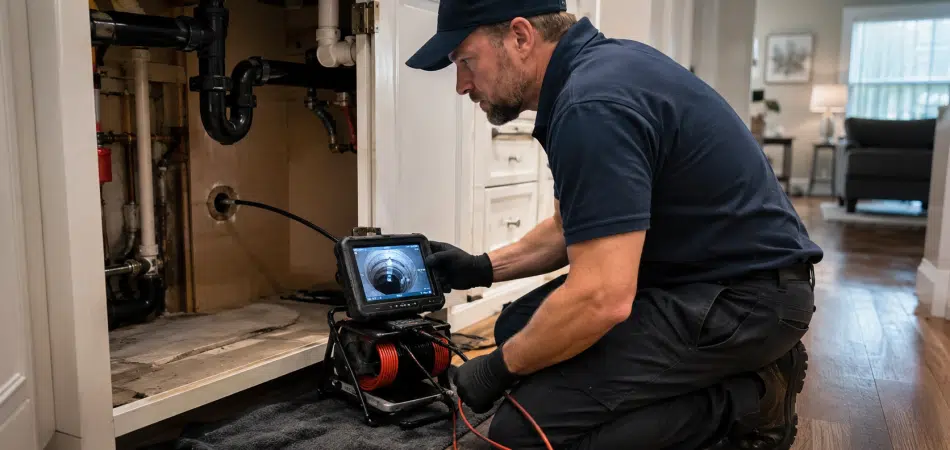
A sewer camera inspection sends a camera through the sewer line and records the inside of the pipe. The footage shows the pipe’s material and condition, any roots, sags, cracks or breaks, and how far along the line each one sits. It does not predict future problems.
The footage identifies what the pipe is made of and how it looks inside, including buildup, scale and joints that have shifted. A sewer camera inspection gives a buyer a recording to review instead of a description of what someone expects to find.
Roots that have entered a joint, a low spot that holds water, a crack or a break each show up on camera. Each one points toward a different fix, so seeing which one is present matters more than knowing that something is wrong.
A good recording notes how far along the line each finding sits, usually measured from where the camera went in. That distance helps a plumber price a spot repair or a larger job and helps a buyer see how much of the line is affected.
A camera cannot see past a full blockage or through standing water, so part of a line can stay unseen. The footage is also a record of the pipe on the day of the inspection, not a forecast of its future condition.
Buyers can ask whether the sewer line has ever been inspected, repaired or replaced, whether the home has had a backup or slow drains, and where the cleanout is. Answers from the seller, an agent or past records give a starting point, and a camera inspection can confirm what the pipe looks like now.
Records of past inspections, spot repairs or a replacement help show how the line has been treated. A buyer can ask the seller or the listing agent for any paperwork, keeping in mind that an answer of no records does not mean no history.
Backups, repeat clogs and slow drains in more than one fixture are worth asking about. Buyers weighing a purchase can also ask Knoxville plumbing professionals what such a history could mean for the line.
A cleanout is an access point on the sewer line that lets a camera or cleaning equipment enter without removing a fixture. A buyer can ask where it is, and a home with no easy access may need another entry point for an inspection.
Footage is easier to use when someone qualified reads it with the buyer. A plumber can explain what each finding means for the pipe, and an agent or attorney can advise on how it fits into the purchase.
A clean recording gives a buyer a baseline, and a recording with findings gives a starting point for the next decision. Minor findings may call for monitoring, while cracks, breaks or major sags may call for a repair or replacement estimate. The buyer, an agent and an attorney decide how the findings affect the purchase.
A line with no major findings still ages, so the footage works as a record to compare against later. Keeping the recording with the closing documents makes that comparison possible.
A root intrusion, a sag or a break can lead to a repair estimate, and the footage lets several contractors price the same line. The difference between a lateral and the lines inside the house is explained in a guide to sewer lines and drain lines.
If a line is badly damaged, replacement may be the sound option, and methods range from open trench work to trenchless methods that a camera inspection helps evaluate. Details on underground sewer line replacement show what the work involves.
Inspection windows in a purchase contract can be short. A buyer can check the dates with an agent early so there is time to schedule a camera inspection and read the footage before a deadline.
Our team at Tennessee Standard Plumbing provides sewer camera inspections and sewer line replacement across Knoxville, Knox County and the surrounding East Tennessee communities. We are glad to explain what the footage shows and what the next step could be.
The main points carry through everything above. The sewer line is hidden, the property owner is responsible for the lateral, and a camera inspection shows the pipe’s condition on the day of the visit. Questions about past backups, repairs and the cleanout round out the picture.
Buyers and new homeowners with questions about a sewer line can reach our team at (865) 352-9003 or schedule your service online. Service covers Knoxville, Farragut, Powell, Oak Ridge and Maryville, along with other communities across Knox County and East Tennessee. Peaceful Pipes, Peaceful Life.
A sewer line runs underground, so a standard walk-through shows little about it. Some buyers add a sewer camera inspection because the property owner is responsible for the lateral after closing. A real estate agent can advise on timing within the contract.
It records the inside of the pipe. The footage shows the material, the condition, any roots, sags, cracks or breaks, and where each sits along the line.
No. The footage shows the pipe’s condition on the day of the visit and does not predict future problems. A plumber can describe what the findings suggest, but no recording gives a service life.
The Insurance Information Institute says the sewer lateral is owned and maintained by the property owner. The responsibility includes any part of the lateral that extends into the street or public right of way. A buyer can ask the utility serving the address how it handles the connection to the public main.
Coverage depends on the policy. The Insurance Information Institute notes that sewer backup coverage is available from most providers. Whether a policy pays to repair or replace the line itself is a question for the insurer, and a buyer can ask before closing.
A camera cannot see past a full blockage or through standing water, so part of the line can stay unseen. A line sometimes needs cleaning before it can be recorded. The footage also shows only the day of the inspection.
A cleanout is an access point on the sewer line. It lets a camera or cleaning equipment enter without removing a toilet or other fixture. A home with no easy cleanout may need another entry point.
Older homes can have older pipe materials, and pipe wears over time. Age alone does not mean a line has failed, since many old lines still work. A camera inspection shows the actual condition instead of leaving it to age.
A minor finding may call for monitoring, while a crack, a break or a major sag may call for a repair or replacement estimate. The footage can be shared with several contractors so they price the same line. The buyer, an agent and an attorney decide how it affects the purchase.
No. It describes plumbing information only. Contract deadlines, seller disclosures and negotiation are questions for a real estate professional or an attorney.



Trenchless sewer line repair offers a faster, less disruptive alternative to traditional excavation by fixing pipes without digging up the yard. Al... Read More

Backflow preventers are required in Knoxville to stop contaminated water from flowing into the public supply. Most properties must install, test, a... Read More

Older Knoxville homes (especially those built before 1980) often have bathrooms in the 30 to 50-square-foot range. These small footprints respond w... Read More