
Why Is Backflow Testing Important for Knoxville Homes and Businesses?
Key Takeaways Backflow happens when contaminated water flows backward through a plumbing system into the clean water supply, and annual te... Read More
Same-Day Service Available
Need a Plumber in Knoxville? We’re Ready to Help!




Key Takeaways
Hard water affects appliances more directly than it affects plumbing, because the minerals leave solution when water is heated. USGS reports that heated hard water forms deposits that can reduce equipment life, raise water heating costs, lower the efficiency of electric water heaters, and clog pipes. Dishwashers, washing machines, ice makers, coffee makers, and both tank and tankless water heaters are the components that meet hot or standing water most often. The first symptoms are usually performance-related rather than mechanical, appearing as cloudy glassware, stiff laundry, slower ice production, or reduced hot water volume. EPA sets no enforceable standard for hardness and classifies scale and equipment damage as a technical effect rather than a health risk.
Appliances rarely announce a hard water problem. They just get a little worse at their jobs. The dishwasher stops drying glasses clearly, towels come out of the wash feeling rough, the ice maker falls behind on a hot weekend, and everyone in the house adjusts without ever naming the cause.
Tennessee Standard Plumbing has worked on water treatment, water heaters and household plumbing across Knoxville, Knox County, and the surrounding East Tennessee counties for more than 13 years. According to the company, our team carries a 5.0 Google rating across more than 1,000 reviews, holds HomeAdvisor Elite Service recognition, and fields more than 50 technicians. We handle water quality testing, filtration systems, whole home water treatment, softeners, and point-of-use reverse osmosis. Appliance and water heater problems tied to water quality are a regular part of that work across East Tennessee.
Tennessee Standard Plumbing offers a free plumbing evaluation for households in the service area that have seen a high water bill. This offer runs through the end of September.
*EXCLUSIONS APPLY, CALL FOR DETAILS
This offer cannot be combined with any other offer, discount, or promotion.
Hardness is dissolved calcium and magnesium, and those minerals stay dissolved until something changes. Heat is the usual trigger. USGS states that heated hard water forms deposits that can reduce the life of equipment, raise the costs of heating the water, lower the efficiency of electric water heaters, and clog pipes. Appliances heat water, so appliances collect the deposits.
Calcium carbonate becomes less soluble as water temperature rises, which is the opposite of how sugar or salt behave. In an appliance, that means the hottest surface in the machine is the surface that collects deposits: a heating element, a heat exchanger, or the wall of a tank holding hot water. Cold water components in the same appliance stay comparatively clean, which is why a symptom often appears on one function of a machine and not another.
Deposition also happens where water sits and evaporates rather than moves. Spray arms, dispenser cups, ice maker trays and drip pans all hold small volumes between cycles, and each cycle leaves behind whatever the evaporated water was carrying. This is the mechanism behind the chalky film on a dishwasher door and the crust around a coffee maker reservoir, and it operates at room temperature without needing a heating element at all.
USGS puts it plainly: with hard water, “more soap or detergent is needed to get things clean.” Calcium and magnesium bind with cleaning agents before those agents can act on soil, which is the chemistry behind soap scum. The household cost shows up as detergent volume rather than as a repair invoice, and it recurs on every load rather than once. Households comparing treatment options can look at the range of water treatment services available before deciding what suits their situation.
The number differs by supply, so the same advice does not apply evenly across the region. Homes on Knoxville Utilities Board water, Maryville or Alcoa city water, Oak Ridge water, or one of the utility districts serving Union, Anderson and Loudon counties are each on a different source with different treatment. Homes on private wells around Corryton, Maynardville, Seymour and Strawberry Plains draw straight from carbonate groundwater with no utility treatment, and those readings tend to run higher and vary more from house to house.
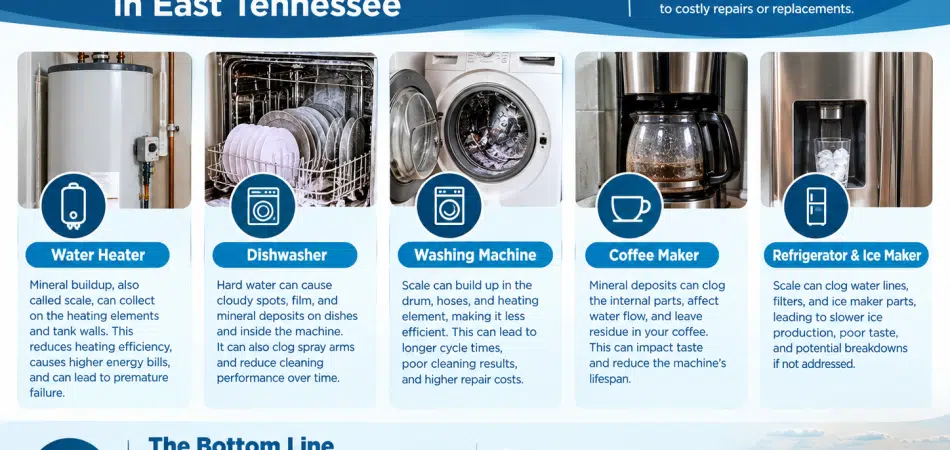
Each appliance fails in its own way, and knowing the pattern makes the diagnosis faster. Dishwashers show it optically, washing machines show it in fabric, ice makers show it in output, and water heaters show it in volume and sound. Recognizing which machine is complaining points to the right fix.
Cloudy glassware and a white film on the inside of the door are the classic signs, and they are cosmetic before they are mechanical. Underneath, deposits narrow the openings in spray arms and coat the heating element, which reduces spray coverage and slows drying. Households often respond by adding more detergent or a rinse aid, which treats the symptom while the deposit continues to build. Running a cycle with a descaling product made for dishwashers is the maintenance step manufacturers usually name in the manual.
Laundry is where hard water shows up as texture. Minerals combine with detergent to leave residue in fabric, which is what makes towels feel stiff, and colors look dull over time. Inside the machine, the inlet valve and any heating element collect deposits the same way a dishwasher does. Households tend to describe this as a detergent problem long before they describe it as a water problem, which is usually the wrong end of it, and it is a common reason people start looking up a trusted Knoxville plumber.
Small water paths are the most sensitive to a given thickness of deposit. Ice maker fill tubes, solenoid valves and refrigerator water lines have narrow openings, so cloudy or undersized ice cubes and slower fill times appear early. Coffee makers concentrate the effect further, since they boil small volumes repeatedly in the same chamber. A machine that takes longer to brew and leaves a crust in the reservoir is showing mineral buildup rather than age.
Water heaters see the most heat and hold the most water, which makes them the appliance where deposits matter most. Reduced hot water volume, popping or rumbling sounds during heating, and longer recovery between showers are the signals homeowners tend to notice. Tankless units concentrate heat through a narrow heat exchanger, which is why manufacturers generally specify periodic flushing for them. This is covered in depth in a separate look at what hard water does to a water heater, so it is kept short here.
The table below matches each appliance to the symptom it usually produces first and the component that is generally responsible. It describes typical patterns rather than the condition of any particular machine.
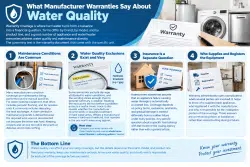 Warranty coverage is where hard water turns from a nuisance into a financial question. Terms differ by brand, by model, and by product line, and a good number of appliance and water heater warranties address water quality and maintenance directly. The governing text is the warranty document that came with the specific unit.
Many manufacturers condition coverage on maintenance being performed as the manual specifies. For water heating equipment, that often includes periodic flushing, and for tankless units it commonly includes descaling the heat exchanger. A claim denied on maintenance grounds is denied because the required work was not documented, not because the water was hard. Keeping receipts and service records is the practical defense, and it costs nothing.
Some warranties exclude damage attributed to water conditions, and the wording varies enough that no general summary is reliable. Reading the exclusions section before a problem arises is a useful move, since it also reveals whether the manufacturer recommends or requires treatment in hard water areas. Where a manufacturer names a hardness threshold, that number is the one worth measuring against. Households can compare their water against those thresholds using whole home water filtration systems and softening options once they have a test result in hand.
Homeowners sometimes assume that an appliance failure causing water damage is automatically a covered loss. Coverage depends on policy terms, exclusions, and limits, and gradual damage is treated differently from a sudden failure under many policies. Any specific question about a specific loss belongs with the insurer or the issuing agency rather than with a general article.
Warranty administration gets complicated when several parties are involved. It helps to know who supplied each appliance, who registered it with the manufacturer, and who is responsible for the installation portion of the coverage. Those answers are worth writing down at installation rather than reconstructing during a failure.
Each option here starts from the same place: a hardness number. USGS classifies 0 to 60 mg/L as calcium carbonate as soft, 61 to 120 as moderately hard, 121 to 180 as hard, and above 180 as very hard. Without a result, treatment is guesswork, and guesswork is how the wrong equipment gets installed.
Homes on public water can start with the serving utility’s annual water quality report, which covers the system rather than the individual house. Hardness is not a federally required reporting item, so it may not appear there, and the utility can generally supply it on request. A test at the tap gives the figure for one address, which matters where a water heater, an existing softener, or an old service line may be changing what arrives at the appliance. Homes on private wells have no utility report at all, so testing is the only route to a number.
Treating water where it enters the house protects appliances throughout, since the appliances sit downstream of that point. Point-of-use equipment such as reverse osmosis at the kitchen tap addresses drinking water quality but does not reach the dishwasher, the laundry or the water heater. Households frequently benefit from both, and choosing between them without a test result is the common mistake.
Ion exchange softeners remove calcium and magnesium and exchange them for sodium or potassium, which changes the water chemistry. Scale inhibitors and conditioners take a different approach, altering how minerals crystallize so they are less likely to bond to surfaces, without removing them. The two suit different priorities and different households, and the choice depends on the test result, the appliances in the house, and what the household wants from the water.
Treatment equipment is a system that needs attention rather than a one-time purchase. Softener resin exhausts, salt bridges form in the brine tank during cold months, filter media reaches capacity, and none of that announces itself at the tap. Retesting after installation confirms the equipment performs as selected, and continuing to test periodically catches the point where it stops. Appliance descaling routines from each manufacturer’s manual remain worthwhile even in treated water.
Our team at Tennessee Standard Plumbing handles water quality testing, water softeners, whole home water treatment, filtration systems, point-of-use reverse osmosis, and water heaters for households across Knoxville, Knox County, Blount County, Anderson County, and the surrounding East Tennessee communities. We test first and recommend second, because the appliance that is complaining does not reliably identify the reason.
Four things are worth holding onto. Heat drives deposition, so appliances that heat water carry the load. Symptoms show up as performance changes long before anything breaks. Warranty terms vary by brand and model, and documented maintenance is what protects a claim. And treatment decisions follow a hardness result rather than a symptom.
Households that want their water tested and their appliances protected can reach our team at (865) 352-9003 or contact our team online. We serve Knoxville, Maryville, Alcoa, Oak Ridge, Clinton, and communities across Knox County and East Tennessee. Peaceful Pipes, Peaceful Life.
Hard water reduces the efficiency and lifespan of household appliances by leaving behind mineral deposits known as limescale.
The dishwasher or coffee maker/kettle usually shows hard water damage first because they use hot water and have visible, transparent, or frequently inspected parts where chalky residue appears quickly.
Dishes come out cloudy in East Tennessee homes primarily because of hard water caused by the region’s unique limestone geology. As groundwater and municipal water supplies flow through the area’s dense limestone layers, they dissolve high concentrations of minerals, specifically calcium and magnesium. When this water is heated and evaporates during a dishwasher’s drying cycle, it leaves behind a chalky mineral film or “limescale” on glassware and ceramics.
Yes, hard water makes laundry detergent significantly less effective by binding with its active ingredients.
Hard water harms appliances faster than pipes because appliances use heat, tiny internal parts, and moving components that trap and react to mineral scale.
Yes, hard water can void an appliance warranty if damage results from mineral scale buildup or water quality that exceeds the manufacturer’s specified limits.
Water across East Tennessee is generally moderately hard to hard, depending on whether you use municipal tap water or a private well.
Protecting household appliances from hard water damage does not strictly require a traditional salt-based water softener, but it depends entirely on the mineral content of your water supply.
Not by itself. Point of use reverse osmosis treats water at one fixture, usually the kitchen tap for drinking and cooking. Appliances elsewhere in the house draw untreated water unless the treatment sits where water enters the home. Many households use both, with whole home treatment for equipment and point of use for drinking water.
USGS states that hardness is a property of water that is not a health concern, but it can be a nuisance. EPA sets no drinking water standard for hardness, and its secondary standards, which EPA says it does not enforce, address aesthetic, cosmetic, and technical effects. Equipment damage falls under the technical category.


Key Takeaways Backflow happens when contaminated water flows backward through a plumbing system into the clean water supply, and annual te... Read More
Frequent plumbing repairs can indicate that your pipes are aging, corroded, or near the end of their lifespan. In such cases, replacement is often ... Read More

Advanced plumbing tools improve repair accuracy by replacing guesswork with high-precision diagnostics, utilizing non-invasive technology to locate... Read More